
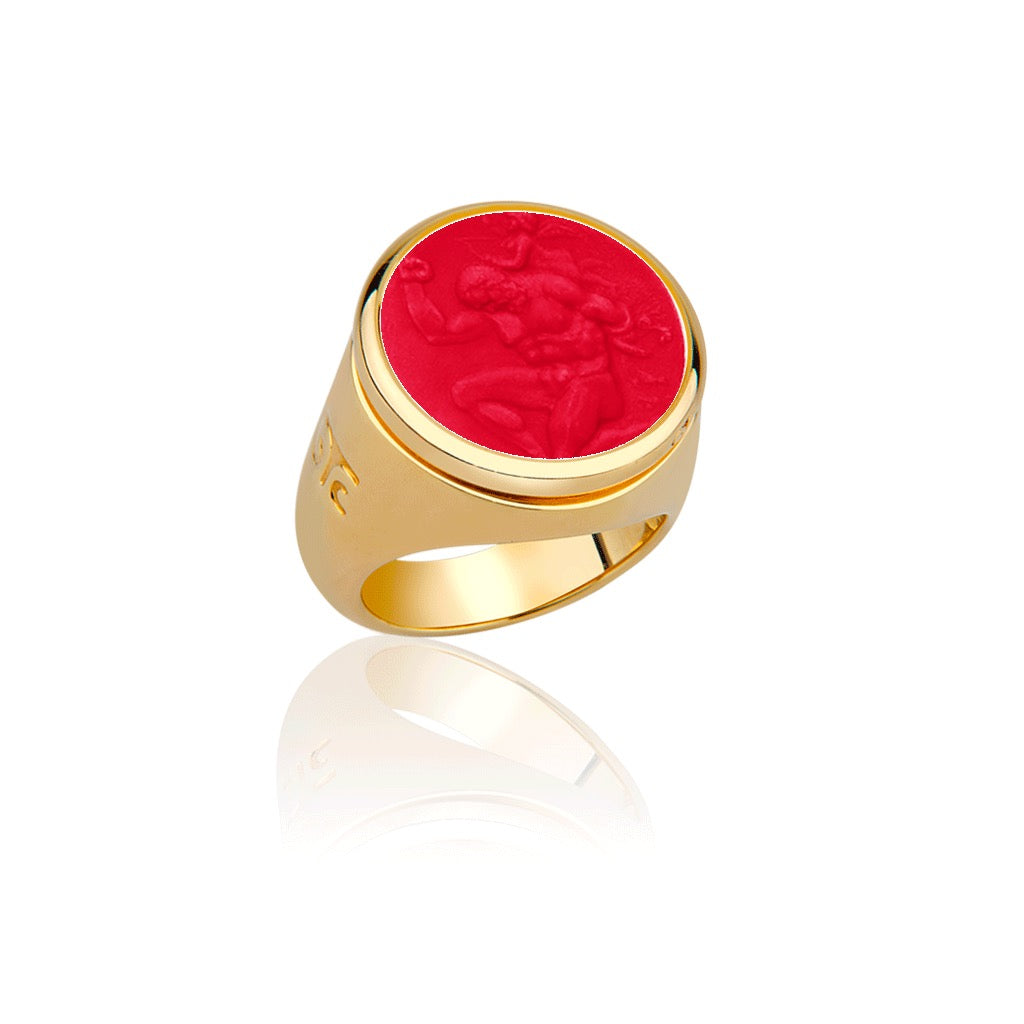
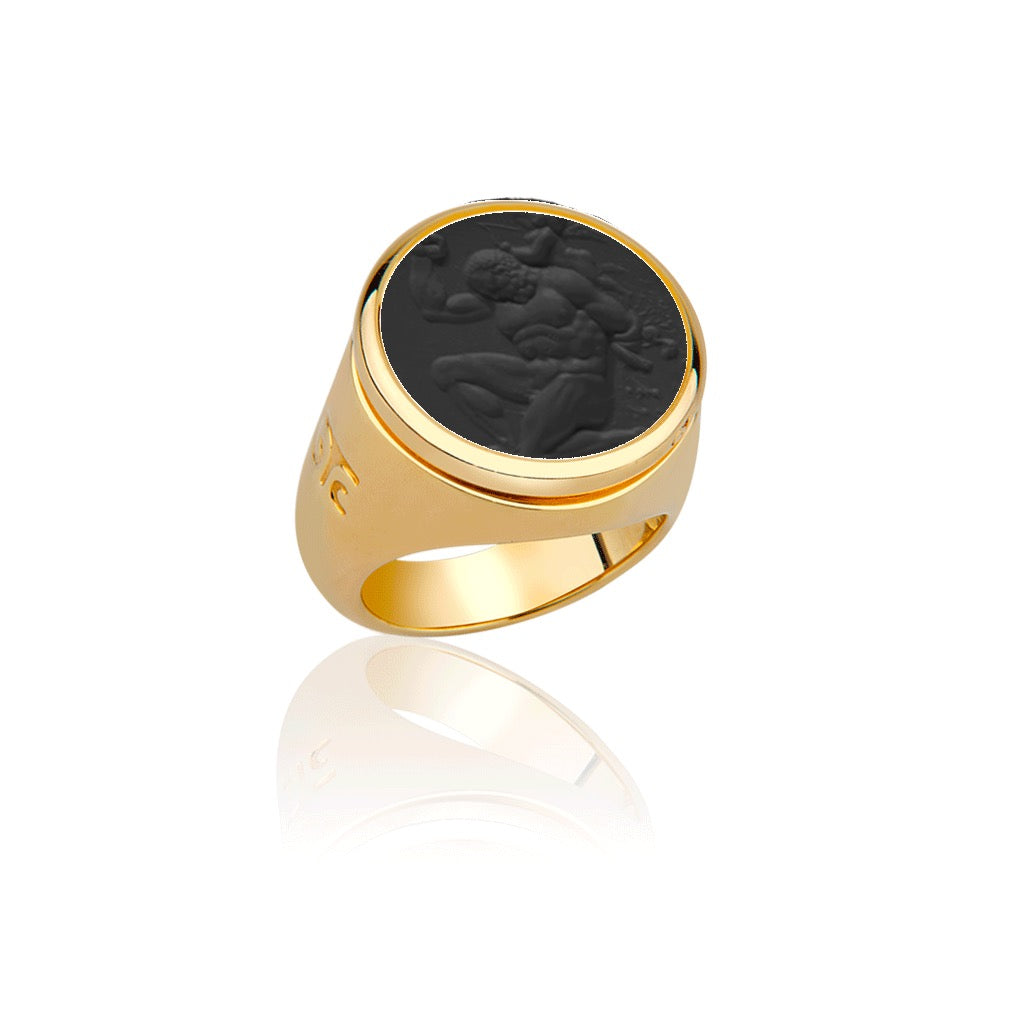
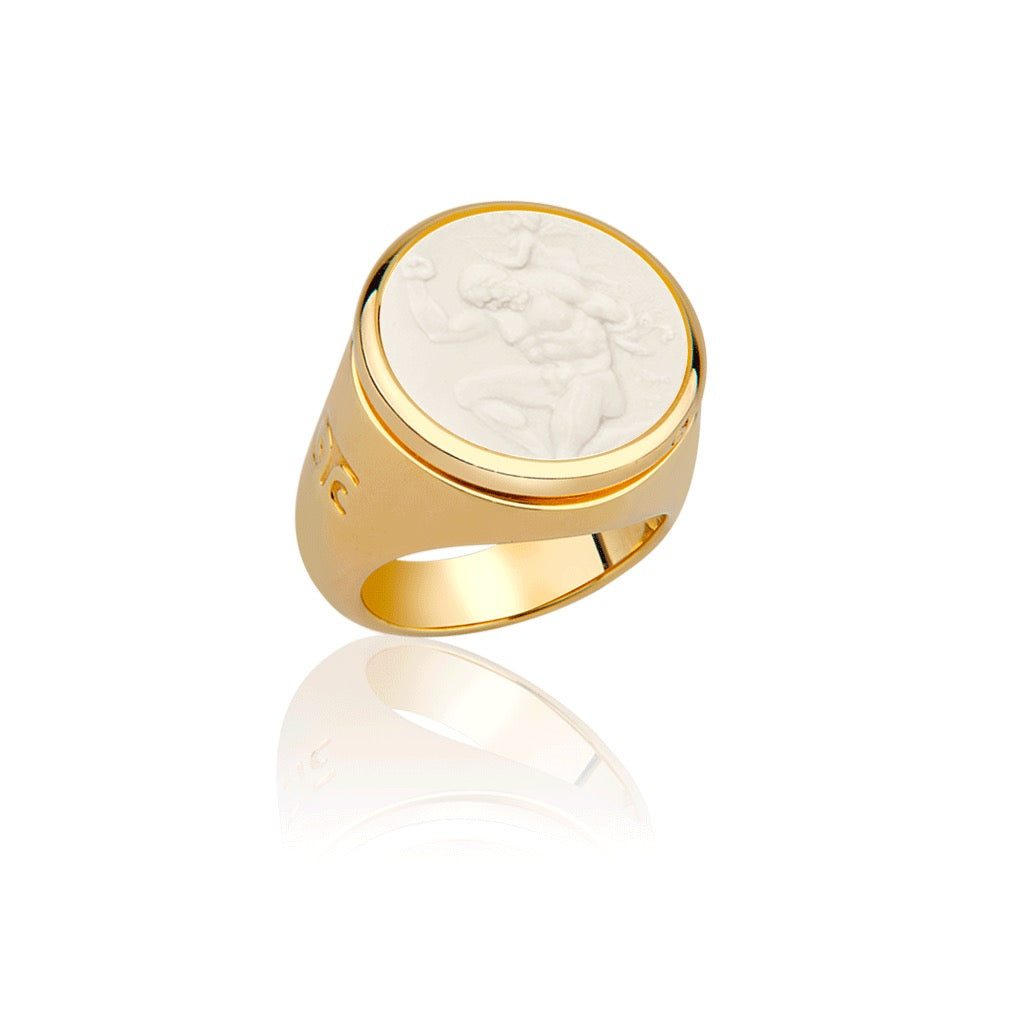
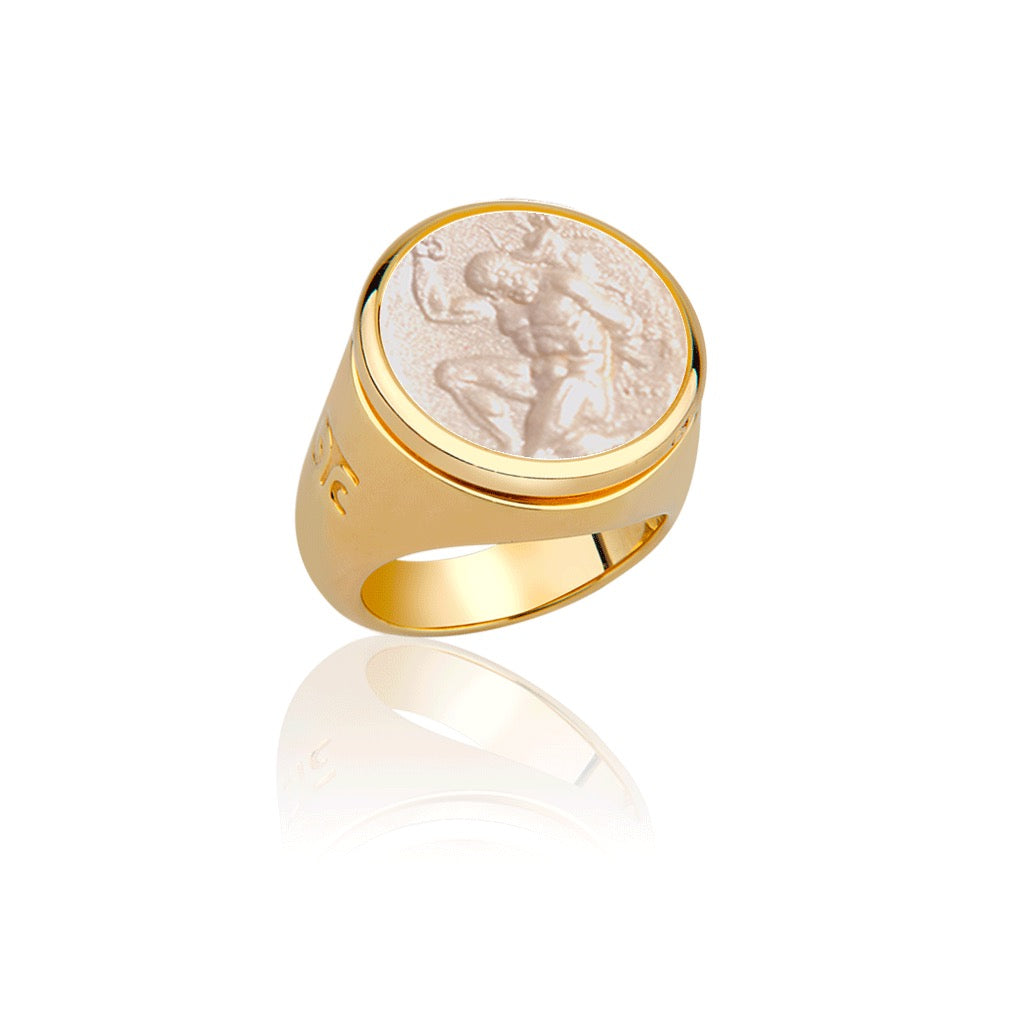
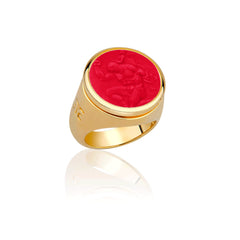
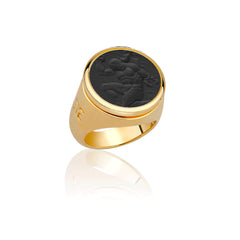
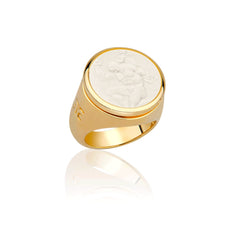
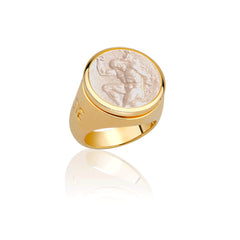
Solid bronze, ancient and refined lost-wax casting, the smoothing of the surfaces and the 18kt gilding — these are the qualities of a ring that carries a story of love and force, contained within its small intaglio. An allegory with the intensity of love: its consistency and force reflected in the curves, the volumes, the corporeal weight of the jewel.
Cupid swoops above — winged, light, capricious. Hercules is below him, on his knees — powerful body, head bowed, strength held in check. On the LUXOR model lives this ancient scene — the mightiest demigod in mythology bowing before love, embodied by the smallest of the gods.
White is ancient marble — the figures emerge from stone with the clarity of a frieze brought to light, Hercules and Cupid defined, every tension legible. Black sharpens the contrast — shadows work their way between Hercules's muscles, Cupid stands above him, unreachable and luminous, and the weight of force and the lightness of flight emerge at the same instant. Pearl is where the energy between them becomes light, flowing across the volumes like satin — iridescent, shifting with different nuances at every angle. The game becomes exchange, resistance becomes ceremony. Red ignites everything — tension rises, the bodies charge, and that encounter reveals its truth: force finds its direction, and becomes a force for good.
The intaglio is articulated and precise — Hercules's muscles, the gathered posture, Cupid's wings open toward the sky. The volumes develop with generosity and both figures have their own space, their own legibility. The light flows across the relief with every movement of the hand, discovering depths that are always new.
The game is subtle. Hercules chose to bow before Cupid — that is the true feat, and it surpasses all the others combined.
Important Notes
The jewels' colors in the photo may look different from the original one. This depends from the resolution. Each object is handmade and has unique characteristics.Size chart

SIZE GUIDE
Find your size
Simple steps to measure the correct size of your finger:
- Measure your finger at the end of the day;
- Do not measure your finger when it is either too hot or too cold;
- Don’t forget that our hands are not identical, and that a ring that might fit on a finger on our left hand might not fit on the same finger on our right hand;
- Please be sure to check that your selected size slides along the full length of your finger.
To measure the circumference of your finger, you can use a taylor’s tape measure, or take a look at our video demonstration for another technique (which will require a ring that fits on your selected finger.) This size corresponds to the circumference, which you must use to find your corresponding appropriate size. (S - M - L - XL)
| Size | Italy | USA | France | Diameter (mm) | Circumference (mm) |
|---|---|---|---|---|---|
| S | 12 > 13 | 6 > 6,5 | 52 > 53 | 16,5 > 16,9 | 52 > 53 |
| M | 14 > 15 | 7 > 7 1/4 | 54 > 55 | 17,2 > 17,4 | 54 > 55 |
| L | 16 > 17 | 7,5 > 8 | 56 > 57 | 17,8 > 18,1 | 56 > 57 |
| XL | 18 > 19 | 8, 5 > 9 | 58 > 59 | 18,5 > 18,8 | 58 > 59 |
| 2XL | 20 | 9 | 60 | 19,1 | 60 |
| 3XL | 22 | 10 | 62 | 19,7 | 62 |
| 4XL | 24 | 10 3/4 | 64 | 20,4 | 64 |
| 5XL | 26 | 11 3/4 | 66 | 21 | 66 |
Hercules and Cupid
The mythological hero Hercules (or Herakles) was famed for his great strength and endurance and celebrated as an extraordinary mortal who, through success in seemingly impossible labors, won his immortal place amongst the Olympian gods. Being the greatest of Greek mythological heroes, he has been ascribed a multitude of adventures and heroic exploits over the centuries which were probably originally connected to lesser, more local figures. In mythology it was Zeus who lay with Alkmene and so fathered Hercules, explaining the origin of Hercules’ great strength. Hera, the wife of Zeus, was (understandably) always jealous of Hercules and made life difficult for him from an early age. The goddess delayed his birth so that his cousin Eurystheus would be born first and so become the ruler of Greece according to Zeus’ decree. Hera also sent two snakes to kill the newborn Hercules, but the baby easily strangled them. Hercules enjoyed divine favour from the Olympian gods and he was particularly favoured by Athena. Ercole Farnese, Napoli, Museo Archeologico Nazionale.
Show all products- Choosing a selection results in a full page refresh.