
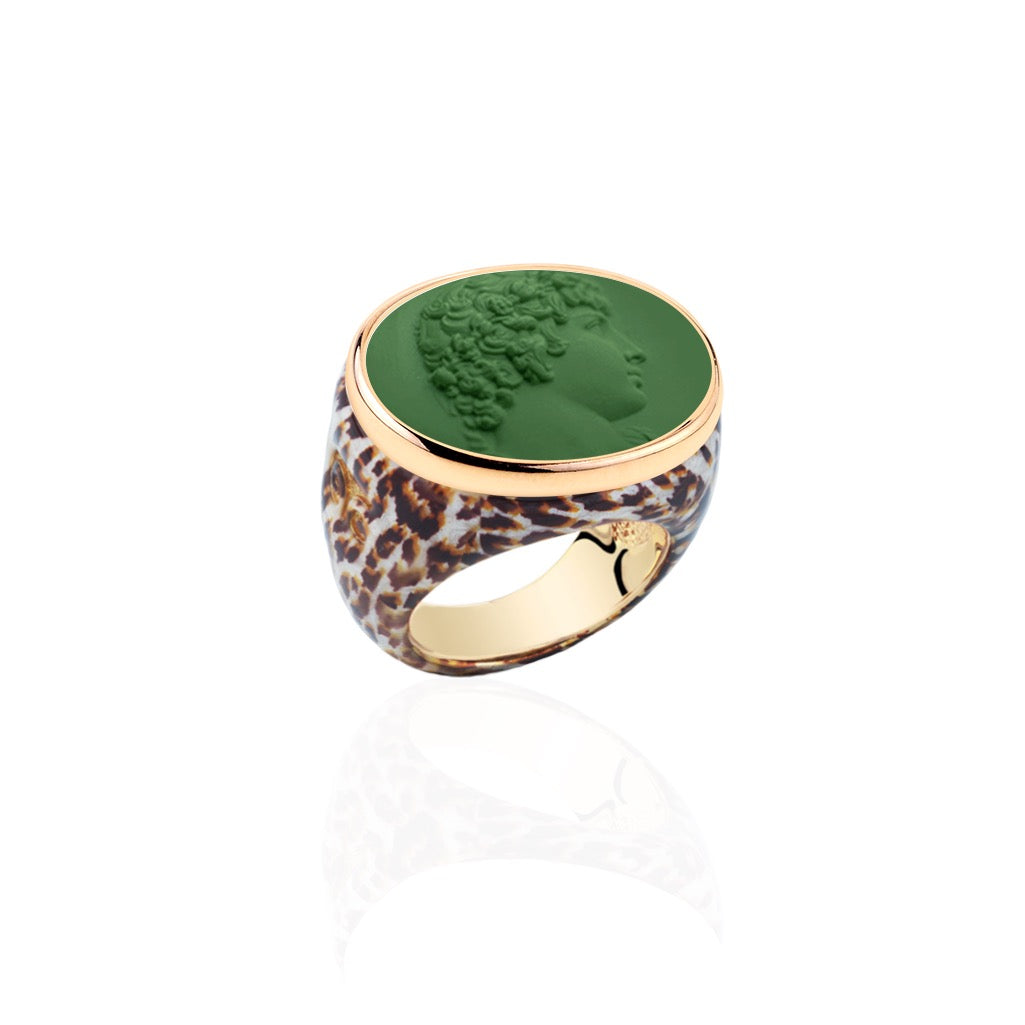
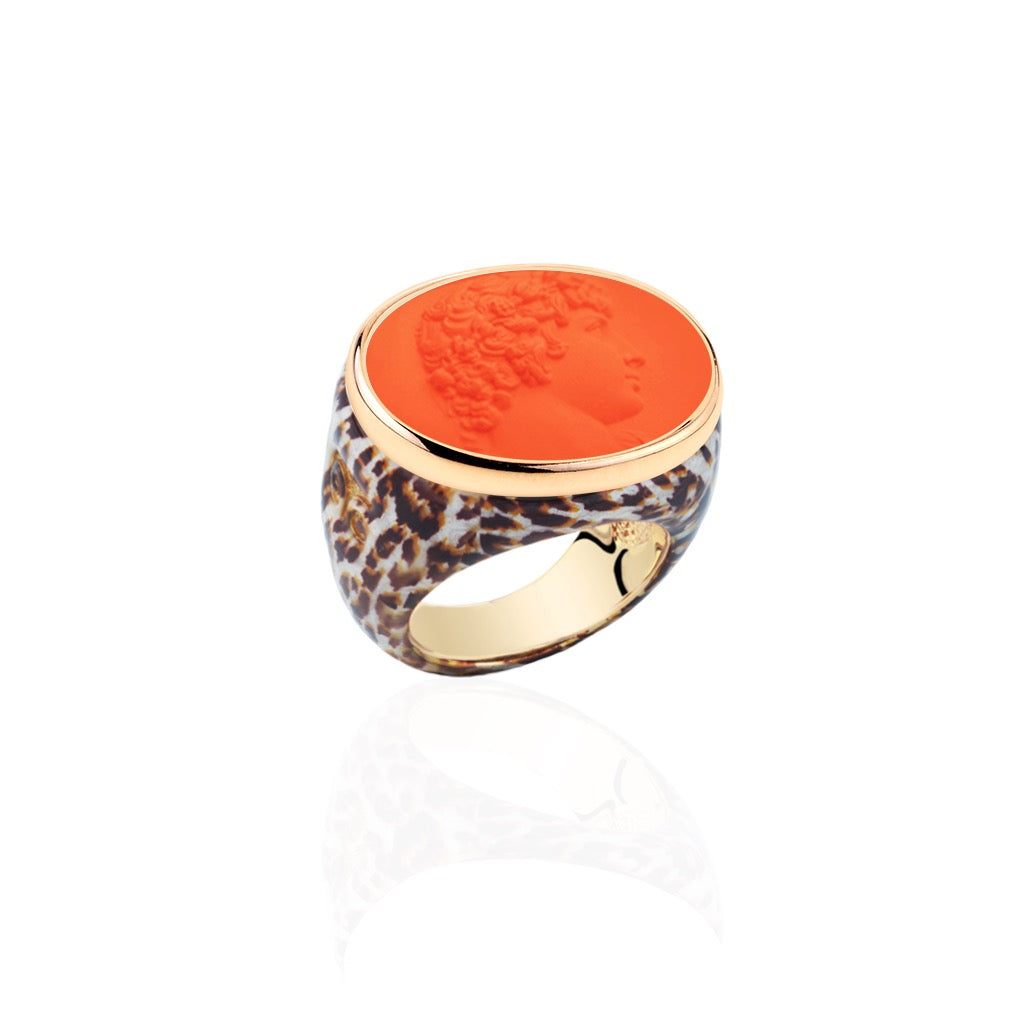
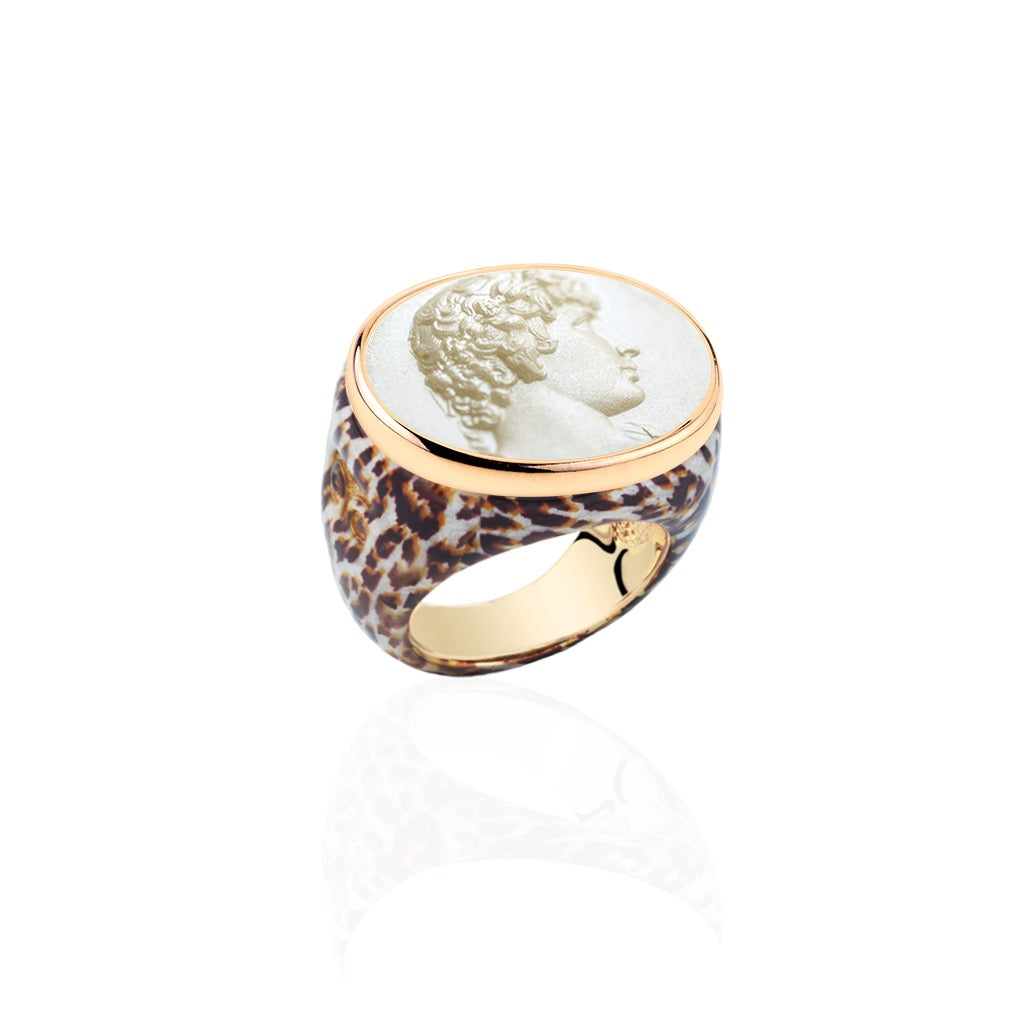
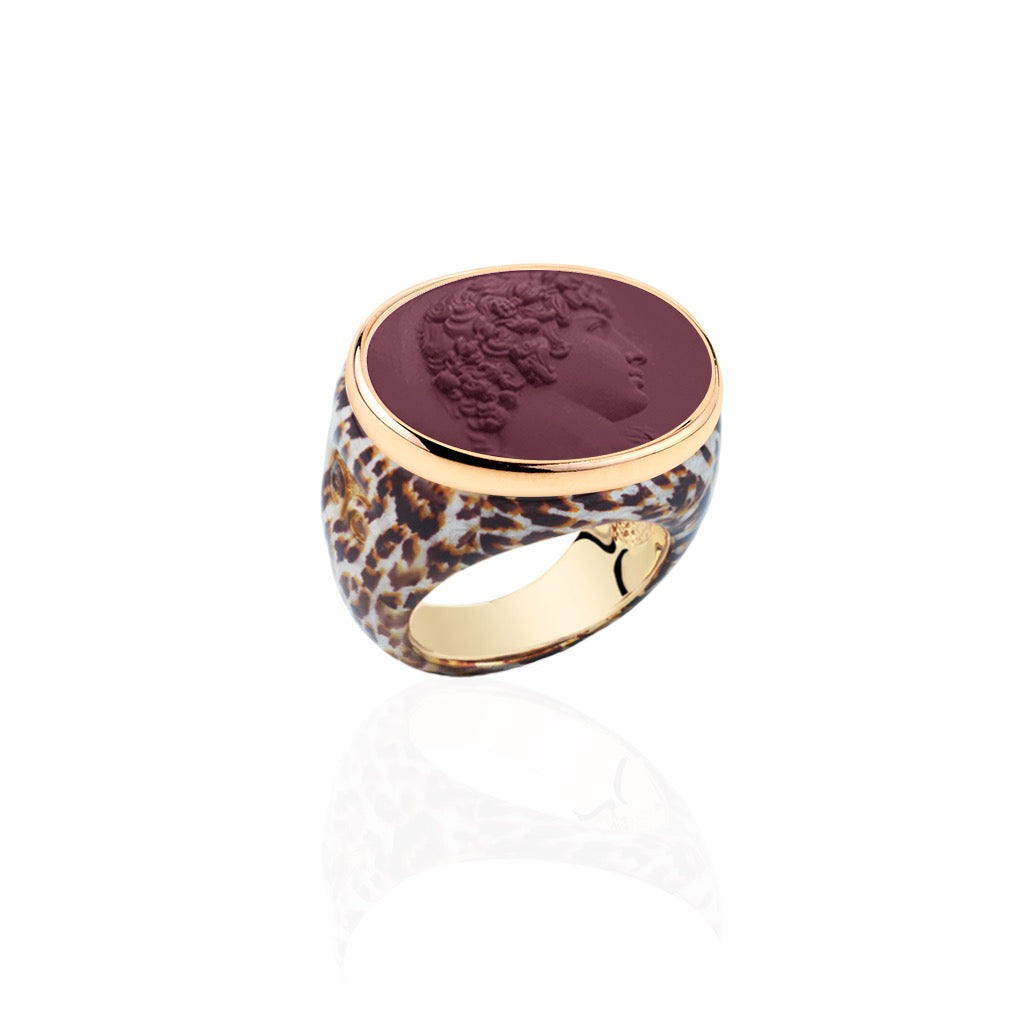
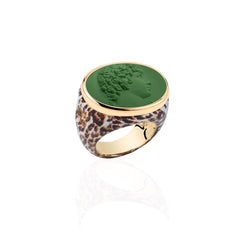
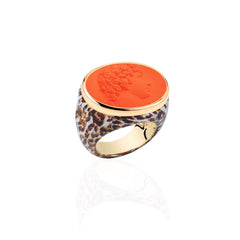
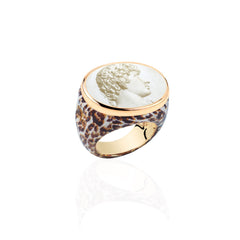
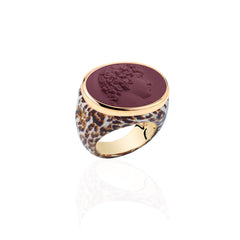
A decisive, textured structure wraps the finger: bronze beneath spotted enamel creates a surface alive with warm, unpredictable reflections. This is the Jaguar Ring — and upon this coat emerges the face of Antinous, with the clarity of a cameo that time has made eternal. A youth celebrated for a beauty that crosses the centuries, a harmony between composure and instinct that draws the eye. On the feline pattern, that classical perfection acquires a new dimension: the rigour of the profile meets the instinctive energy of the motif, and the result is a visual play of rare intensity. There is something surprising in this dialogue — the neoclassical purity of the carving rests upon a living, vibrant, moving surface. The profile is heightened by the contrast — as though this energy could reveal its full strength. A consciously bold ring, an animal touch upon a relief that portrays a young man with classical features, now an age-old myth. Love and acceptance shine beyond time. The colours set different tones in this narrative. Orange creates a warm, enveloping accord with the spotted base — analogous colours that amplify each other, like a sunset on the jaguar's skin. Pearl brings a veiled, suspended light: measured freshness on the vigour of the coat, a softness that enhances the fineness of the features. Porphyry is the most layered accord — the substance of imperial Rome, dense and mineral, finding a deep, natural resonance on the spotted ground. Green recalls Mediterranean foliage and its quiet strength, opening a fresh, unexpected breath within the jewel. Each variant reveals a different Antinous — always him, ever magnetic, always new.
Important Notes
The jewels' colors in the photo may look different from the original one. This depends from the resolution. Each object is handmade and has unique characteristics.Size chart

SIZE GUIDE
Find your size
Simple steps to measure the correct size of your finger:
- Measure your finger at the end of the day;
- Do not measure your finger when it is either too hot or too cold;
- Don’t forget that our hands are not identical, and that a ring that might fit on a finger on our left hand might not fit on the same finger on our right hand;
- Please be sure to check that your selected size slides along the full length of your finger.
To measure the circumference of your finger, you can use a taylor’s tape measure, or take a look at our video demonstration for another technique (which will require a ring that fits on your selected finger.) This size corresponds to the circumference, which you must use to find your corresponding appropriate size. (S - M - L - XL)
| Size | Italy | USA | France | Diameter (mm) | Circumference (mm) |
|---|---|---|---|---|---|
| S | 12 > 13 | 6 > 6,5 | 52 > 53 | 16,5 > 16,9 | 52 > 53 |
| M | 14 > 15 | 7 > 7 1/4 | 54 > 55 | 17,2 > 17,4 | 54 > 55 |
| L | 16 > 17 | 7,5 > 8 | 56 > 57 | 17,8 > 18,1 | 56 > 57 |
| XL | 18 > 19 | 8, 5 > 9 | 58 > 59 | 18,5 > 18,8 | 58 > 59 |
| 2XL | 20 | 9 | 60 | 19,1 | 60 |
| 3XL | 22 | 10 | 62 | 19,7 | 62 |
| 4XL | 24 | 10 3/4 | 64 | 20,4 | 64 |
| 5XL | 26 | 11 3/4 | 66 | 21 | 66 |
Antinous
Love remembered is never lost.
Antinous (also Antinoo or Antinoös; 27 November, c. 111 – before 30 October 130) was a Bithynian Greek youth and a favourite, or lover, of the Roman emperor Hadrian. He was deified after his death, being worshiped in both the Greek East and Latin West, sometimes as a god (theos) and sometimes merely as a deified mortal (heros). Antinous became associated with homosexuality in Western culture, appearing in the work of Oscar Wilde and the Portuguese poet Fernando Pessoa.
Show all products- Choosing a selection results in a full page refresh.