
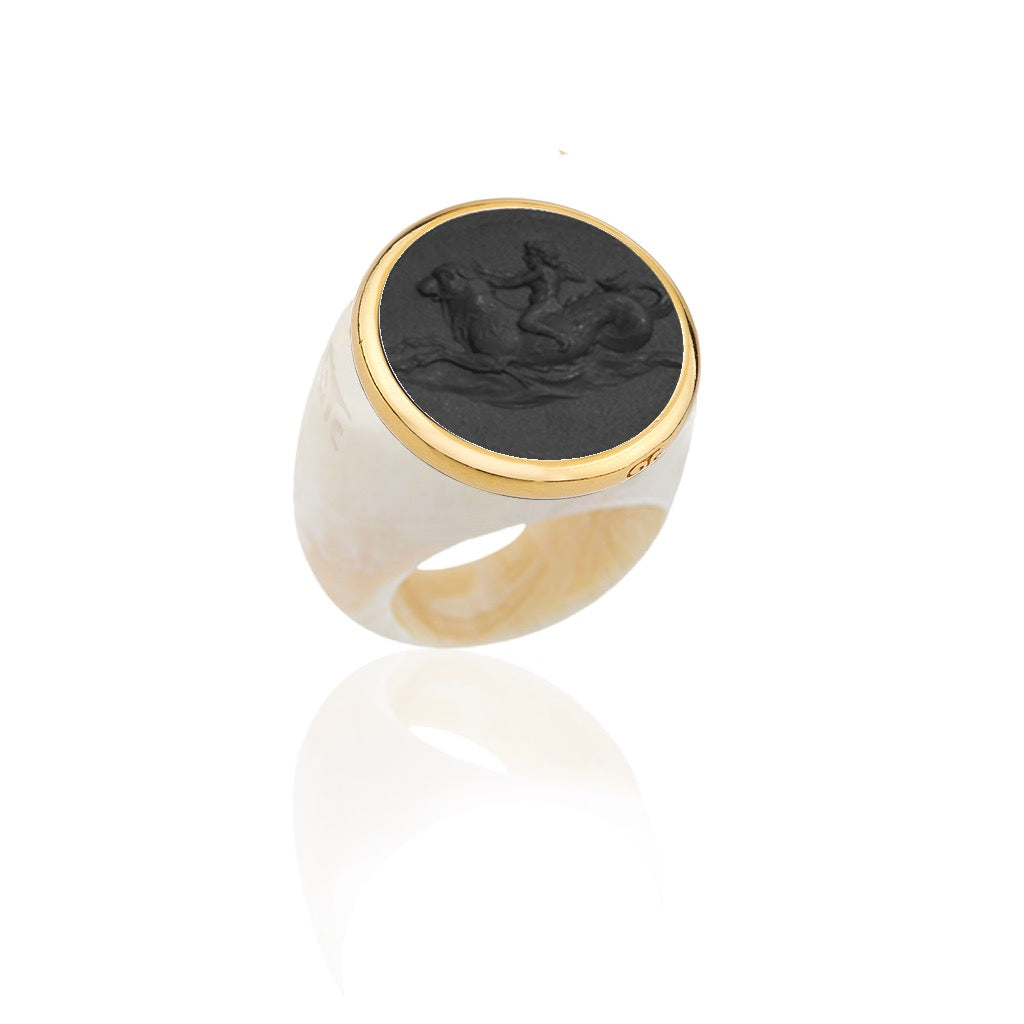
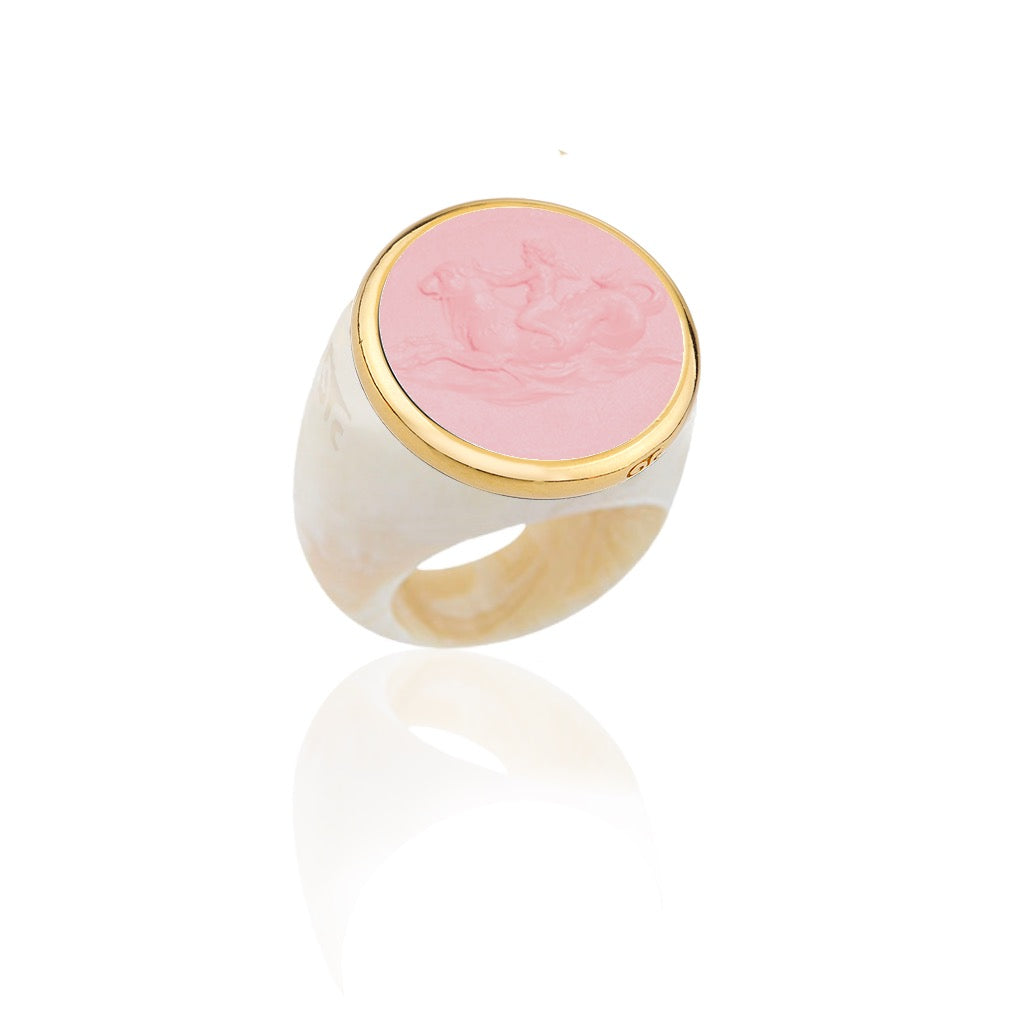
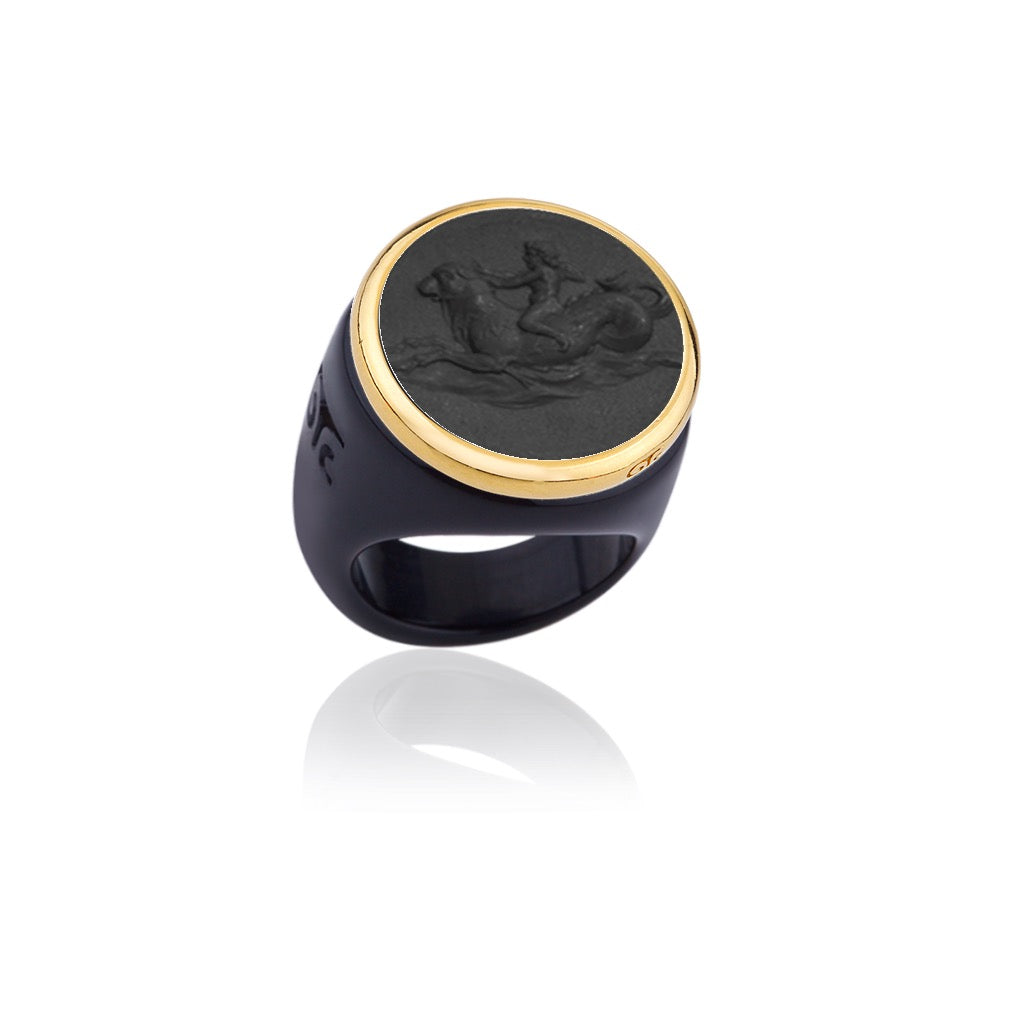
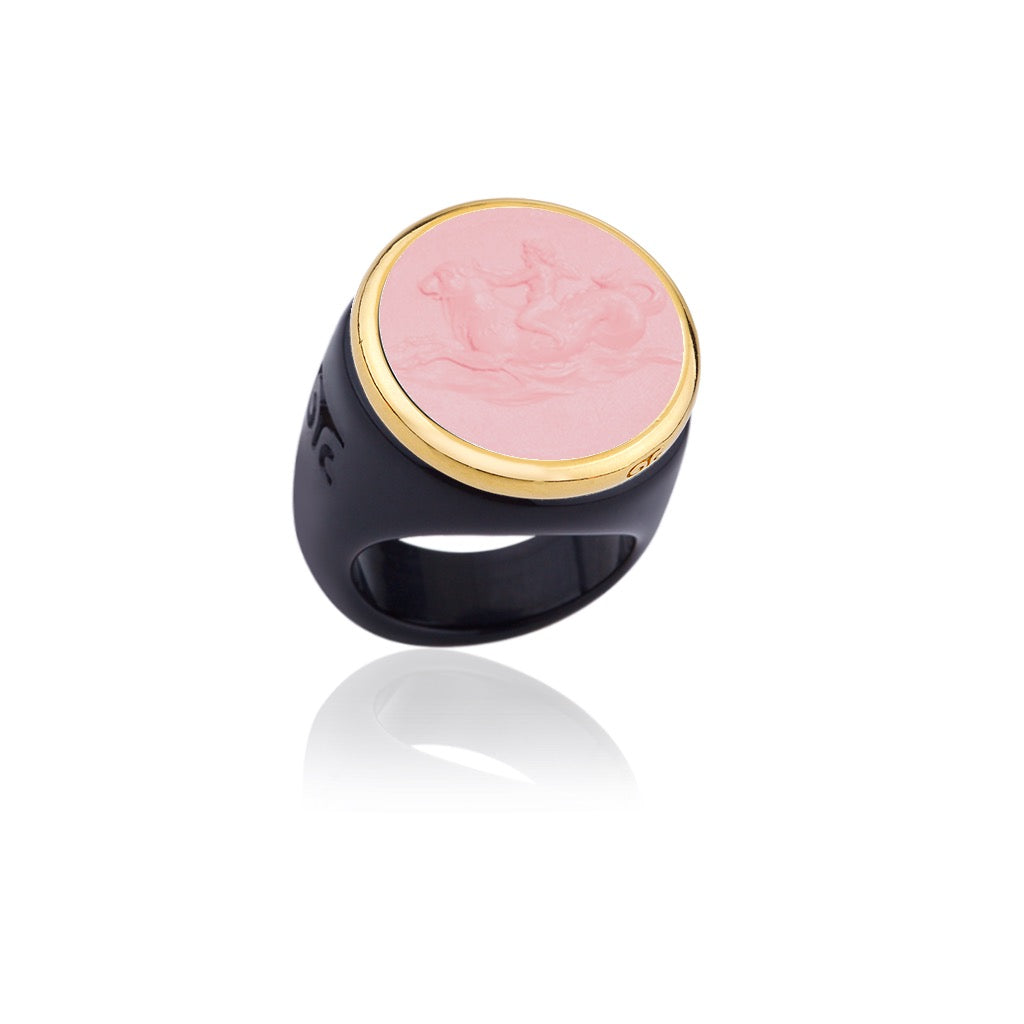
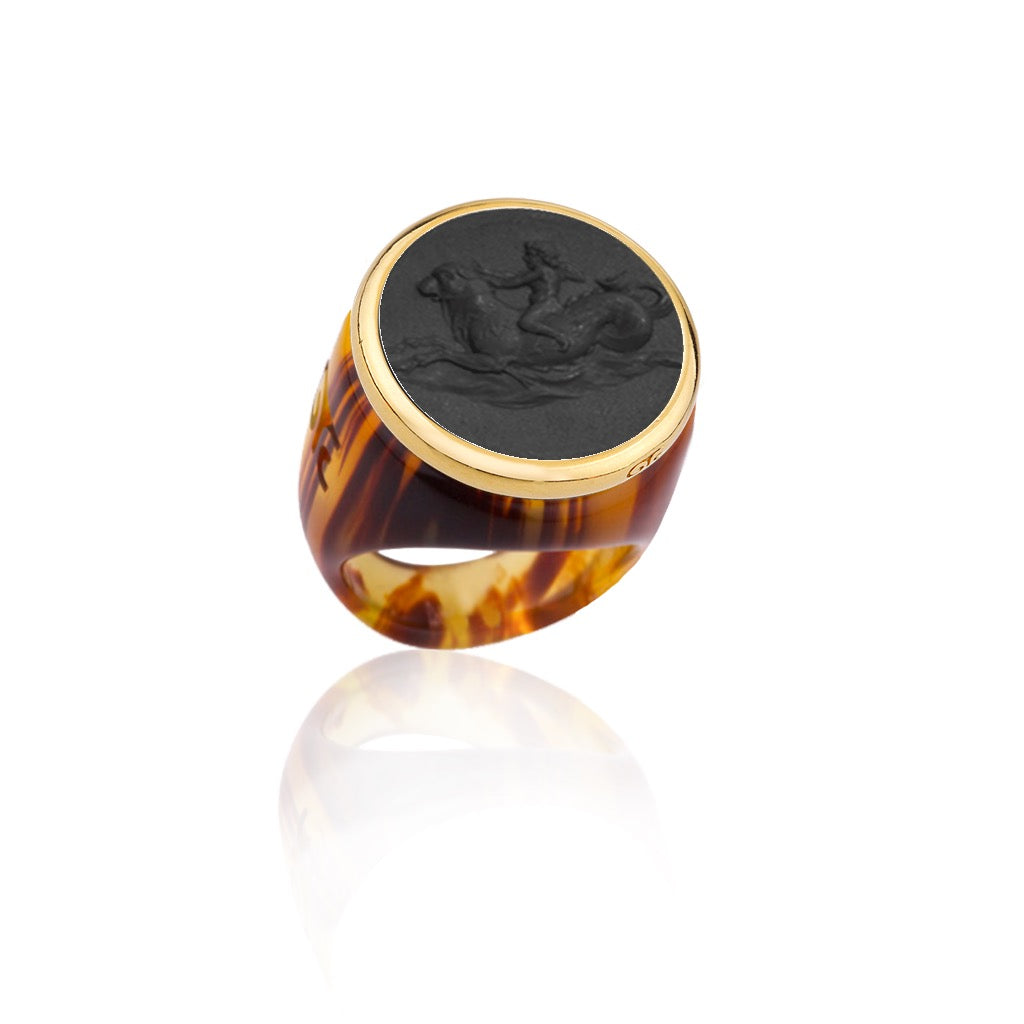
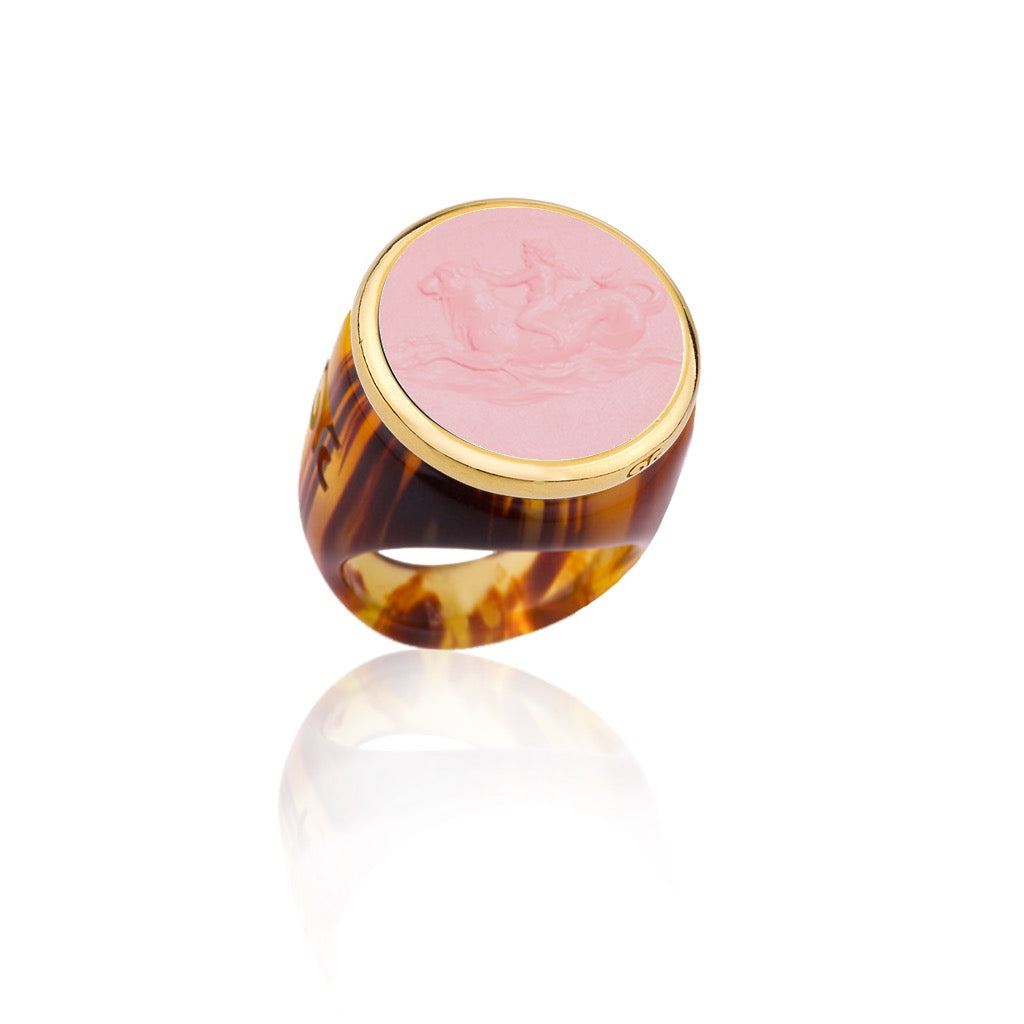
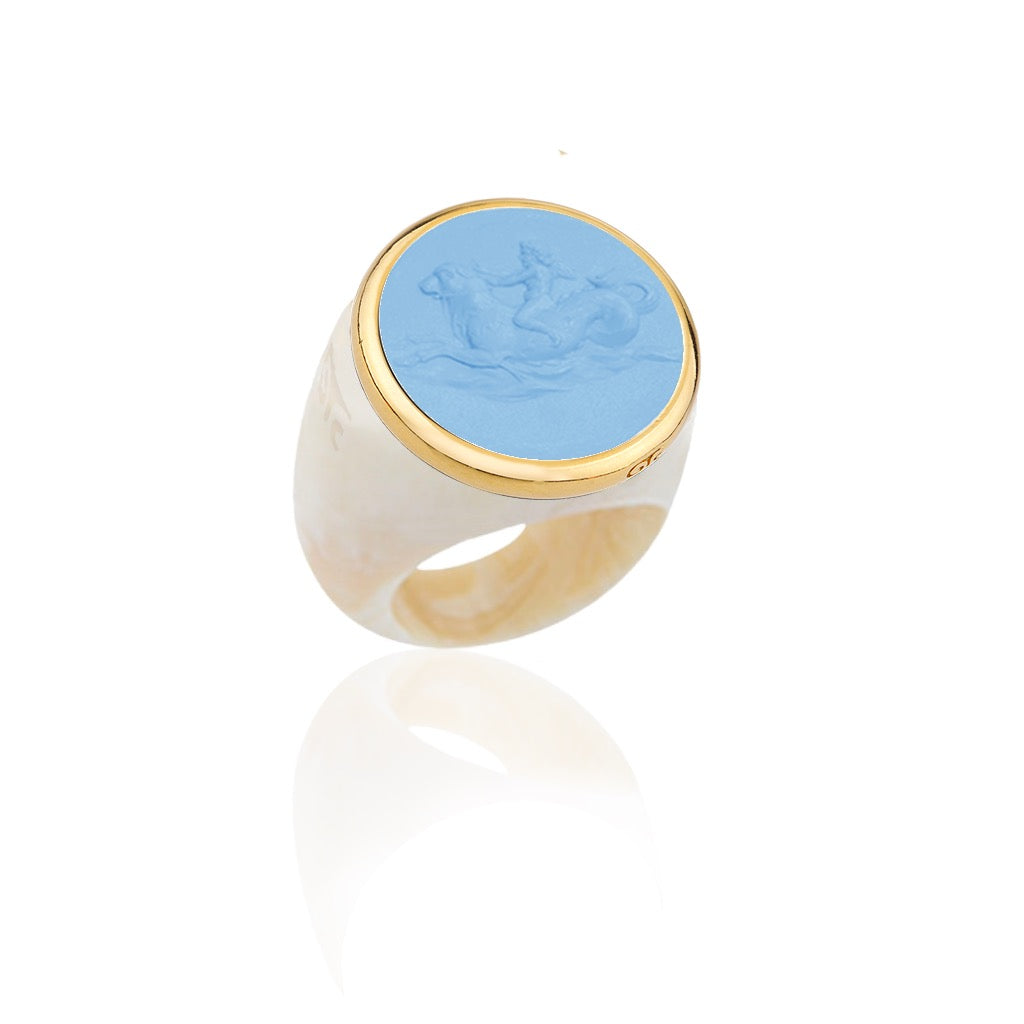
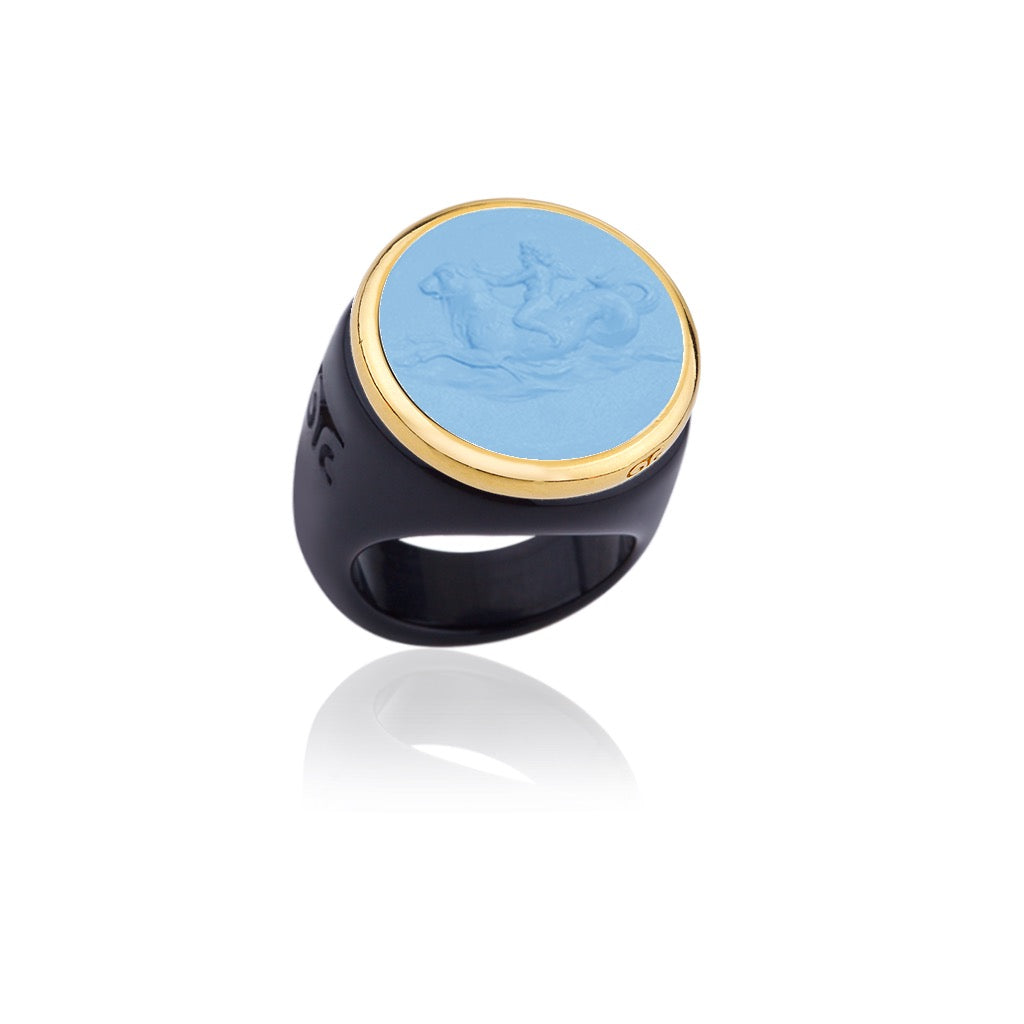
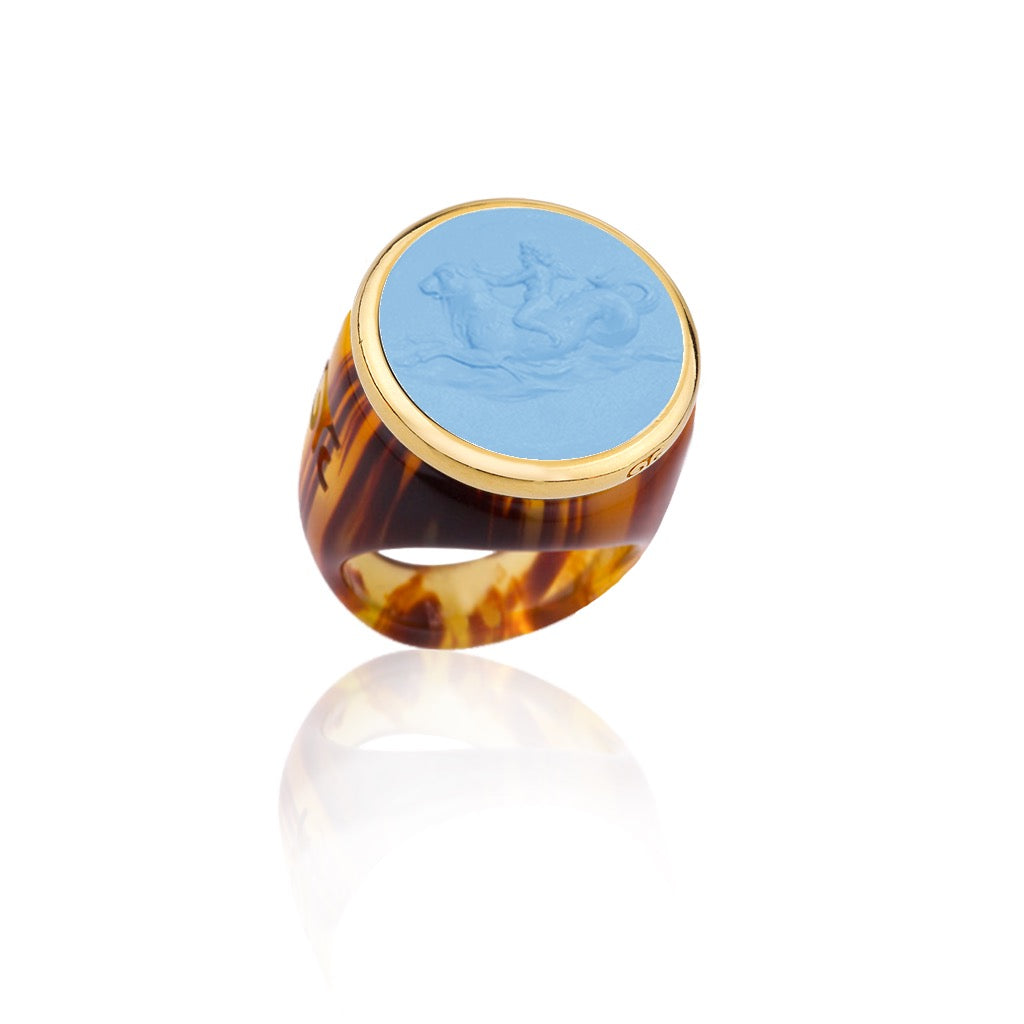
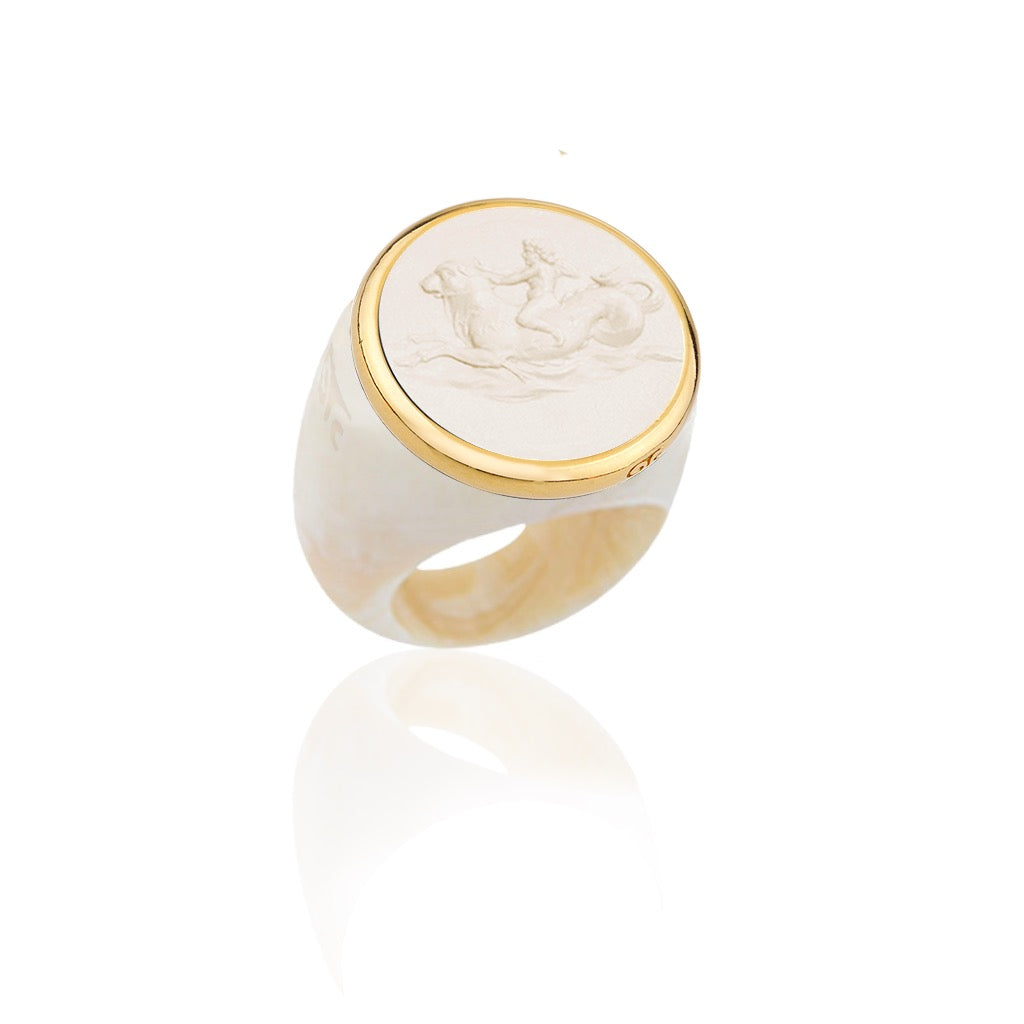
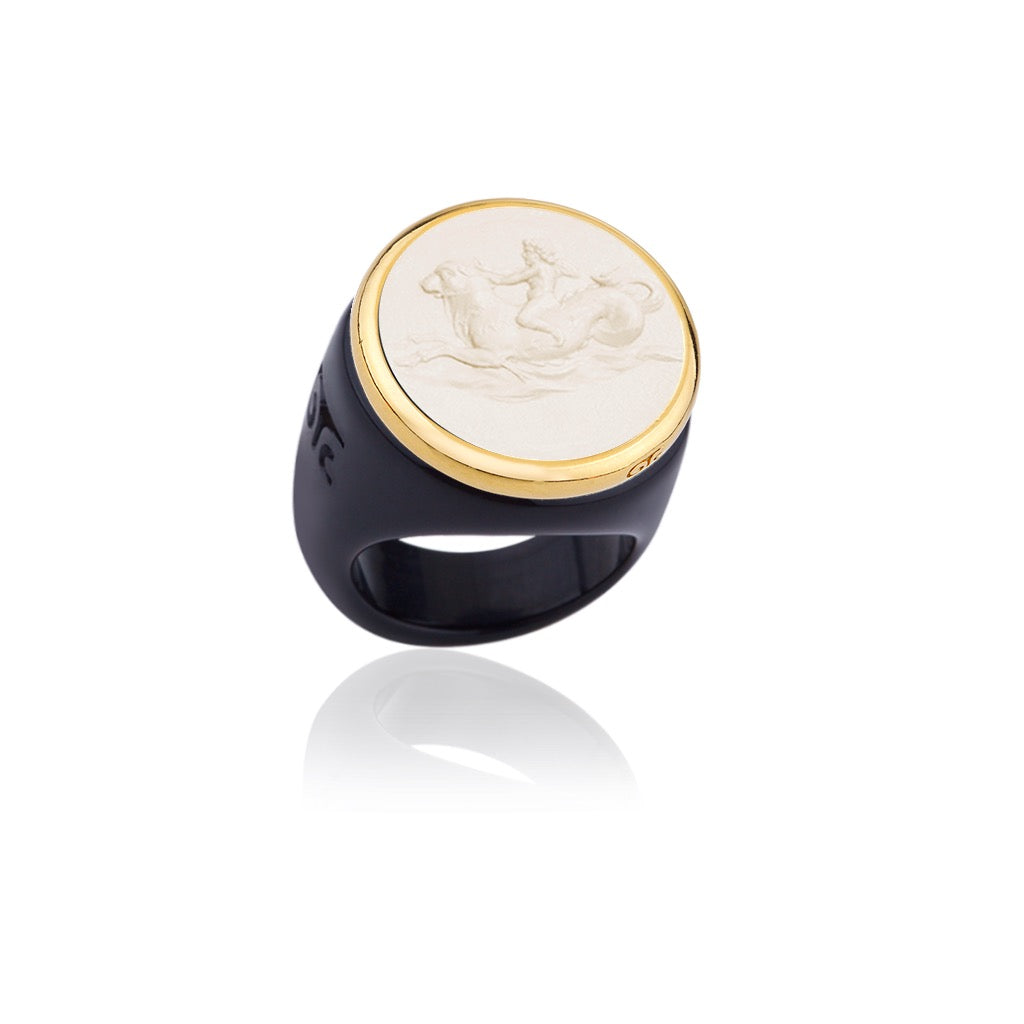
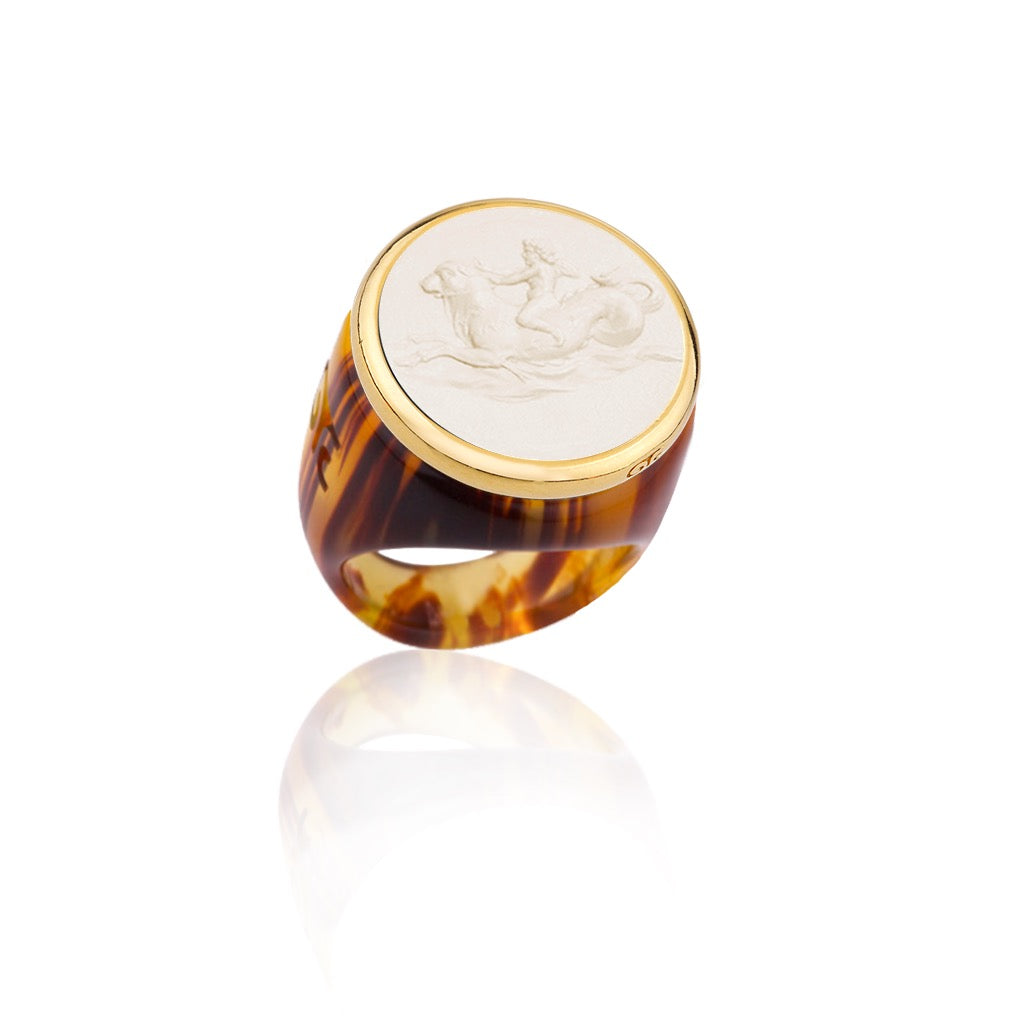
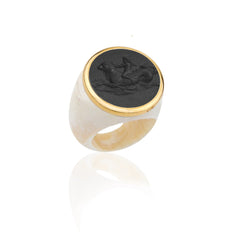
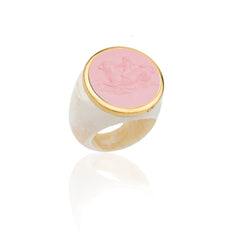
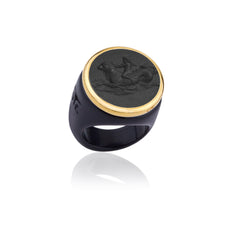
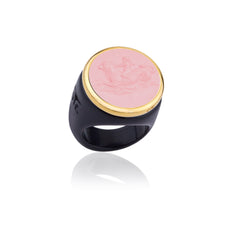
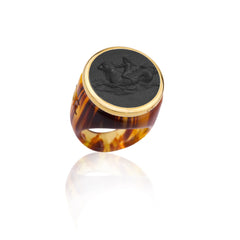
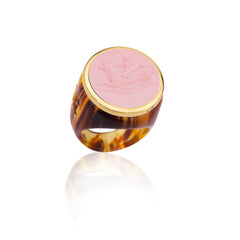
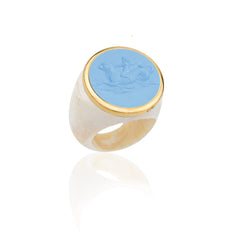
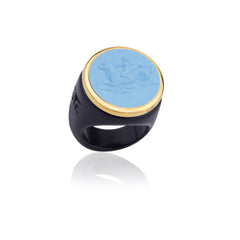
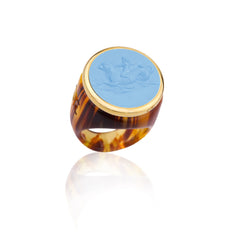
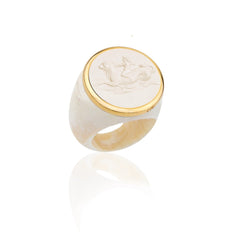
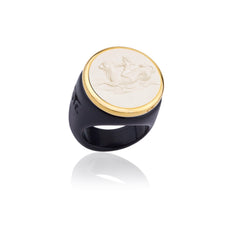
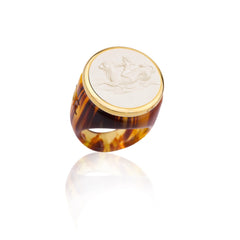
A round arena where light circles without interruption — the AURA's circular bezel changes the way the Cavallino appears. Muscles taut, mane in the wind — an animal that embodies virtues both divine and natural, perfectly framed in gilded bronze. The plexiglass ring body further emphasises the momentum the cameo expresses: a material light in essence yet substantial in form. A jewel of great presence, with its full volumes, proportions kept contained and curves kept soft.
The ring body is plexiglass — the shank adapts to the hand with fluidity, the weight contained, the jewel moving with the finger. The GTc signature is engraved on the bezel.
On black, the horse's profile emerges with the force of a bas-relief — lines lifting from the dark ground with graphic clarity: azure carries the horse towards the full afternoon sky, the colour of Giotto's Italy; white is the clarity of marble, every muscle in full light; black makes the silhouette absolute, profile against dark ground like an engraving; gold closes in warm dialogue between bronze and relief. On tortoiseshell, the veins of the plexiglass change from piece to piece, close-set and marked or soft — like a real shell, every ring is already unique before choosing the relief colour: azure vibrates among the natural tones; white brightens them; black strengthens them; gold warms them. On ivory, the natural bone tone softens the bronze's presence — every cut reveals different tonal gradations: azure opens towards the sky; white is almost monochrome; black offers the most elegant contrast; gold creates warm resonance between materials. Every combination renews the expression.
The gallop does not stop — only the ground beneath it changes.
Important Notes
The jewels' colors in the photo may look different from the original one. This depends from the resolution. Each object is handmade and has unique characteristics.Size chart

SIZE GUIDE
Find your size
Simple steps to measure the correct size of your finger:
- Measure your finger at the end of the day;
- Do not measure your finger when it is either too hot or too cold;
- Don’t forget that our hands are not identical, and that a ring that might fit on a finger on our left hand might not fit on the same finger on our right hand;
- Please be sure to check that your selected size slides along the full length of your finger.
To measure the circumference of your finger, you can use a taylor’s tape measure, or take a look at our video demonstration for another technique (which will require a ring that fits on your selected finger.) This size corresponds to the circumference, which you must use to find your corresponding appropriate size. (S - M - L - XL)
| Size | Italy | USA | France | Diameter (mm) | Circumference (mm) |
|---|---|---|---|---|---|
| S | 12 > 13 | 6 > 6,5 | 52 > 53 | 16,5 > 16,9 | 52 > 53 |
| M | 14 > 15 | 7 > 7 1/4 | 54 > 55 | 17,2 > 17,4 | 54 > 55 |
| L | 16 > 17 | 7,5 > 8 | 56 > 57 | 17,8 > 18,1 | 56 > 57 |
| XL | 18 > 19 | 8, 5 > 9 | 58 > 59 | 18,5 > 18,8 | 58 > 59 |
| 2XL | 20 | 9 | 60 | 19,1 | 60 |
| 3XL | 22 | 10 | 62 | 19,7 | 62 |
| 4XL | 24 | 10 3/4 | 64 | 20,4 | 64 |
| 5XL | 26 | 11 3/4 | 66 | 21 | 66 |
Cupid on Sea Calf
Let love take you in new directions.
In Roman mythology, Cupid (Latin cupido, meaning “desire”) is the god of desire, affection and erotic love. He is often portrayed as the son of the goddess Venus, with a father rarely mentioned. His Greek counterpart is Eros. Cupid is also known in Latin as Amor (“Love”). The Amores (plural) or amorini in the later terminology of art history are the equivalent of the Greek Erotes. Although Eros appears in Classical Greek art as a slender winged youth, during the Hellenistic period he was increasingly portrayed as a chubby boy. During this time, his iconography acquired the bow and arrow that remain a distinguishing attribute; a person, or even a deity, who is shot by Cupid’s arrow is filled with uncontrollable desire. The Roman Cupid retains these characteristics, which continue in the depiction of multiple cupids in both Roman art and the later classical tradition of Western art. Cupid’s ability to compel love and desire plays an instigating role in several myths or literary scenarios. In Vergil’s Aeneid, Cupid prompts Dido to fall in love with Aeneas, with tragic results. Ovid makes Cupid the patron of love poets. Cupid is a central character, however, in only the traditional tale of Cupid and Psyche, as told by Apuleius. Cupid was a continuously popular figure in the Middle Ages, when under Christian influence he often had a dual nature as Heavenly and Earthly love, and in the Renaissance, when a renewed interest in classical philosophy endowed him with complex allegorical meanings. In contemporary popular culture, Cupid is shown shooting his bow to inspire romantic love, often as an icon of Valentine’s Day.
Show all products- Choosing a selection results in a full page refresh.