
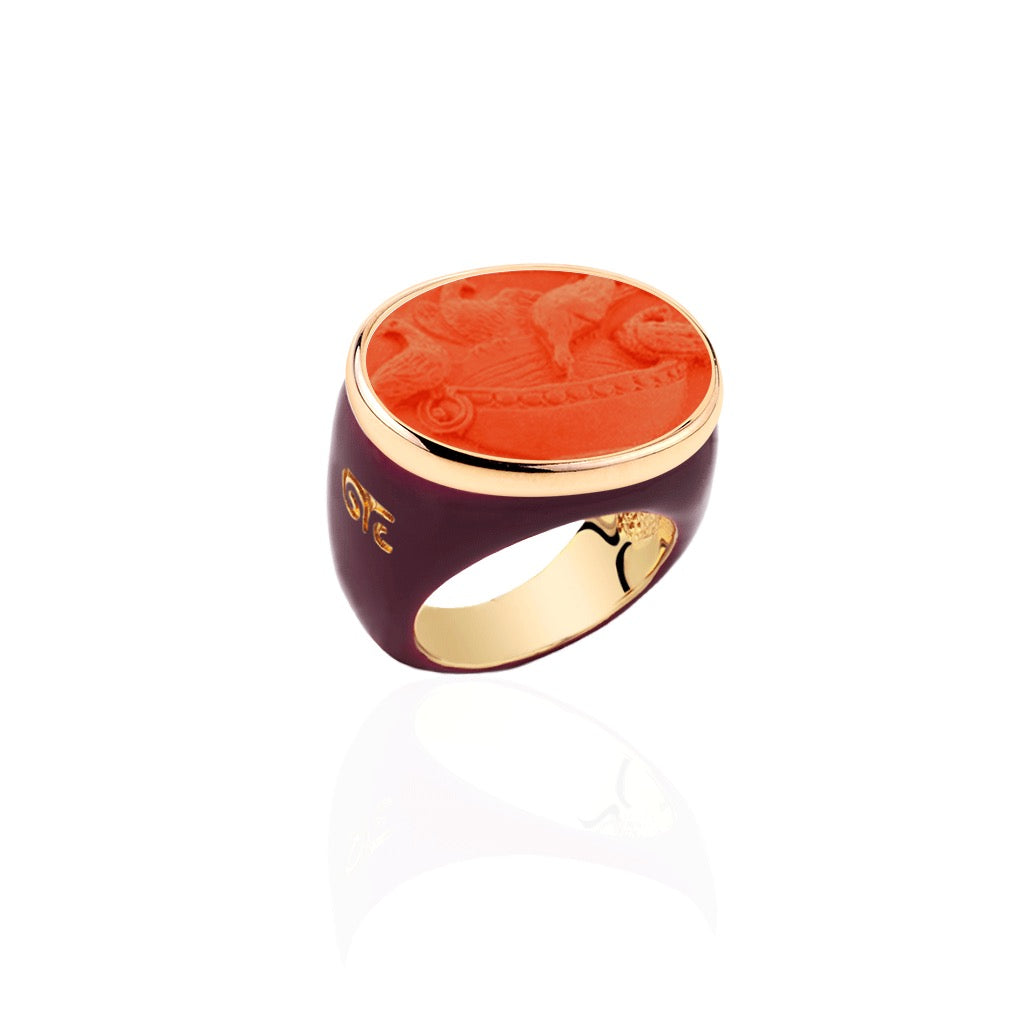
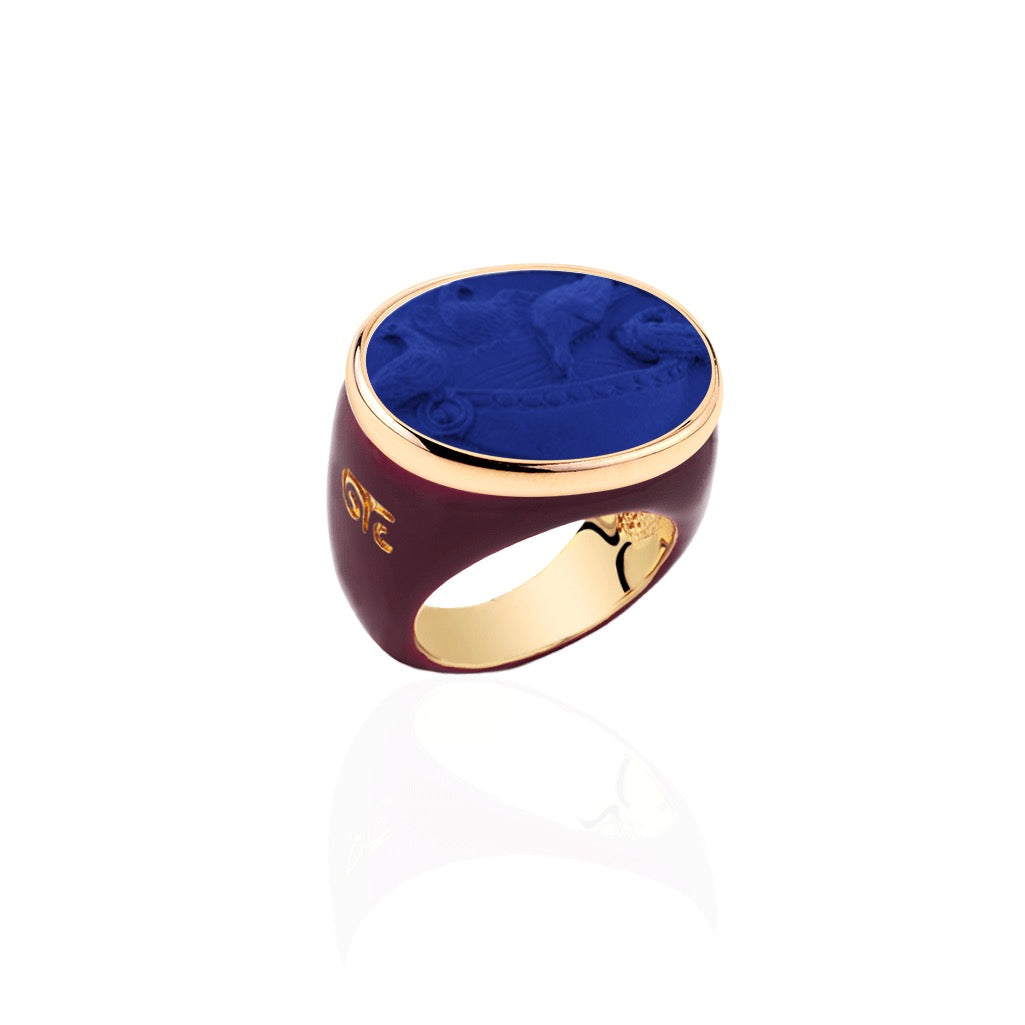
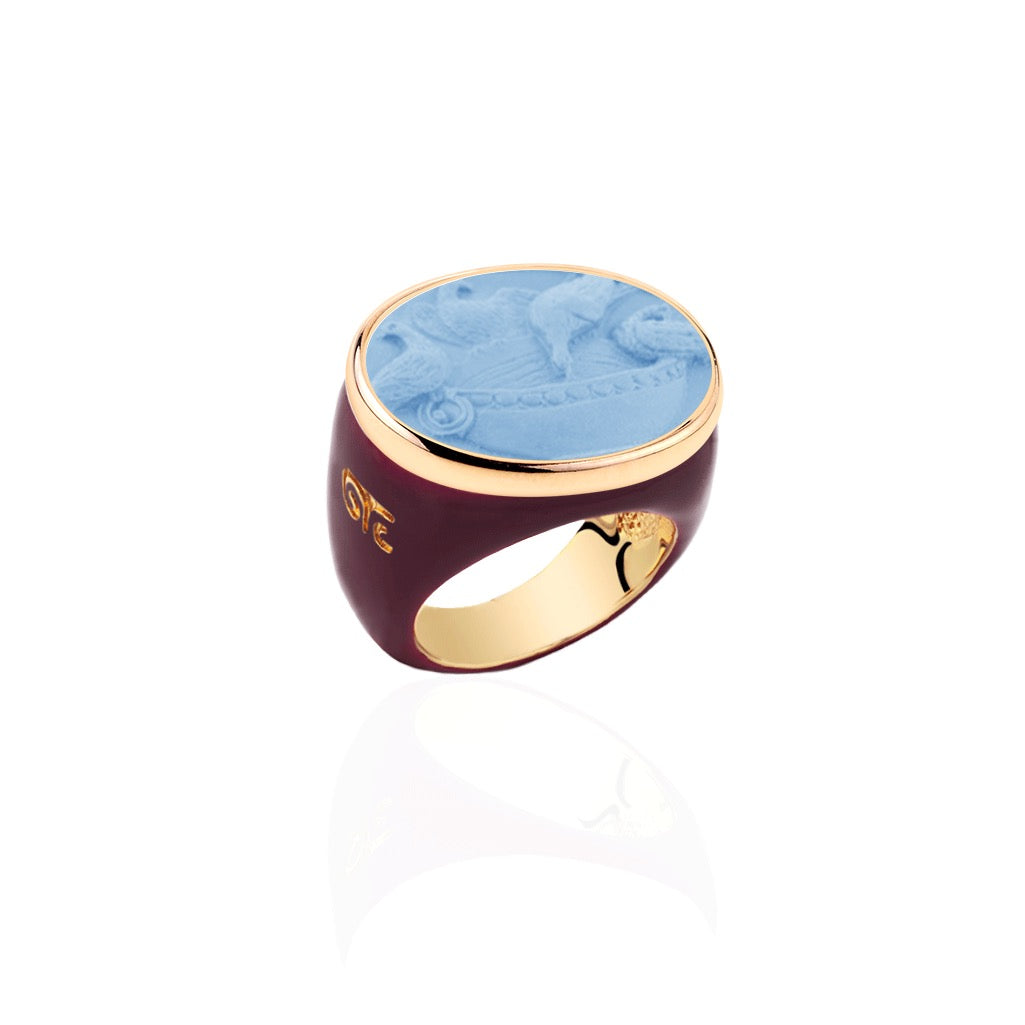
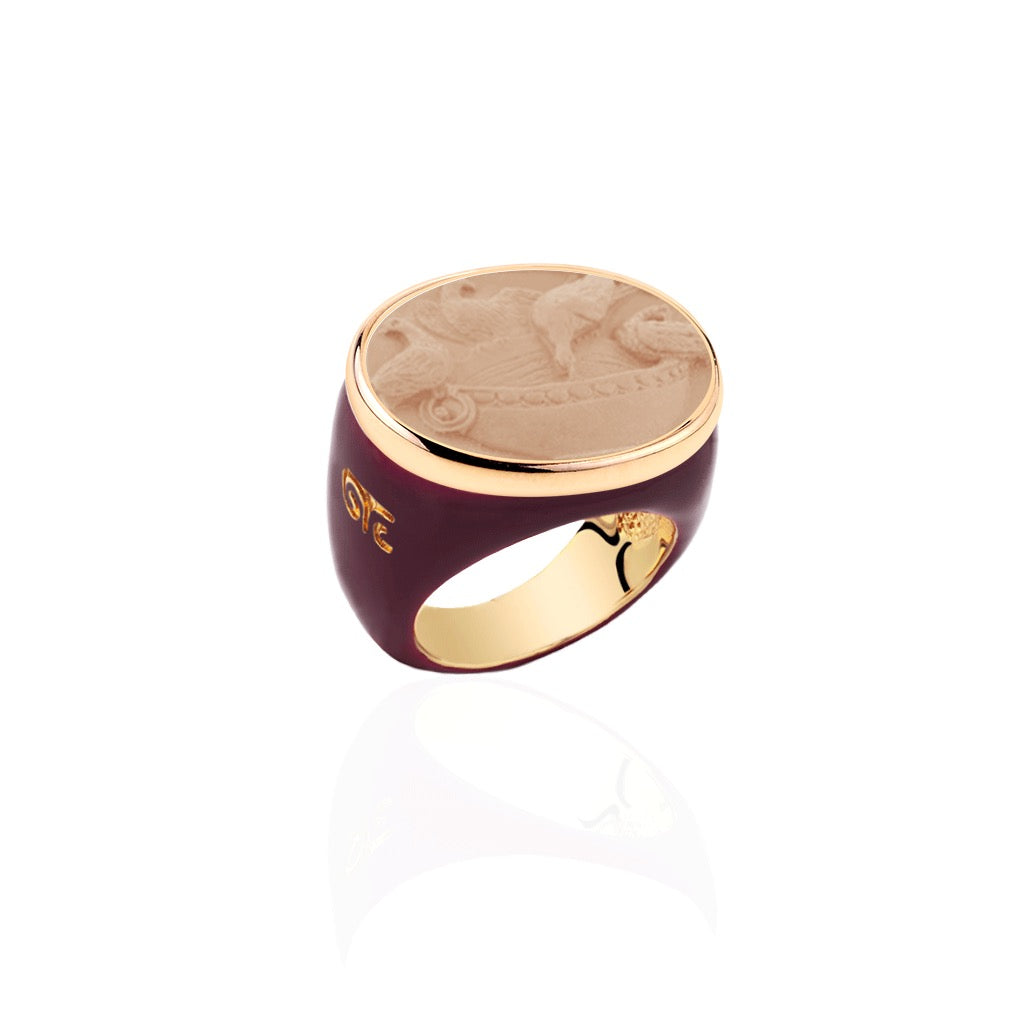
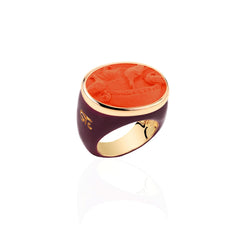
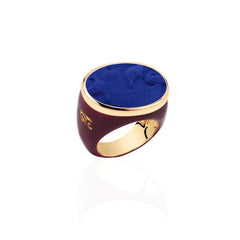


The doves on this oval ring are gathered within the bezel, and the bordeaux holds them in its embrace. The composition is calm, wrapped in enamel: four figures around the cup, set upon the colour that welcomes them with a deep, familiar warmth. This brilliant finish coats the bronze and dresses the cameo, and the weight of the jewel is felt in the hand. The scene vibrates with detail: the plumage, the drops of water, the cooing, the gathered quiet. Within this cameo there is something that calls forth immediate tactile sensations and, at the same time, looking at it one can step into the scene through imagination.
The subject is that of the celebrated ancient mosaic Pliny cites with admiration — the gift of holding an instant still. Against the intensity of the base, that quiet grows more intimate: a journey through time that pauses in this stillness. The colour softens and heightens the warmth of the gilded frame around the cameo; every volume is perfectly drawn, every dove with a movement of its own.
Orange paired with red carries a full beauty, like the generous curves of the carving. Blue, saturated and alive, brings out the relief — every fold of the plumage declares itself with fresh intensity. Light Blue is airy and gracious, heightening the contrast between the porosity of the cameo and the lustre of the enamel: pleasant, light, a delight to the eye. Sand is a drawing barely traced, essential strokes on the silhouettes — that line that recalls Picasso's graphic mark, ancient and modern at once.
This combination conveys a sense of deep serenity, simplicity, and genuine joy.
Wichtige Hinweise
The jewels' colors in the photo may look different from the original one. This depends from the resolution. Each object is handmade and has unique characteristics.Größentabelle

SIZE GUIDE
Find your size
Simple steps to measure the correct size of your finger:
- Measure your finger at the end of the day;
- Do not measure your finger when it is either too hot or too cold;
- Don’t forget that our hands are not identical, and that a ring that might fit on a finger on our left hand might not fit on the same finger on our right hand;
- Please be sure to check that your selected size slides along the full length of your finger.
To measure the circumference of your finger, you can use a taylor’s tape measure, or take a look at our video demonstration for another technique (which will require a ring that fits on your selected finger.) This size corresponds to the circumference, which you must use to find your corresponding appropriate size. (S - M - L - XL)
| Size | Italy | USA | France | Diameter (mm) | Circumference (mm) |
|---|---|---|---|---|---|
| S | 12 > 13 | 6 > 6,5 | 52 > 53 | 16,5 > 16,9 | 52 > 53 |
| M | 14 > 15 | 7 > 7 1/4 | 54 > 55 | 17,2 > 17,4 | 54 > 55 |
| L | 16 > 17 | 7,5 > 8 | 56 > 57 | 17,8 > 18,1 | 56 > 57 |
| XL | 18 > 19 | 8, 5 > 9 | 58 > 59 | 18,5 > 18,8 | 58 > 59 |
| 2XL | 20 | 9 | 60 | 19,1 | 60 |
| 3XL | 22 | 10 | 62 | 19,7 | 62 |
| 4XL | 24 | 10 3/4 | 64 | 20,4 | 64 |
| 5XL | 26 | 11 3/4 | 66 | 21 | 66 |
Pliny’s Doves
Gentle hearts stay strong.
A mosaic from Hadrian’s Villa, now in the Capitoline Museums, depicts a group of doves on a round bowl. As described by Pliny, one dove is drinking while the others are sunning themselves. The Doves of Pliny, or the Capitoline Doves depicts the doves artistically but realistically. The mosaic is made only of cubes of colored marble, without any colored glass as in other mosaics. It was discovered in 1737 during excavations at Hadrian’s Villa led by Cardinal Giuseppe Alessandro Furietti, who thought it was the mosaic that Pliny had described, although other scholars think it is a copy of the original that was made for Hadrian. The Hadrian’s villa mosaic has in turn been copied many times in many formats. Musei Capitolini – Roma
Show all products- Die Auswahl einer Auswahl führt zu einer vollständigen Seitenaktualisierung.