
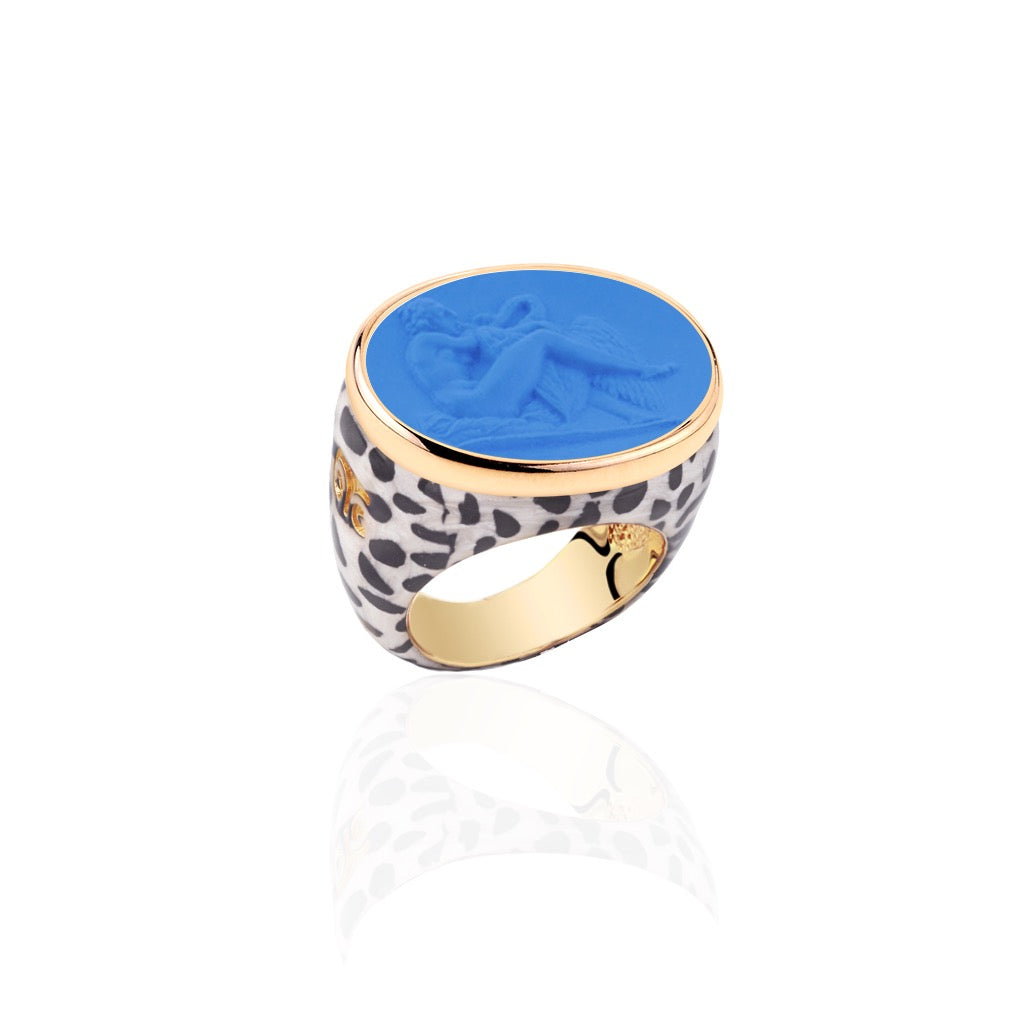
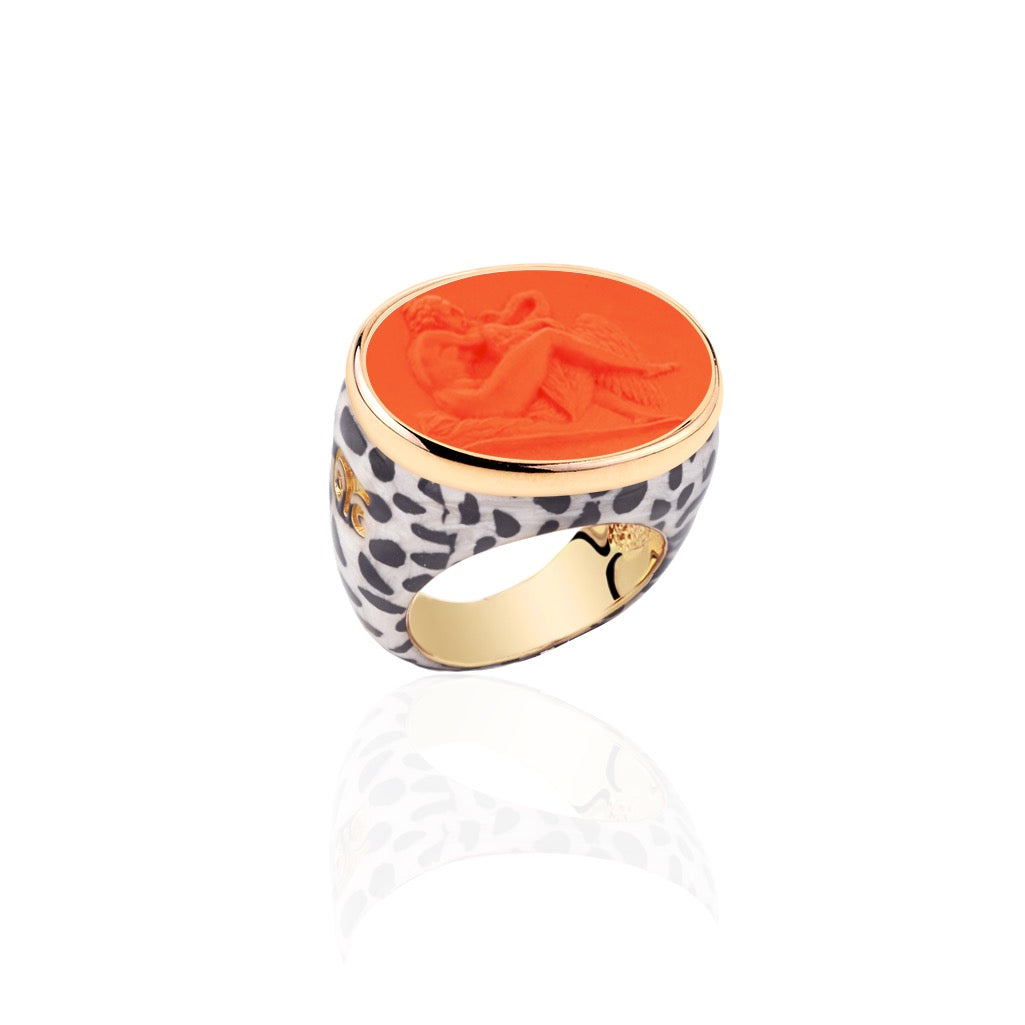
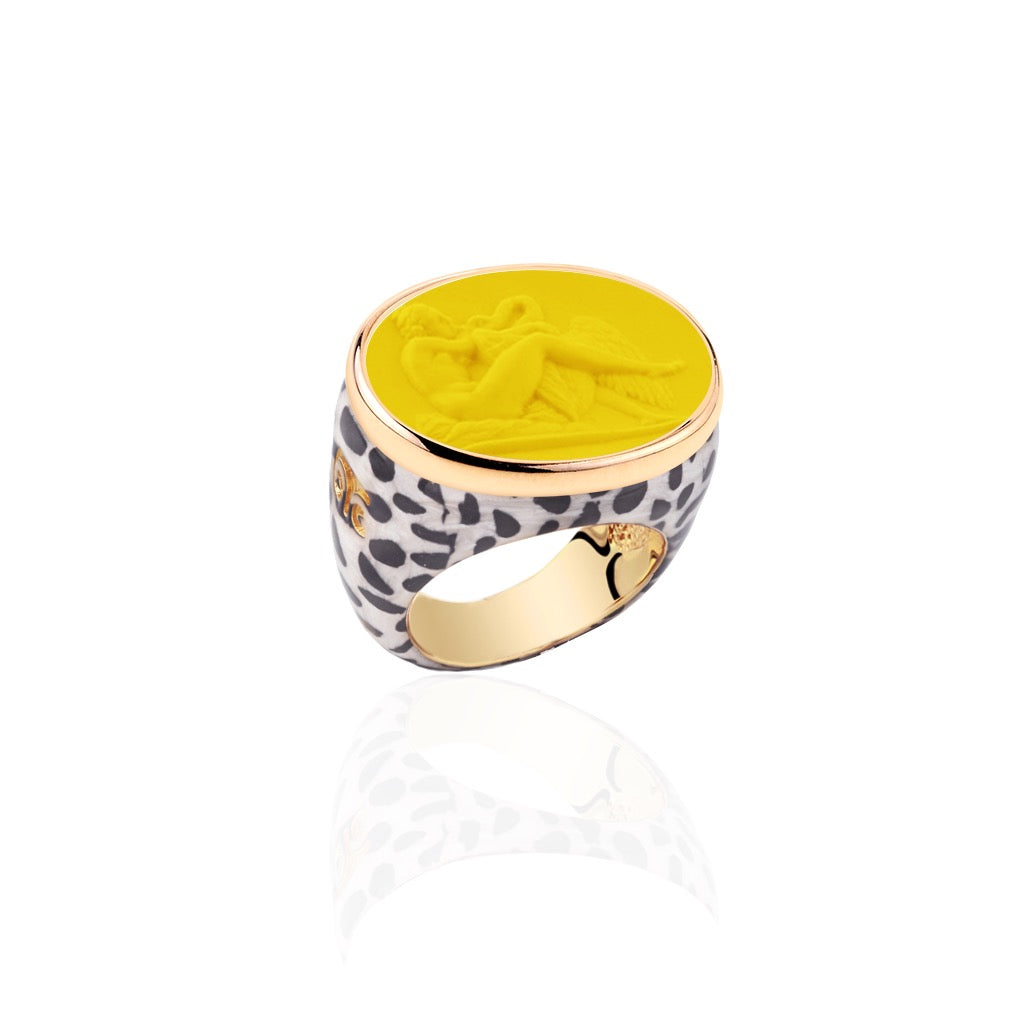
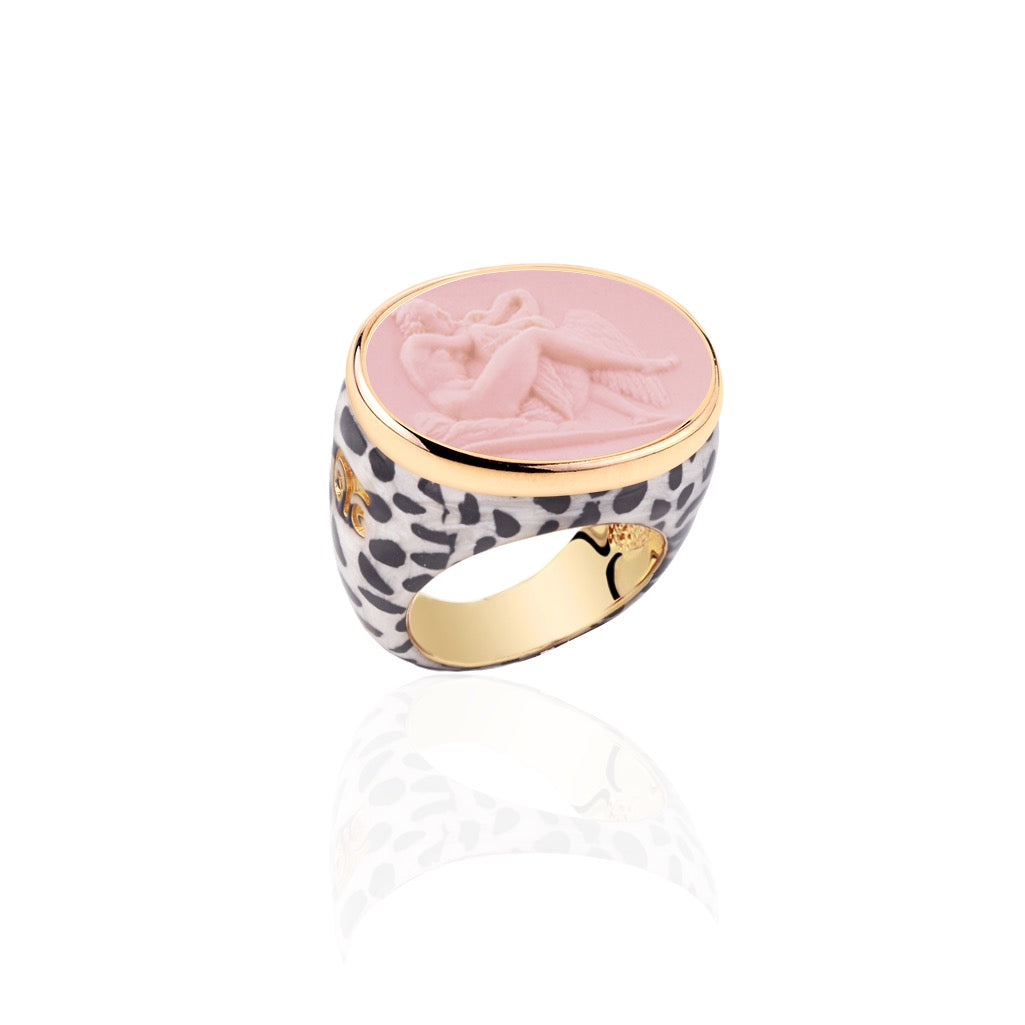
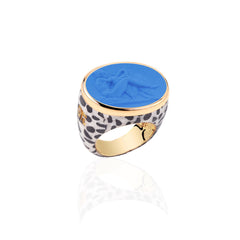
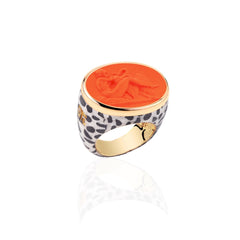
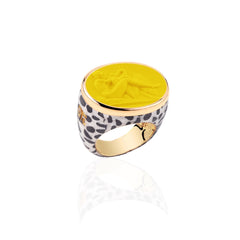
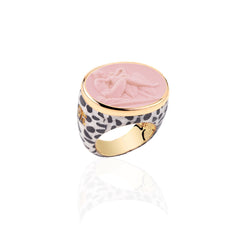
Ein Schmuckstück von großem Charakter, mit einem Intaglio, das Leda und den Schwan gewidmet ist – die kühnste Szene der klassischen Mythologie auf einem Untergrund, der ihr neue Freiheit verleiht. Der Schwan und Leda, das Göttliche und das Menschliche, eröffnen über schwarz-weißen Flecken der klassischen Szene eine unerwartete Lebendigkeit. Die Form des Rings nimmt diese voluminöse Komposition auf – und jede Farbe schafft eine andere Metamorphose in den Tiefen des Intaglios.
Aus dieser Verbindung gingen Helena von Troja und die Dioskuren hervor. Der Schwan als Verwandlung des Göttlichen: Jupiter (Zeus im Griechischen) wählt die Metamorphose, Anmut als Form der Liebe. Liebe als etwas, das jede Gestalt annimmt – ein Spiel von Echos, das über die mediterrane Kultur hinaus fasziniert. Auf Dalmatiner findet diese Freiheit der Substanz einen Untergrund, der sie versteht – das Schwarz-Weiß des Dalmatiners trägt seine eigene unvorhersehbare Logik, und Alt und Neu finden eine Harmonie, die dem Schmuckstück einen konventionslosen und visuell beeindruckenden Ausdruck verleiht.
Die Flecken des Dalmatiners umhüllen die Szene mit einem visuellen Rhythmus, der mit den Federn des Schwans im Dialog steht – Schwarz und Weiß wechseln sich ab wie Licht und Schatten auf der Oberfläche des antiken Emails.
Orange ist Feuer und Ausdruck – mit unmittelbarer Energie tritt es in das Muster ein, die Szene flammt auf. Hellblau: Himmel und Wasser – der Schwan in seinem natürlichen Element, die Szene öffnet sich weit. Gelb ist die direkteste und leuchtendste Farbe – Schwarz und Weiß werden heller, das Kameo tritt deutlich hervor. Rosa ist zart, pastellfarben – auf Dalmatiner setzt es einen überraschenden, ganz aktuellen Akzent, die Anmut des Motivs wird poppig und frisch.
Wichtige Hinweise
Die Farben der Schmuckstücke auf dem Foto können vom Original abweichen. Dies hängt von der Auflösung ab. Jedes Stück ist handgefertigt und besitzt einzigartige Merkmale.Größentabelle

GRÖSSENTABELLE
Finden Sie Ihre Größe
Einfache Schritte, um die richtige Ringgröße zu ermitteln:
- Messen Sie Ihren Finger am Ende des Tages;
- Messen Sie Ihren Finger nicht, wenn er zu heiß oder zu kalt ist;
- Vergessen Sie nicht, dass unsere Hände nicht identisch sind und ein Ring, der an einem Finger der linken Hand passt, am gleichen Finger der rechten Hand möglicherweise nicht passt;
- Bitte stellen Sie sicher, dass die ausgewählte Größe über die gesamte Länge Ihres Fingers gleitet.
Um den Umfang Ihres Fingers zu messen, können Sie ein Schneidermaßband verwenden oder sich unser Video-Tutorial für eine andere Methode ansehen (dazu benötigen Sie einen Ring, der auf den ausgewählten Finger passt). Diese Größe entspricht dem Umfang, den Sie zur Ermittlung Ihrer passenden Ringgröße verwenden müssen. (S - M - L - XL)
| Größe | Italien | USA | Frankreich | Durchmesser (mm) | Umfang (mm) |
|---|---|---|---|---|---|
| S | 12 > 13 | 6 > 6,5 | 52 > 53 | 16,5 > 16,9 | 52 > 53 |
| M | 14 > 15 | 7 > 7 1/4 | 54 > 55 | 17,2 > 17,4 | 54 > 55 |
| L | 16 > 17 | 7,5 > 8 | 56 > 57 | 17,8 > 18,1 | 56 > 57 |
| XL | 18 > 19 | 8, 5 > 9 | 58 > 59 | 18,5 > 18,8 | 58 > 59 |
| 2XL | 20 | 9 | 60 | 19,1 | 60 |
| 3XL | 22 | 10 | 62 | 19,7 | 62 |
| 4XL | 24 | 10 3/4 | 64 | 20,4 | 64 |
| 5XL | 26 | 11 3/4 | 66 | 21 | 66 |
Leda und der Schwan
Lass das Schicksal auf deine Wahl treffen.
Leda war die Tochter des Thestius und die Ehefrau des Tyndareus. Sie ist als Königin von Sparta bekannt. Leda wurde von Zeus verführt, als er in der Gestalt eines Schwans zu ihr kam. Leda gebar ein Ei, aus dem die Dioskuren, die Zwillinge Kastor und Pollux, schlüpften. Mit Zeus hatte sie auch Helena, und mit Tyndareus hatte sie Klytämnestra. Jupiter ist der höchste Gott des römischen Pantheons, genannt dies pater, „leuchtender Vater“. Er ist ein Gott des Lichts und des Himmels sowie Beschützer des Staates und seiner Gesetze. Er ist ein Sohn des Saturn und Bruder von Neptun und Juno (die auch seine Ehefrau ist). Die Römer verehrten ihn besonders als Jupiter Optimus Maximus (allgütig, allmächtig). Dieser Name bezieht sich nicht nur auf seine Herrschaft über das Universum, sondern auch auf seine Funktion als Staatsgott, der Gesetze verteilt, das Reich kontrolliert und seinen Willen durch Orakel kundtut. Sein englischer Name ist Jove. Er hatte einen Tempel auf dem Kapitol, zusammen mit Juno und Minerva, war aber der bedeutendste der kapitolinischen Trias. Sein Tempel war nicht nur das wichtigste Heiligtum Roms, sondern auch das Zentrum des politischen Lebens. Hier wurden offizielle Opfer dargebracht, Verträge unterzeichnet und Kriege erklärt, und die siegreichen Generäle der römischen Armee kamen hierher, um ihren Dank zu erweisen. Weitere Titel Jupiters sind: Caelestis (himmlisch), Lucetius (des Lichts), Totans (Donnerer), Fulgurator (des Blitzes). Als Jupiter Victor führte er die römische Armee zum Sieg. Jupiter ist auch der Beschützer des alten Bundes der lateinischen Städte. Sein Attribut ist der Blitz, und der Adler ist sowohl sein Symbol als auch sein Bote. Jupiter ist vollständig identisch mit dem griechischen Zeus. Michelangelo (1530) London-Nationalgalerie Leonardo (1510-1515) Rom-Galleria Borghese Robert Cockle Lucas (1800-1883) Berlin Nationalgalerie
Alle Produkte anzeigen- Die Auswahl einer Auswahl führt zu einer vollständigen Seitenaktualisierung.