


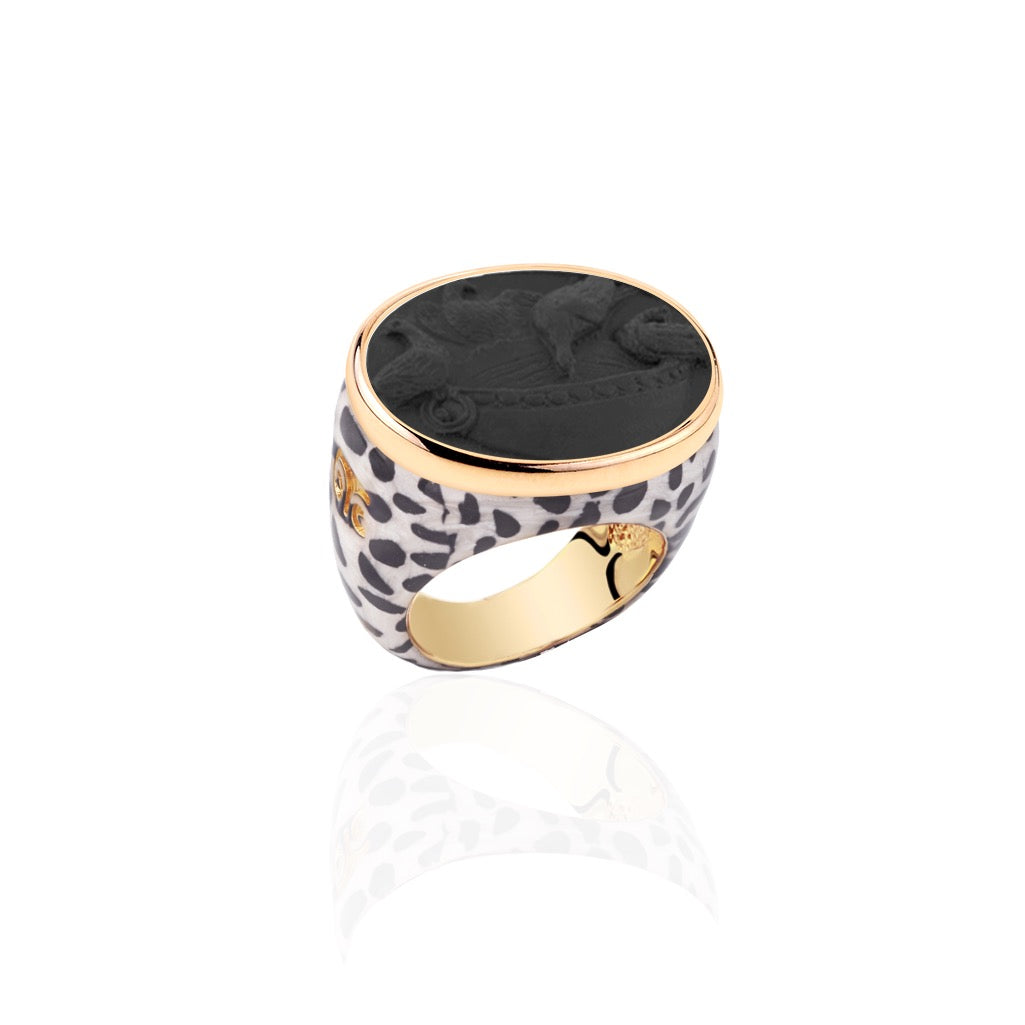
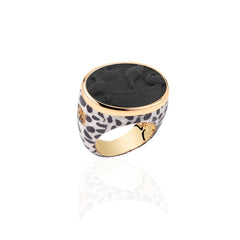
On this ring the colour plays with the intaglio of the doves — bringing them to life. You sense the feathers, the drops of water, the cooing. The scene is a moment of pure harmony: they drink, they stay together, in a stillness you can feel. The black and white spots — the Dalmatian effect — bring dynamism to this jewel, which tells in an entirely new key a classic theme represented and reproduced many times through the ages: the design of its form, the horizontality and the décor give it a completely different and surprising breath.
The subject crosses the centuries in its ability to freeze a single moment. On Dalmatian this effect stays intact and adds something more. The classicism finds here a fresh expression, and the two registers meet with ease. The message is generous, it arrives at once and belongs to everyone, a tale of sharing that comes through instantly.
Colours work magic: they lift the doves into flight, they raise them. And the Dalmatian does the rest — the jewel takes on an energy entirely its own, one that speaks of our time. Violet unites exuberant joy and quiet composure of the soul, the base adds sophistication to the whole. A joyful, light celebration with Pale Blue — the birds seem to float, the scene open and gentle. Black brings almost a visual order, precise and direct. Pearl recalls the natural white of the doves and adds the reflection of water, luminous and distilled.
The enamel pattern transforms the intaglio — which echoes the original iconography of a great polychrome mosaic — into a graphic composition where every colour in the relief speaks, and the jewel conveys every detail.
Notes importantes
Les couleurs des bijoux sur la photo peuvent différer légèrement de la réalité, en fonction de la résolution. Chaque objet est fait main et présente des caractéristiques uniques.Tableau des tailles

GUIDE DES TAILLES
Trouvez votre taille
Étapes simples pour mesurer la taille correcte de votre doigt :
- Mesurez votre doigt en fin de journée ;
- Ne mesurez pas la température de votre doigt lorsqu'il est trop chaud ou trop froid ;
- N'oubliez pas que nos mains ne sont pas identiques et qu'une bague qui peut aller à un doigt de notre main gauche peut ne pas aller au même doigt de notre main droite ;
- Veuillez vérifier que la taille choisie glisse bien sur toute la longueur de votre doigt.
Pour mesurer la circonférence de votre doigt, vous pouvez utiliser un mètre ruban de tailleur ou consulter notre vidéo de démonstration pour une autre méthode (qui nécessitera une bague à votre taille). Cette mesure correspond à la circonférence, que vous devez utiliser pour trouver votre taille de bague. (S - M - L - XL)
- Cliquez ici pour imprimer notre gabarit « Imprimer le gabarit ».
- Cliquez ici pour regarder une vidéo « Regarder la vidéo ».
| Taille | Italie | USA | France | Diamètre (mm) | Circonférence (mm) | Diamètre (pouces) | Circonférence (pouces) |
|---|---|---|---|---|---|---|---|
| S | 12 > 13 | 6 > 6,5 | 52 > 53 | 16,5 > 16,9 | 52 > 53 | 0,65 > 0,67 | 2,05 > 2,09 |
| M | 14 > 15 | 7 > 7 1/4 | 54 > 55 | 17,2 > 17,4 | 54 > 55 | 0,68 > 0,69 | 2,13 > 2,17 |
| L | 16 > 17 | 7,5 > 8 | 56 > 57 | 17,8 > 18,1 | 56 > 57 | 0,71 > 0,72 | 2,21 > 2,25 |
| XL | 18 > 19 | 8, 5 > 9 | 58 > 59 | 18,5 > 18,8 | 58 > 59 | 0,73 > 0,75 | 2,29 > 2,33 |
Pliny’s Doves
Gentle hearts stay strong.
A mosaic from Hadrian’s Villa, now in the Capitoline Museums, depicts a group of doves on a round bowl. As described by Pliny, one dove is drinking while the others are sunning themselves. The Doves of Pliny, or the Capitoline Doves depicts the doves artistically but realistically. The mosaic is made only of cubes of colored marble, without any colored glass as in other mosaics. It was discovered in 1737 during excavations at Hadrian’s Villa led by Cardinal Giuseppe Alessandro Furietti, who thought it was the mosaic that Pliny had described, although other scholars think it is a copy of the original that was made for Hadrian. The Hadrian’s villa mosaic has in turn been copied many times in many formats. Musei Capitolini – Roma
Afficher tous les produits- Le choix d’une sélection entraîne une actualisation complète de la page.