


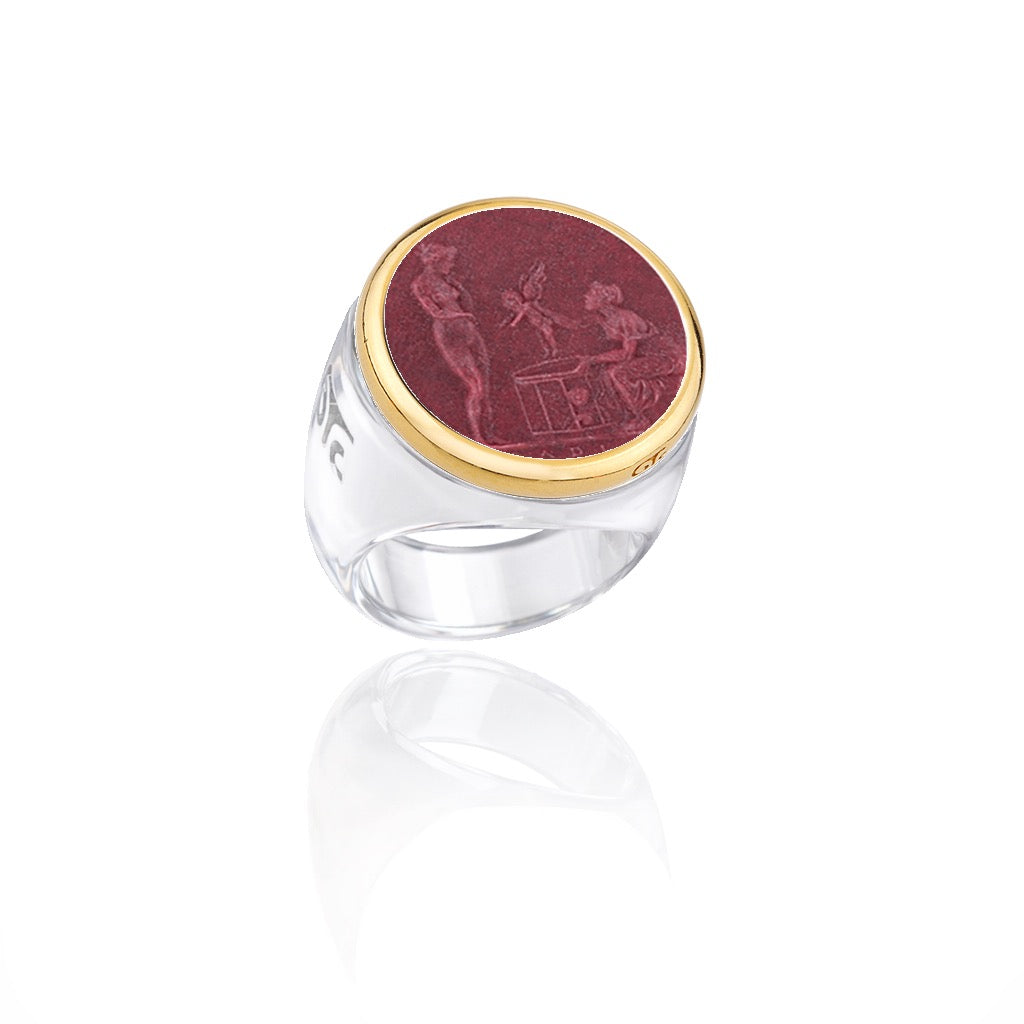
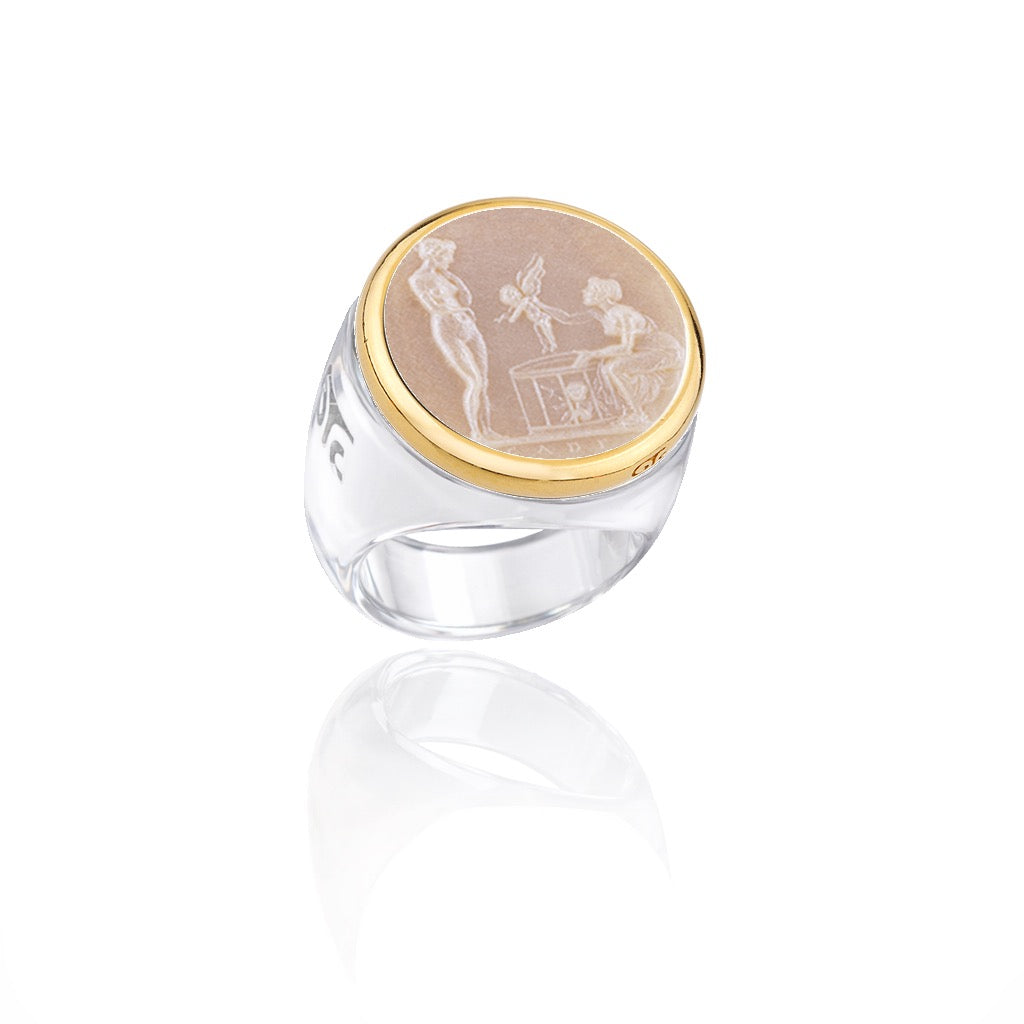

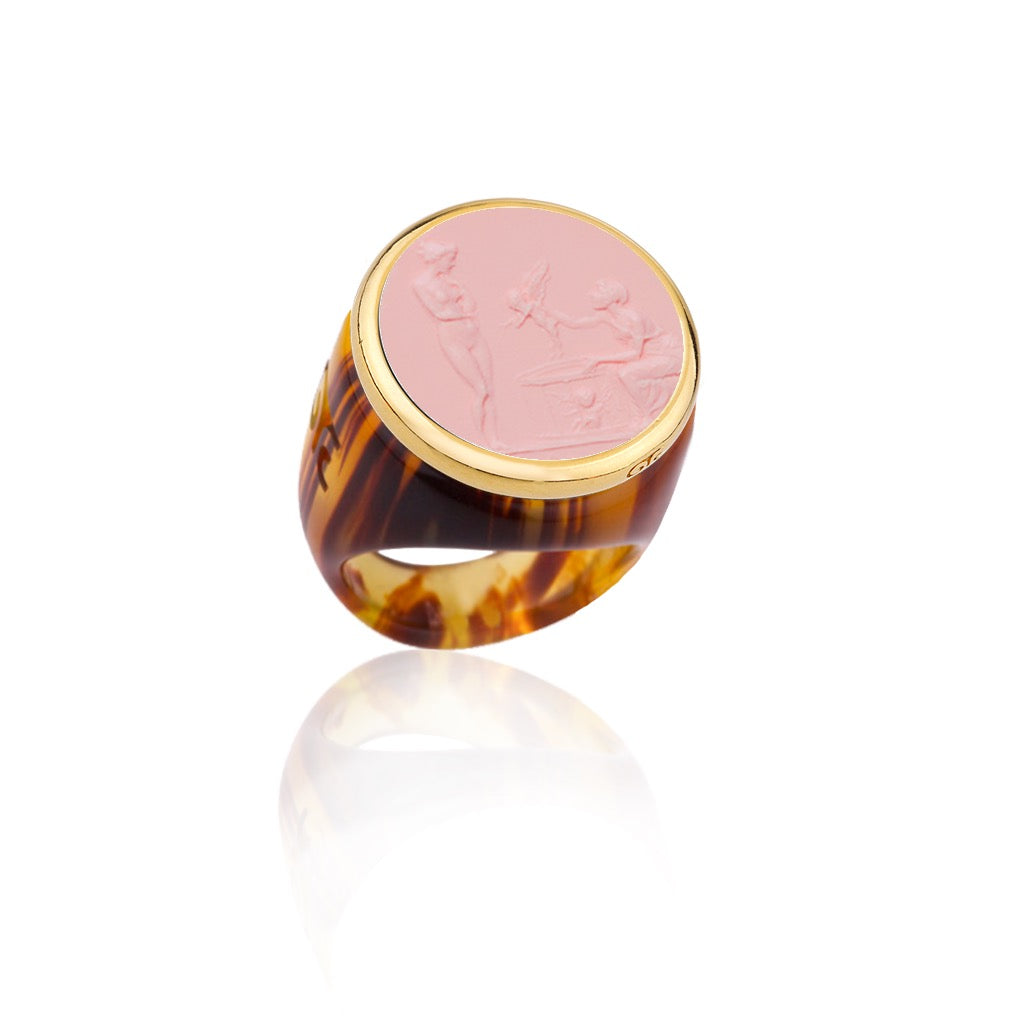

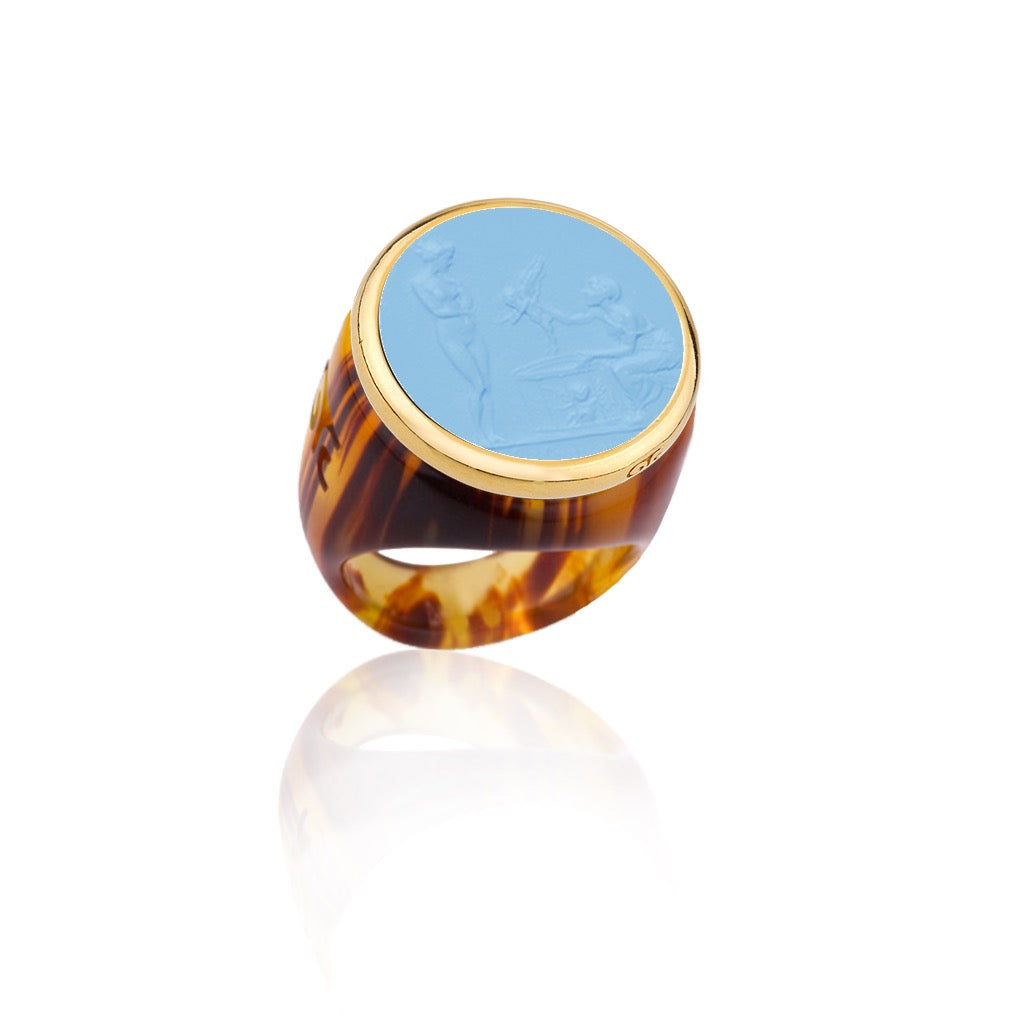
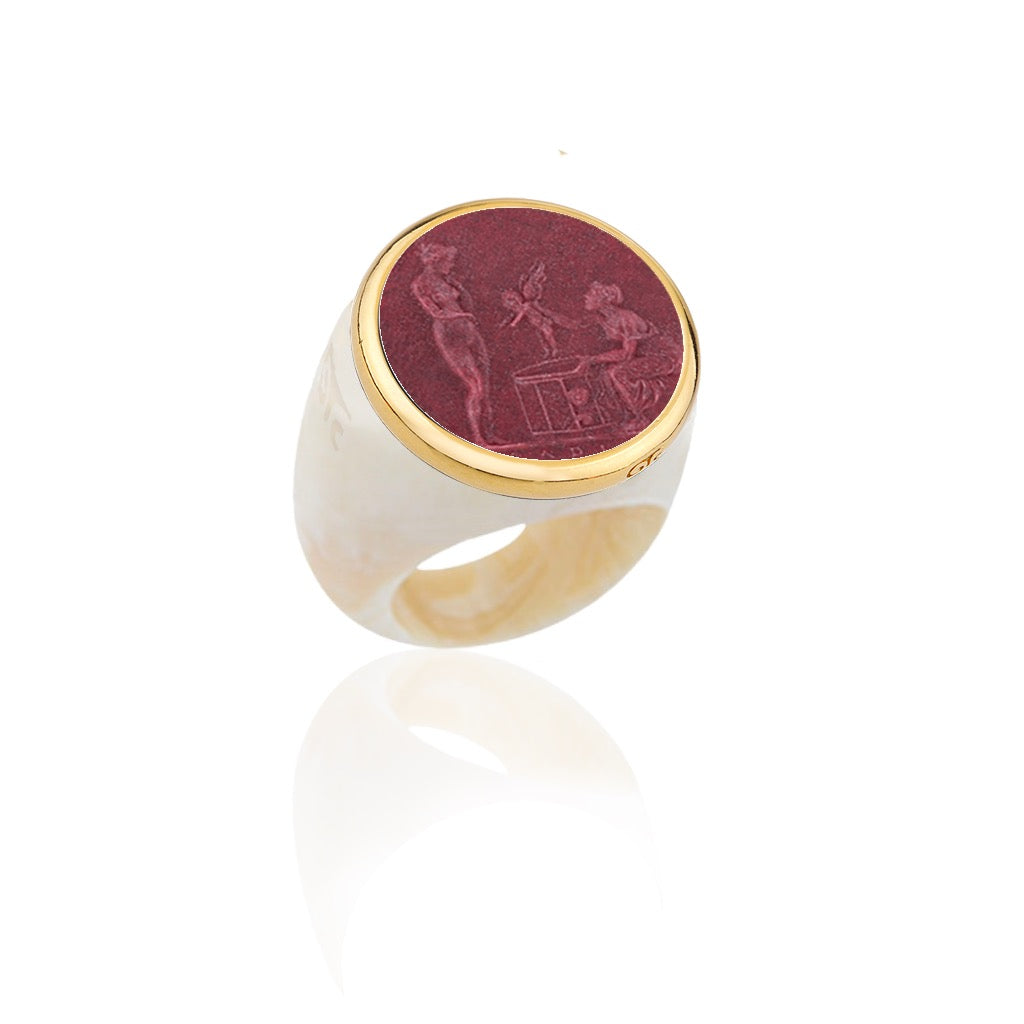
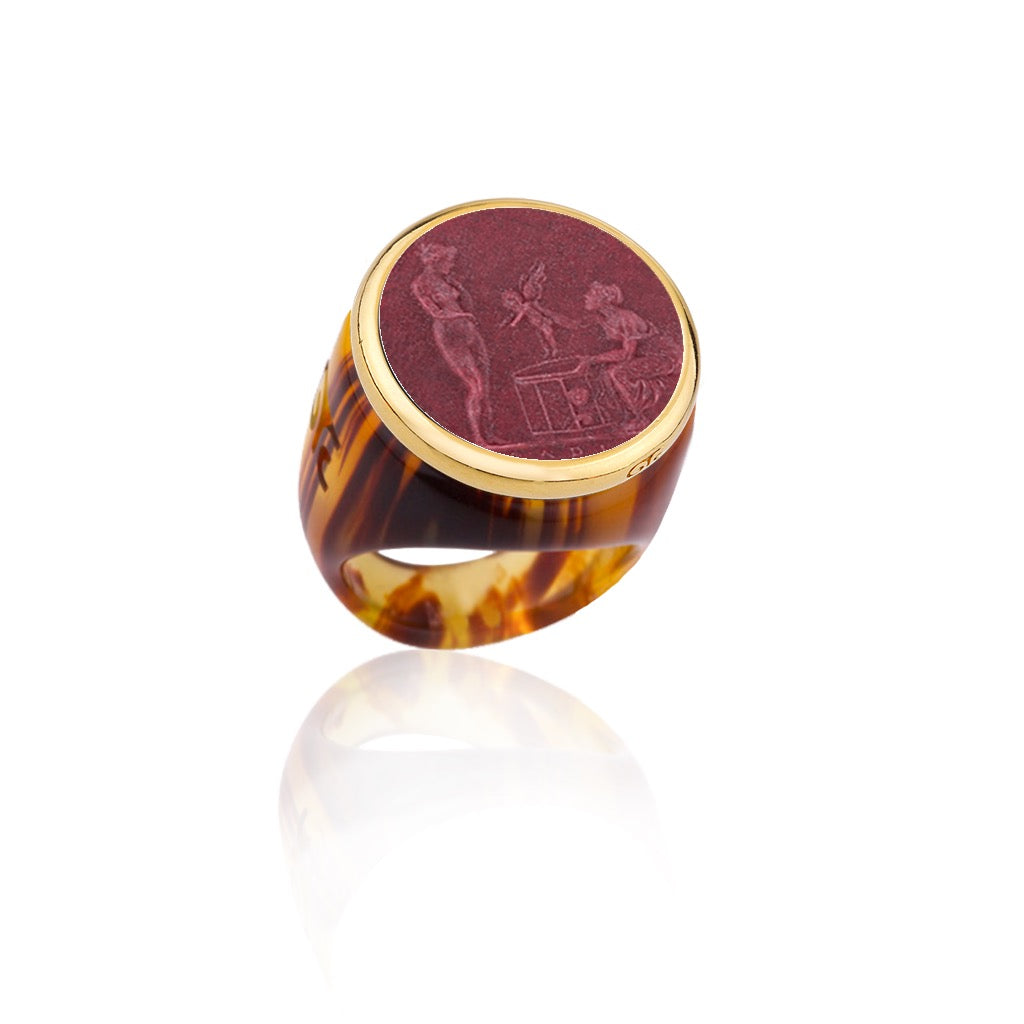

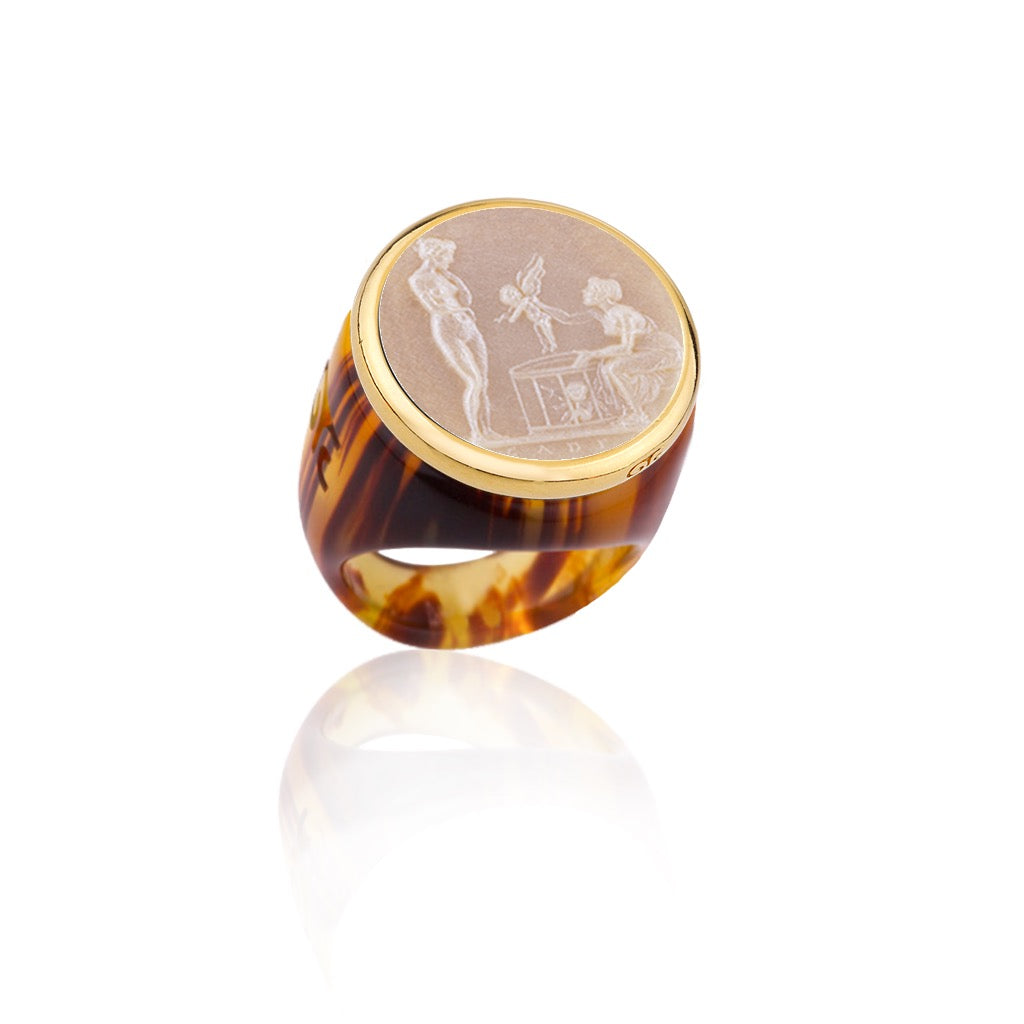


The fresco from Villa Arianna in Stabiae — a woman offering winged cupids as though they were precious fruit — finds in the round 18kt gold-plated bronze bezel the finesse of the cameo in its purest form. The collection's most delicate scene rests here on a plexiglass base that amplifies its grace: the weight is lighter, light entering where before there was only solid material. The carving is narrative — the cupid figures, the woman, the gesture of offering all reading with clarity. The relief is luminous and airy, shadows shifting with the light.
The round bezel distributes reflections evenly, the scene reading from every angle. The GTc signature is engraved on the bezel.
On transparent, the figures seem suspended in air — the gesture of offering becoming as light as the gift itself: light blue is the sky above Stabiae, morning air and the lightness of the cupids in flight; pearl is the quiet light of the ancient fresco, soft and warm, enhancing the sweetness of the composition; porphyry is imperial stone, dense and grounded, the depth of history; red is the vitality of affection, the glow of the love the vendor offers. On tortoiseshell, the veins of the plexiglass run differently in every piece — tight and warm as a sunset or soft and open, every ring unrepeatable: light blue vibrates among the natural tones; pearl illuminates them; porphyry deepens them; red warms them. On ivory, the pale warmth of the material brings the scene into a more intimate register — the gradations shifting in each piece: light blue fresh and luminous; pearl almost monochrome; porphyry decisive and present; red warm and close. Every combination renews the expression.
The grace of the offering — on an airy material that makes it more luminous still.
Notes importantes
Les couleurs des bijoux sur la photo peuvent différer légèrement de la réalité, en fonction de la résolution. Chaque objet est fait main et présente des caractéristiques uniques.Tableau des tailles

GUIDE DES TAILLES
Trouvez votre taille
Étapes simples pour mesurer la taille correcte de votre doigt :
- Mesurez votre doigt en fin de journée ;
- Ne mesurez pas la température de votre doigt lorsqu'il est trop chaud ou trop froid ;
- N'oubliez pas que nos mains ne sont pas identiques et qu'une bague qui peut aller à un doigt de notre main gauche peut ne pas aller au même doigt de notre main droite ;
- Veuillez vérifier que la taille choisie glisse bien sur toute la longueur de votre doigt.
Pour mesurer la circonférence de votre doigt, vous pouvez utiliser un mètre ruban de tailleur ou consulter notre vidéo de démonstration pour une autre méthode (qui nécessitera une bague à votre taille). Cette mesure correspond à la circonférence, que vous devez utiliser pour trouver votre taille de bague. (S - M - L - XL)
- Cliquez ici pour imprimer notre gabarit « Imprimer le gabarit ».
- Cliquez ici pour regarder une vidéo « Regarder la vidéo ».
| Taille | Italie | USA | France | Diamètre (mm) | Circonférence (mm) | Diamètre (pouces) | Circonférence (pouces) |
|---|---|---|---|---|---|---|---|
| S | 12 > 13 | 6 > 6,5 | 52 > 53 | 16,5 > 16,9 | 52 > 53 | 0,65 > 0,67 | 2,05 > 2,09 |
| M | 14 > 15 | 7 > 7 1/4 | 54 > 55 | 17,2 > 17,4 | 54 > 55 | 0,68 > 0,69 | 2,13 > 2,17 |
| L | 16 > 17 | 7,5 > 8 | 56 > 57 | 17,8 > 18,1 | 56 > 57 | 0,71 > 0,72 | 2,21 > 2,25 |
| XL | 18 > 19 | 8, 5 > 9 | 58 > 59 | 18,5 > 18,8 | 58 > 59 | 0,73 > 0,75 | 2,29 > 2,33 |
The Cupid Seller
Love isn't given. It's chosen.
The Villa Arianna is one of the oldest villas in Stabiae, dating from the second century BC. It is situated on the western hills of Varano, in a clifftop position overlooking the Bay of Naples. The exact extent of the villa may never be determined, as large parts of the rooms nearest the sea have collapsed down the cliff, but an initial survey carried out by tunnel in Bourbon times produced a plan which covered an area of over 2500 sq.m. Including the large palaestra to the west the total area must be in the order of 11,000 sq.m. Some of the most important frescoes of ancient Stabiae were found in the adjoining cubicula. Most of them were removed during the Bourbon period and can now be seen in the National Archaeological Museum of Naples. They include frescoes of Medea, Leda and the Swan, Flora (pictured above right) and the Cupid Vendor , which depicts a seated matron, to whom an elderly courtesan seated opposite proffers a winged Cupid, lifted from a birdcage by the wings. National Archaeological Museum - Naples.
Afficher tous les produits- Le choix d’une sélection entraîne une actualisation complète de la page.