
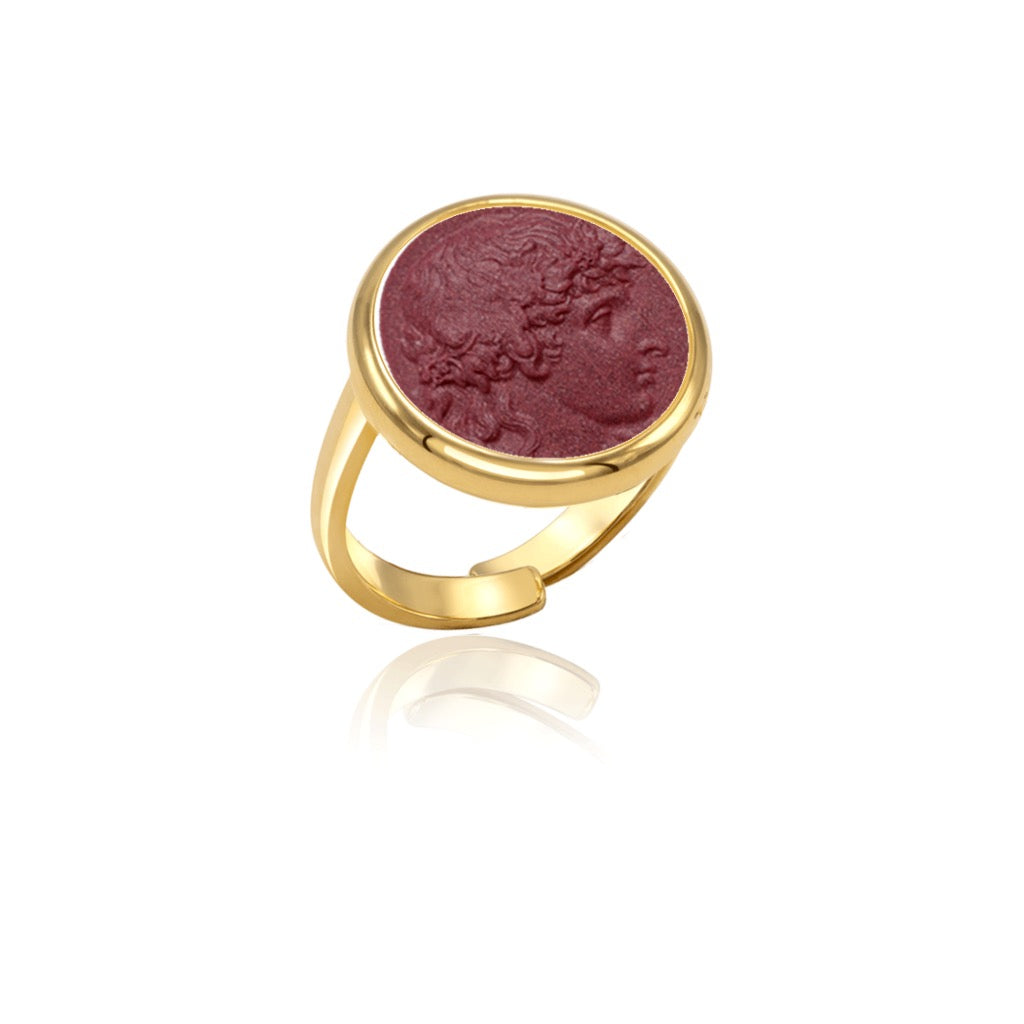
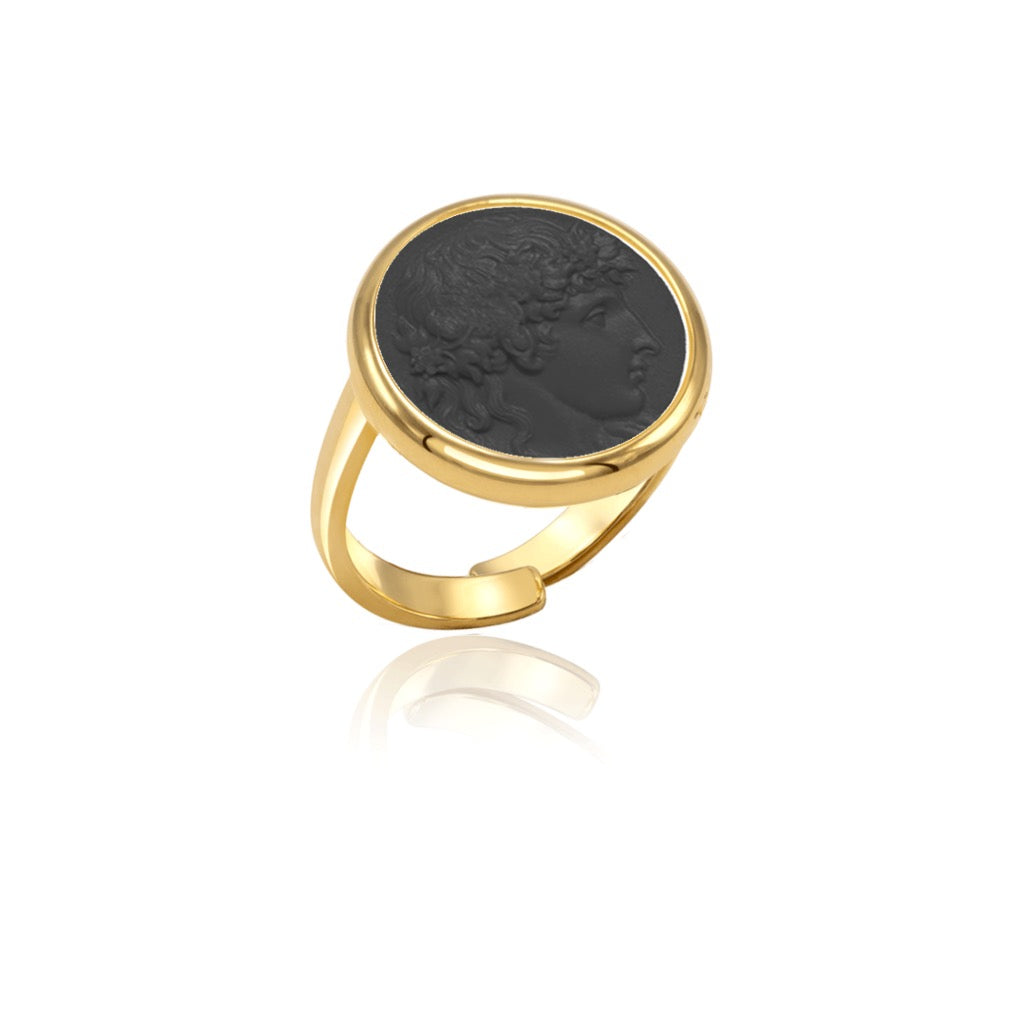

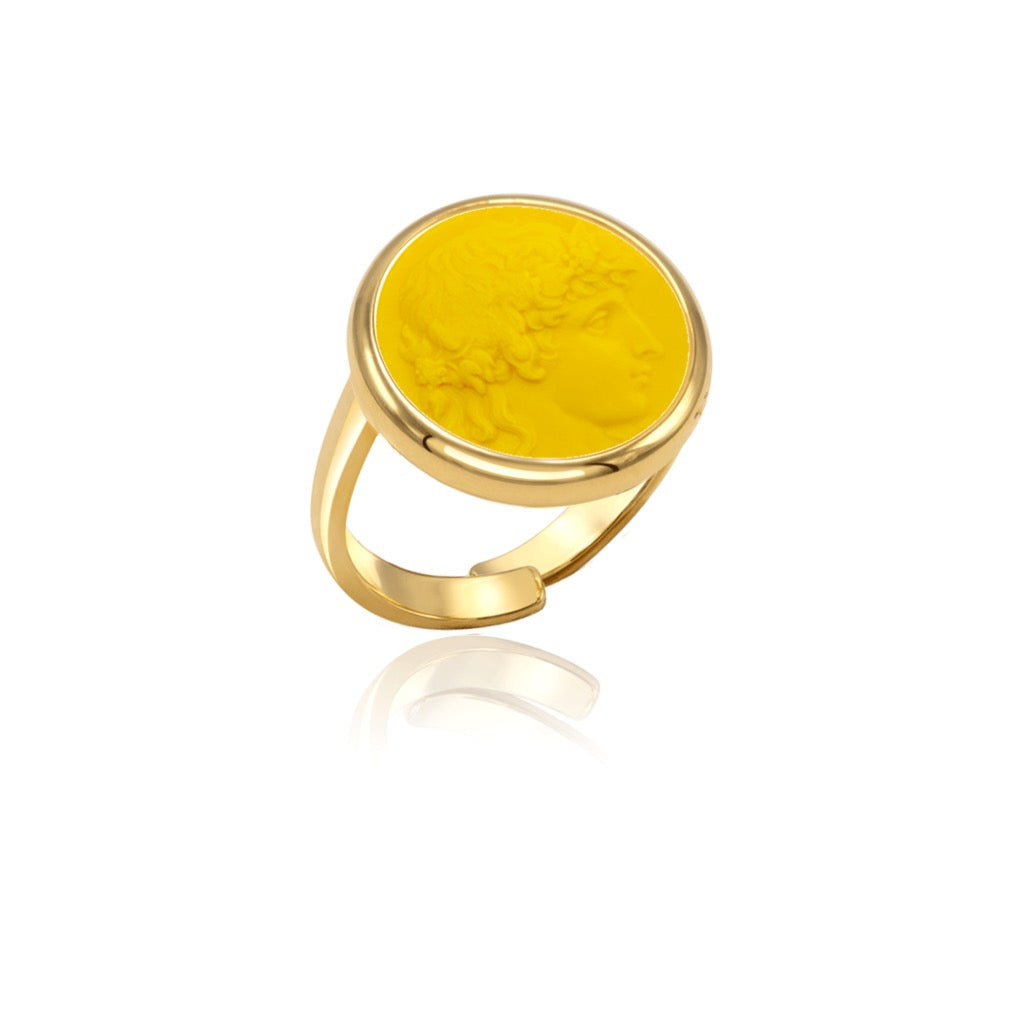


ANTINOUS — A FACE THAT WAS ALWAYS GOING TO LAST Some faces last. Antinous is one of them. In this jewel his face is framed with absolute precision — held in the bezel as if the bronze was always waiting for him. Emperor Hadrian wanted that profile carried forward in every form, and every iconography dedicated to him has kept the memory vivid. Softly curling hair, a composed chin, a gaze that is open and entirely at ease with itself. Each time you look, there is something new to find. The EOS ring starts from a precise idea: make the ring disappear and let the subject emerge. The open shank is not a compromise — it is a design decision. No fixed size because every hand is different; the metal adapts, not the other way around. The EOS ring brings this subject to the finger in its most essential form. The shank is crafted to disappear to the touch: the outer surface gently domed, the inner core perfectly smooth and flat — made for a fit that never tires the hand. The metal's embrace adjusts: widen or close it with a single gesture, move it between fingers with complete freedom. The same face, read differently with each colour. Sky blue releases a luminous clarity — the profile emerges fresh, immediate, precise. Yellow quickens it: the contrast between an ancient subject and a vivid contemporary colour creates a beautiful, unexpected tension. Black brings the face to its purest form — every line of the carving defining itself, absolute. Porphyry recalls the imperial stone of Rome: warm, dense, precious in tone. Four variants, one identity. There is something in this profile — a self-possession carried quietly, a beauty that tells its own story — that finds new words each time.
Important Notes
The jewels' colors in the photo may look different from the original one. This depends from the resolution. Each object is handmade and has unique characteristics.Size chart

SIZE GUIDE
Find your size
Simple steps to measure the correct size of your finger:
- Measure your finger at the end of the day;
- Do not measure your finger when it is either too hot or too cold;
- Don’t forget that our hands are not identical, and that a ring that might fit on a finger on our left hand might not fit on the same finger on our right hand;
- Please be sure to check that your selected size slides along the full length of your finger.
To measure the circumference of your finger, you can use a taylor’s tape measure, or take a look at our video demonstration for another technique (which will require a ring that fits on your selected finger.) This size corresponds to the circumference, which you must use to find your corresponding appropriate size. (S - M - L - XL)
| Size | Italy | USA | France | Diameter (mm) | Circumference (mm) |
|---|---|---|---|---|---|
| S | 12 > 13 | 6 > 6,5 | 52 > 53 | 16,5 > 16,9 | 52 > 53 |
| M | 14 > 15 | 7 > 7 1/4 | 54 > 55 | 17,2 > 17,4 | 54 > 55 |
| L | 16 > 17 | 7,5 > 8 | 56 > 57 | 17,8 > 18,1 | 56 > 57 |
| XL | 18 > 19 | 8, 5 > 9 | 58 > 59 | 18,5 > 18,8 | 58 > 59 |
| 2XL | 20 | 9 | 60 | 19,1 | 60 |
| 3XL | 22 | 10 | 62 | 19,7 | 62 |
| 4XL | 24 | 10 3/4 | 64 | 20,4 | 64 |
| 5XL | 26 | 11 3/4 | 66 | 21 | 66 |
Antinous
Love remembered is never lost.
Antinous (also Antinoo or Antinoös; 27 November, c. 111 – before 30 October 130) was a Bithynian Greek youth and a favourite, or lover, of the Roman emperor Hadrian. He was deified after his death, being worshiped in both the Greek East and Latin West, sometimes as a god (theos) and sometimes merely as a deified mortal (heros). Antinous became associated with homosexuality in Western culture, appearing in the work of Oscar Wilde and the Portuguese poet Fernando Pessoa.
Show all products- Choosing a selection results in a full page refresh.