
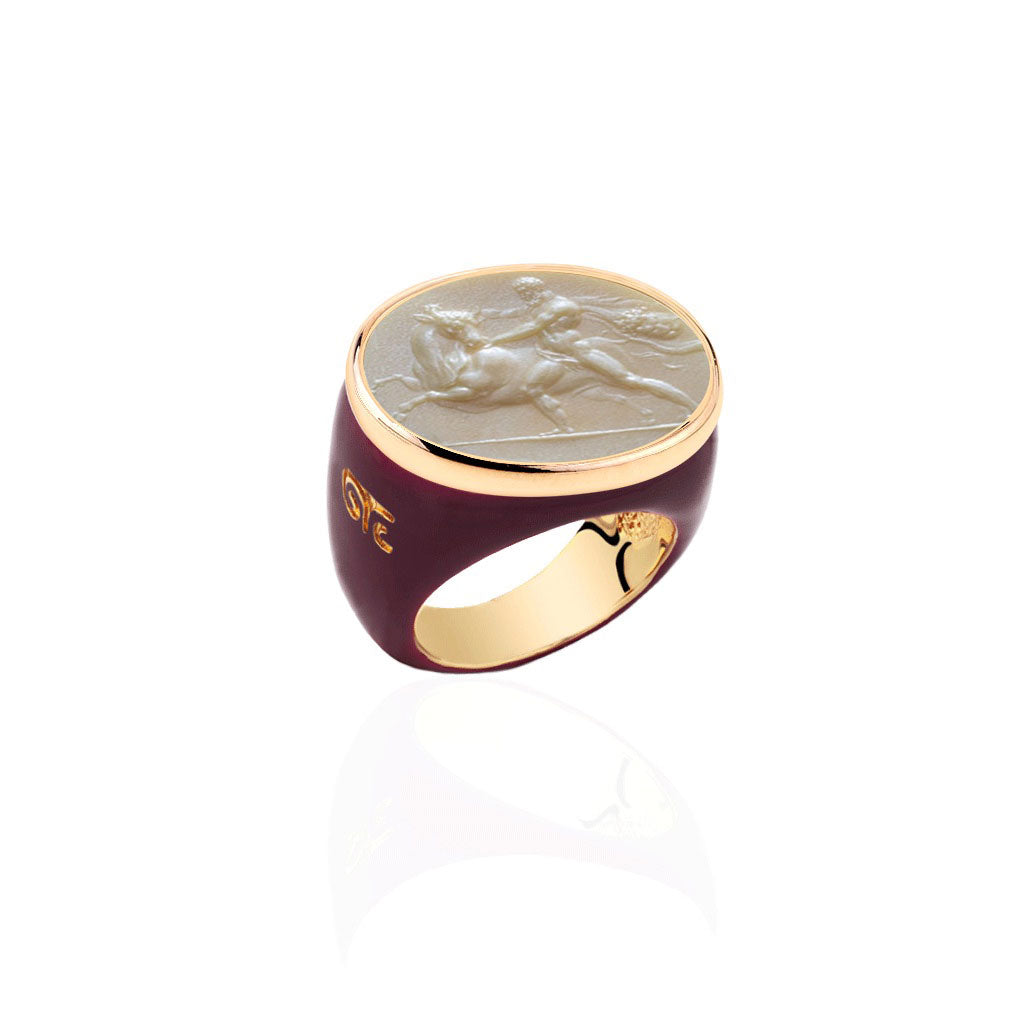
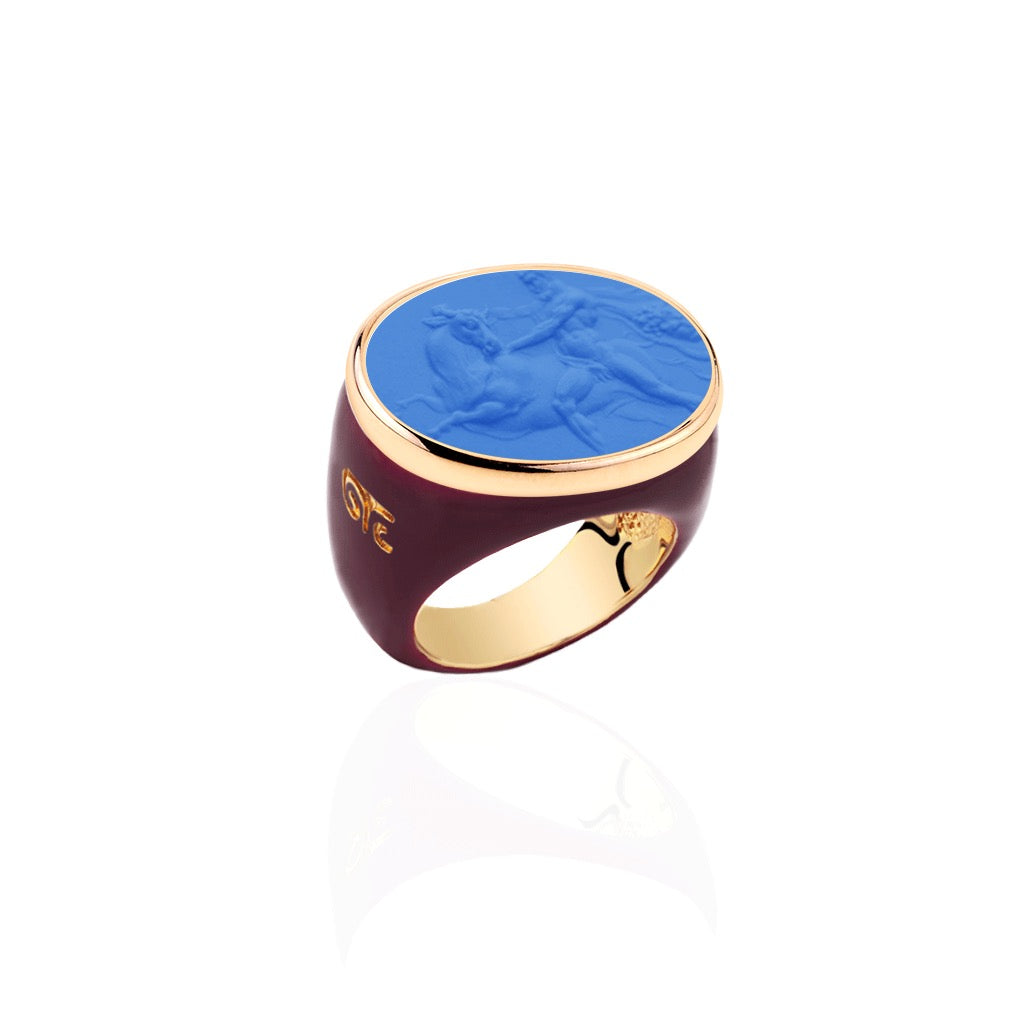
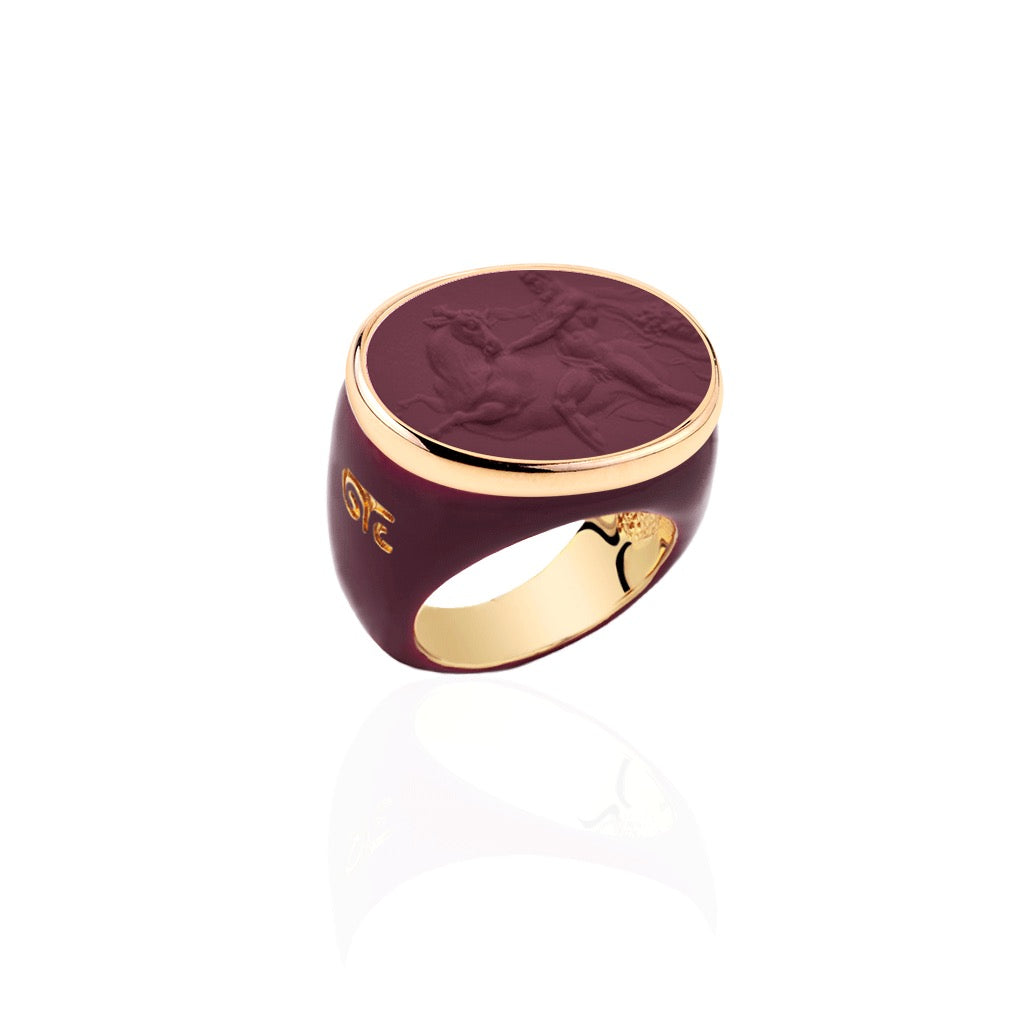
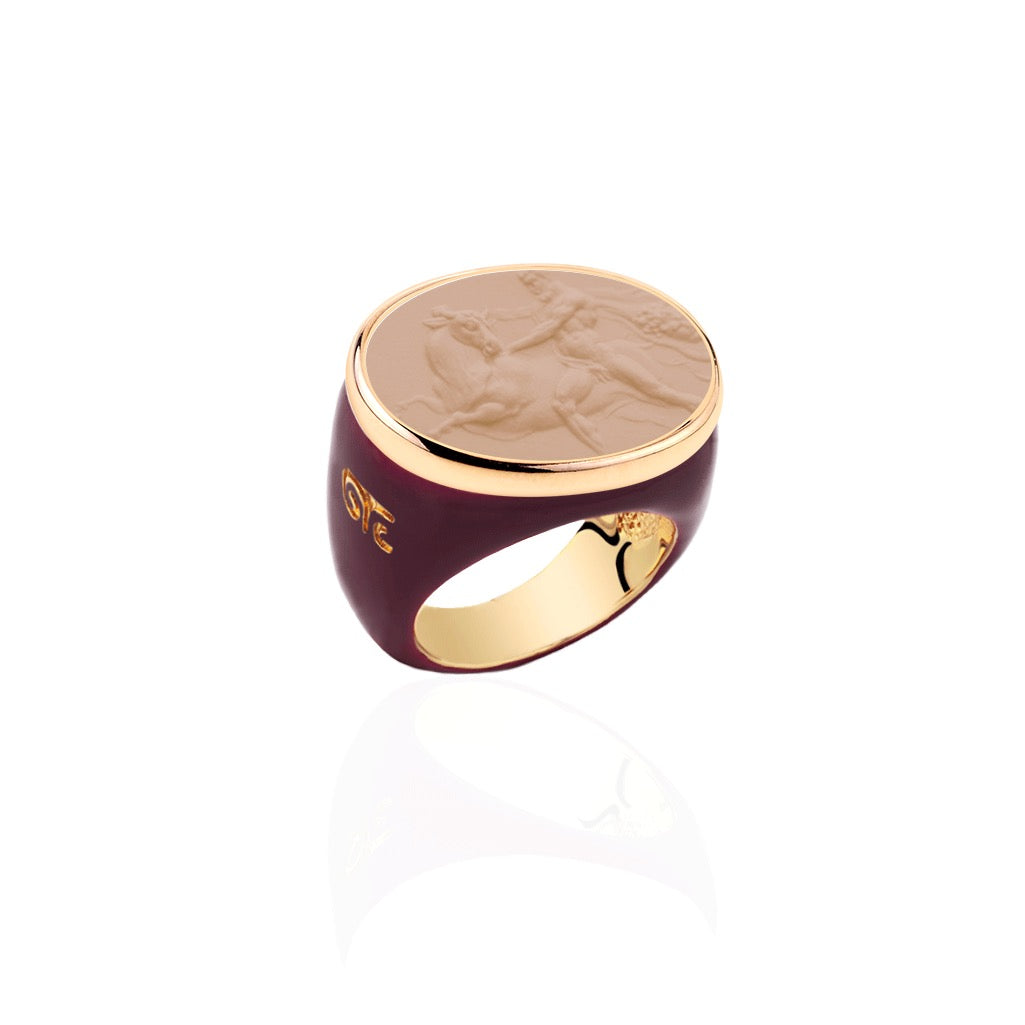
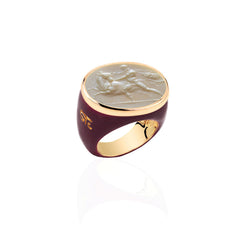
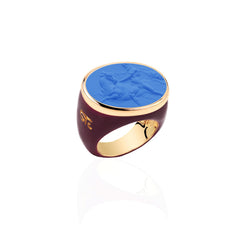
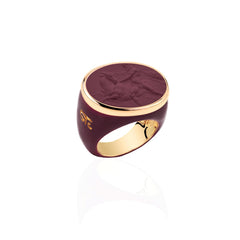
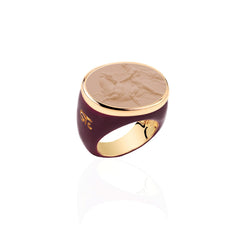
On this base every detail takes on a different resonance. Two figures in the oval bezel of this ring, in motion — the volumes seek each other, gliding across the bordeaux, one toward the other. The relief is dense and full, traced with fluid and precise strokes. The enamel coating the bronze contains them in the gilded bezel and lends the scene its warmth. Hercules and the Bull.
The story speaks of strategy — the ability to steer what seems untameable through tactics and knowledge. The bull in the end is free, and the myth continues. On bordeaux this story grows denser, more intense. The two figures tell you something you can feel. The greatest strength is always when the body is guided by the mind.
The Lumen ring carries this scene with the substance it deserves — the oval bezel, the deep and brilliant enamel, the bronze you feel in your hand. The form of the ring follows the dynamism of the two figures, and the bordeaux draws everything toward the centre, toward the gesture. A solid weight, concrete, like the story itself.
Light Blue is the boldest combination — engaging, decisive, it catches the eye at once. Pearl illuminates: softer, more luminous — the two figures in full relief, the rhythm of the scene entirely readable. With Porphyry the cameo almost merges with the base — the figures emerge through relief alone. Sand brings warmth on warmth — the earthy, porous relief against the deep, glossy ground: two materials the hand recognises before the eye.
Notas importantes
The jewels' colors in the photo may look different from the original one. This depends from the resolution. Each object is handmade and has unique characteristics.Tabla de tallas

SIZE GUIDE
Find your size
Simple steps to measure the correct size of your finger:
- Measure your finger at the end of the day;
- Do not measure your finger when it is either too hot or too cold;
- Don’t forget that our hands are not identical, and that a ring that might fit on a finger on our left hand might not fit on the same finger on our right hand;
- Please be sure to check that your selected size slides along the full length of your finger.
To measure the circumference of your finger, you can use a taylor’s tape measure, or take a look at our video demonstration for another technique (which will require a ring that fits on your selected finger.) This size corresponds to the circumference, which you must use to find your corresponding appropriate size. (S - M - L - XL)
| Size | Italy | USA | France | Diameter (mm) | Circumference (mm) |
|---|---|---|---|---|---|
| S | 12 > 13 | 6 > 6,5 | 52 > 53 | 16,5 > 16,9 | 52 > 53 |
| M | 14 > 15 | 7 > 7 1/4 | 54 > 55 | 17,2 > 17,4 | 54 > 55 |
| L | 16 > 17 | 7,5 > 8 | 56 > 57 | 17,8 > 18,1 | 56 > 57 |
| XL | 18 > 19 | 8, 5 > 9 | 58 > 59 | 18,5 > 18,8 | 58 > 59 |
| 2XL | 20 | 9 | 60 | 19,1 | 60 |
| 3XL | 22 | 10 | 62 | 19,7 | 62 |
| 4XL | 24 | 10 3/4 | 64 | 20,4 | 64 |
| 5XL | 26 | 11 3/4 | 66 | 21 | 66 |
Hercules and the bull
Face challenges head-on.
The mythological hero Hercules (or Herakles) was famed for his great strength and endurance and celebrated as an extraordinary mortal who, through success in seemingly impossible labors, won his immortal place amongst the Olympian gods. Being the greatest of Greek mythological heroes, he has been ascribed a multitude of adventures and heroic exploits over the centuries which were probably originally connected to lesser, more local figures. In mythology it was Zeus who lay with Alkmene and so fathered Hercules, explaining the origin of Hercules’ great strength. Hera, the wife of Zeus, was (understandably) always jealous of Hercules and made life difficult for him from an early age. The goddess delayed his birth so that his cousin Eurystheus would be born first and so become the ruler of Greece according to Zeus’ decree. Hera also sent two snakes to kill the newborn Hercules, but the baby easily strangled them. Hercules enjoyed divine favour from the Olympian gods and he was particularly favoured by Athena. Hercules, Naples, National Archaeological Museum.
Show all products- Al elegir una selección, se actualiza la página completa.