

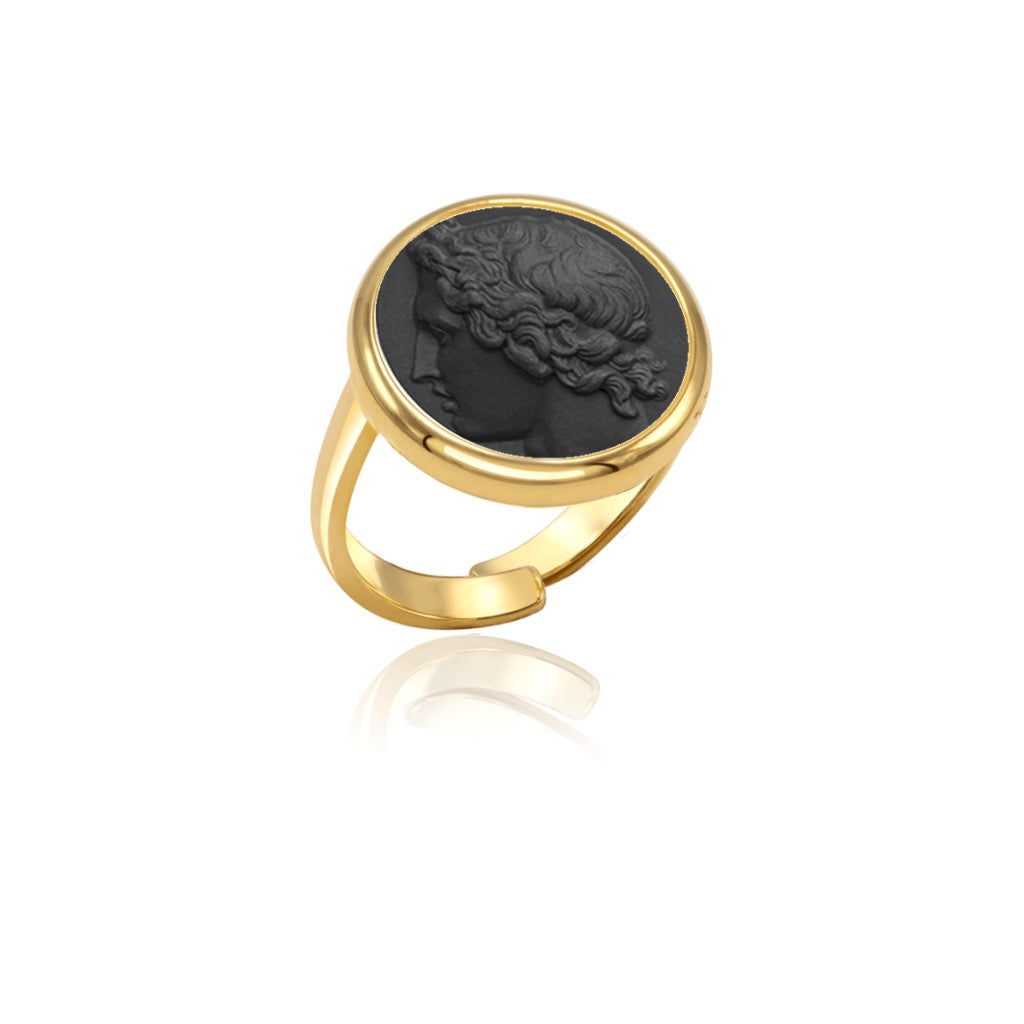


Pollux — son of Zeus, Olympic champion of boxing, an athlete who carries strength with grace. The intaglio on the round EOS bezel portrays him in profile: the curly, abundant hair moving around the face, the firm chin, the young features of the Dioscurus at the height of his vigour. An essential and harmonious ring, designed as a single lost-wax bronze casting, flexible and adaptable — it sits on any finger with a single gesture. The clean simplicity of this form enhances an intaglio of Canovian refinement: the burnished bronze, with its luminous gilding, brings every line of the profile into full light, and the whole essence of Pollux emerges from that bezel. The myths of Castor and Pollux are many — all of them orbit the same centre: absolute loyalty, the bond that holds under any condition. Inseparable brothers, protectors of those at sea, invoked in every moment that called for courage and faithfulness. The Dioscuri embody the union that classical culture always wished to celebrate. The star of the Gemini in the sky of Rome. Blue: the depth of the night sky — the Dioscurus in his stellar dimension, the portrait acquiring the distance of a constellation and its dwelling. Black: every curl stands sharp, the profile becomes a coin — the most precise definition of this face. Red: fire and resolve, the divine boxer in his colour, a boldness that declares and warms. Green: ancient serpentine, the deep-rooted strength that endures the centuries. Pollux on the finger — a jewel that perfectly describes the synthesis between the vigour of ancient sculpture and the freshness of a vision that honours simplicity and nobility of character.
Notas importantes
The jewels' colors in the photo may look different from the original one. This depends from the resolution. Each object is handmade and has unique characteristics.Tabla de tallas

SIZE GUIDE
Find your size
Simple steps to measure the correct size of your finger:
- Measure your finger at the end of the day;
- Do not measure your finger when it is either too hot or too cold;
- Don’t forget that our hands are not identical, and that a ring that might fit on a finger on our left hand might not fit on the same finger on our right hand;
- Please be sure to check that your selected size slides along the full length of your finger.
To measure the circumference of your finger, you can use a taylor’s tape measure, or take a look at our video demonstration for another technique (which will require a ring that fits on your selected finger.) This size corresponds to the circumference, which you must use to find your corresponding appropriate size. (S - M - L - XL)
| Size | Italy | USA | France | Diameter (mm) | Circumference (mm) |
|---|---|---|---|---|---|
| S | 12 > 13 | 6 > 6,5 | 52 > 53 | 16,5 > 16,9 | 52 > 53 |
| M | 14 > 15 | 7 > 7 1/4 | 54 > 55 | 17,2 > 17,4 | 54 > 55 |
| L | 16 > 17 | 7,5 > 8 | 56 > 57 | 17,8 > 18,1 | 56 > 57 |
| XL | 18 > 19 | 8, 5 > 9 | 58 > 59 | 18,5 > 18,8 | 58 > 59 |
| 2XL | 20 | 9 | 60 | 19,1 | 60 |
| 3XL | 22 | 10 | 62 | 19,7 | 62 |
| 4XL | 24 | 10 3/4 | 64 | 20,4 | 64 |
| 5XL | 26 | 11 3/4 | 66 | 21 | 66 |
Pollux
Stay loyal to all around.
One of the Dioscuri, sons of Zeus and Leda, excellent boxer. When his brother Castor, tamer of horses and a mortal, was wounded, Pollux begged Zeus to let him die or to also give immortality to his brother. Jove gave them permission to be together forever, half of their time in to the underworld and half with the gods on Mount Olympus. According to legend, the Dioscuri were transformed by Zeus in to the constellation Gemini. On the Quirinal hill in the fourth century BC the temple of the god Quirinus was built, god of the Romans organized in curiae, which gave the name to the hill. The most impressive appearances on the hill were certainly those of the baths of Constantine and the temple of Serapis, built by Caracalla in 217 d. C. From the ancient Roman temple come the sculptures of the Dioscuri, whose constant presence on the Quirinal hill led to its being called Monte Cavallo.
Show all products- Al elegir una selección, se actualiza la página completa.