
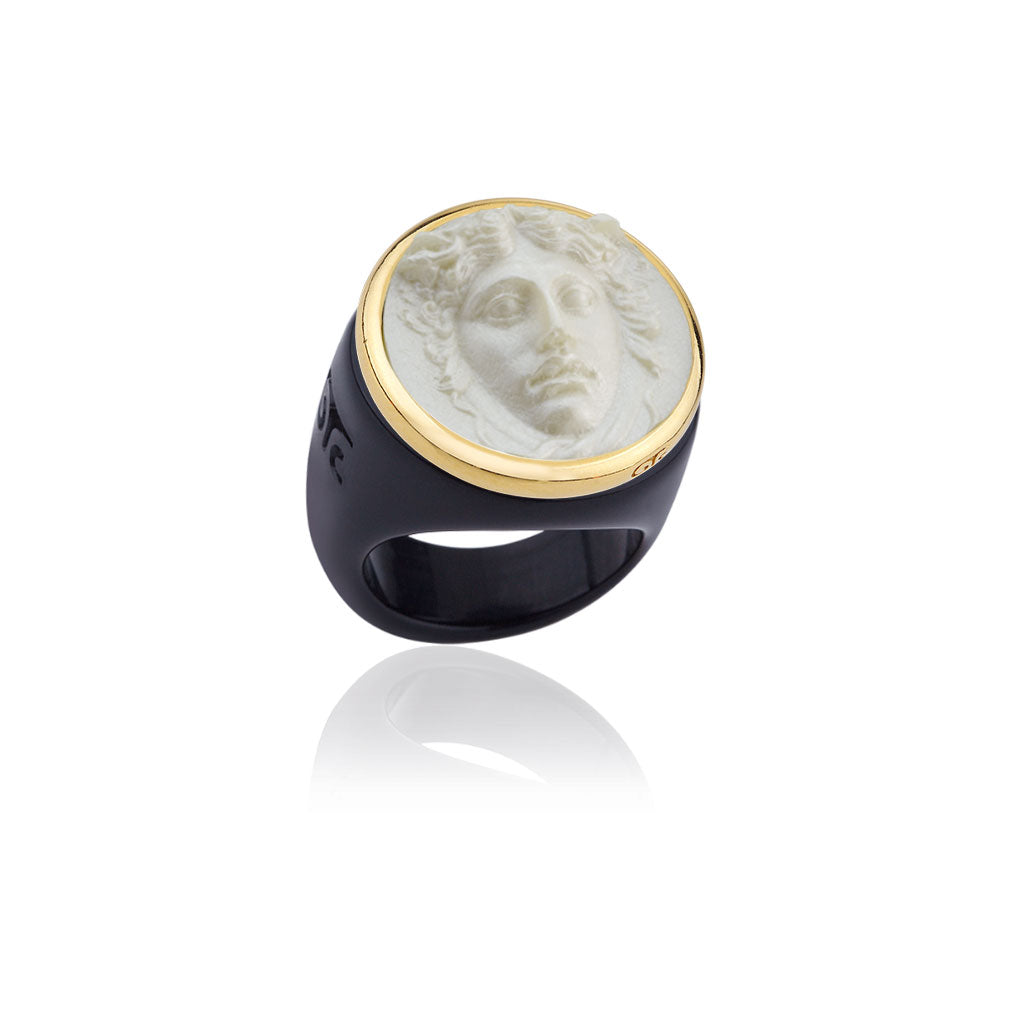
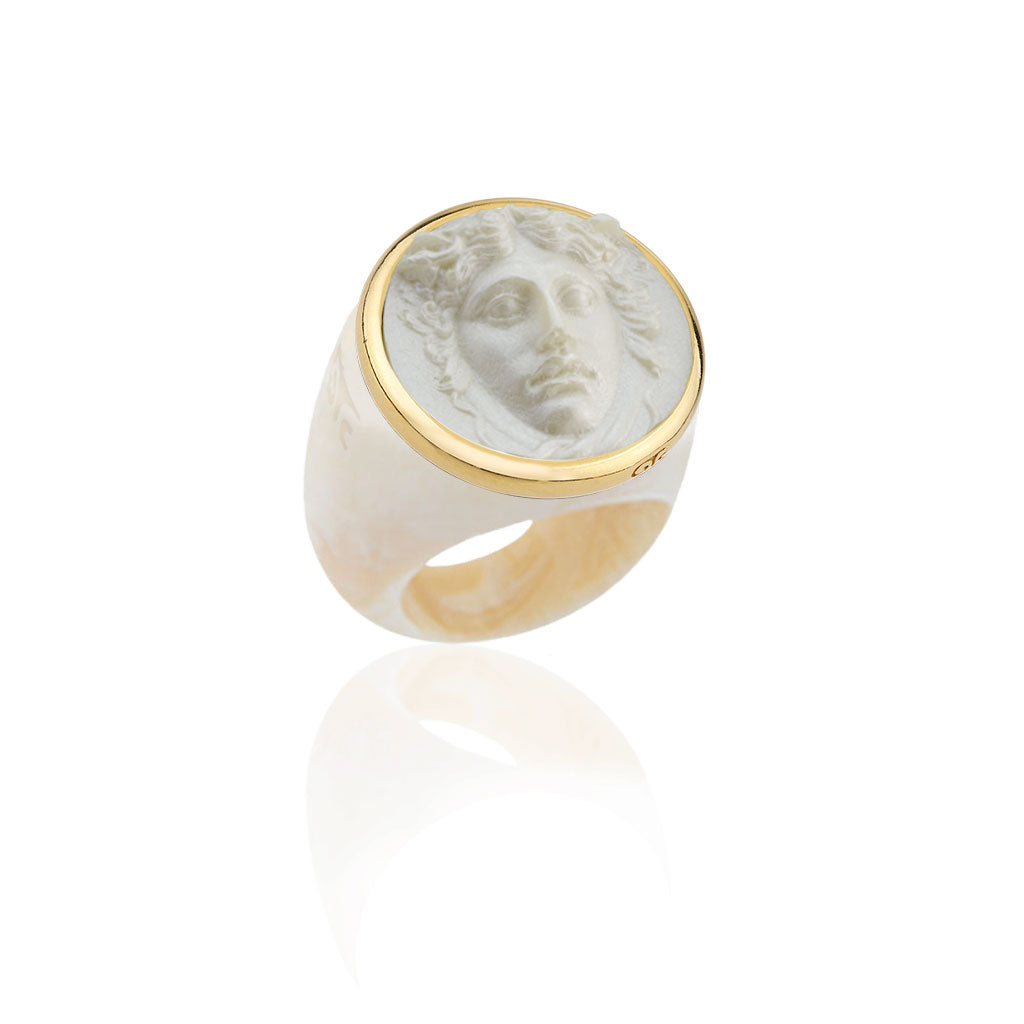
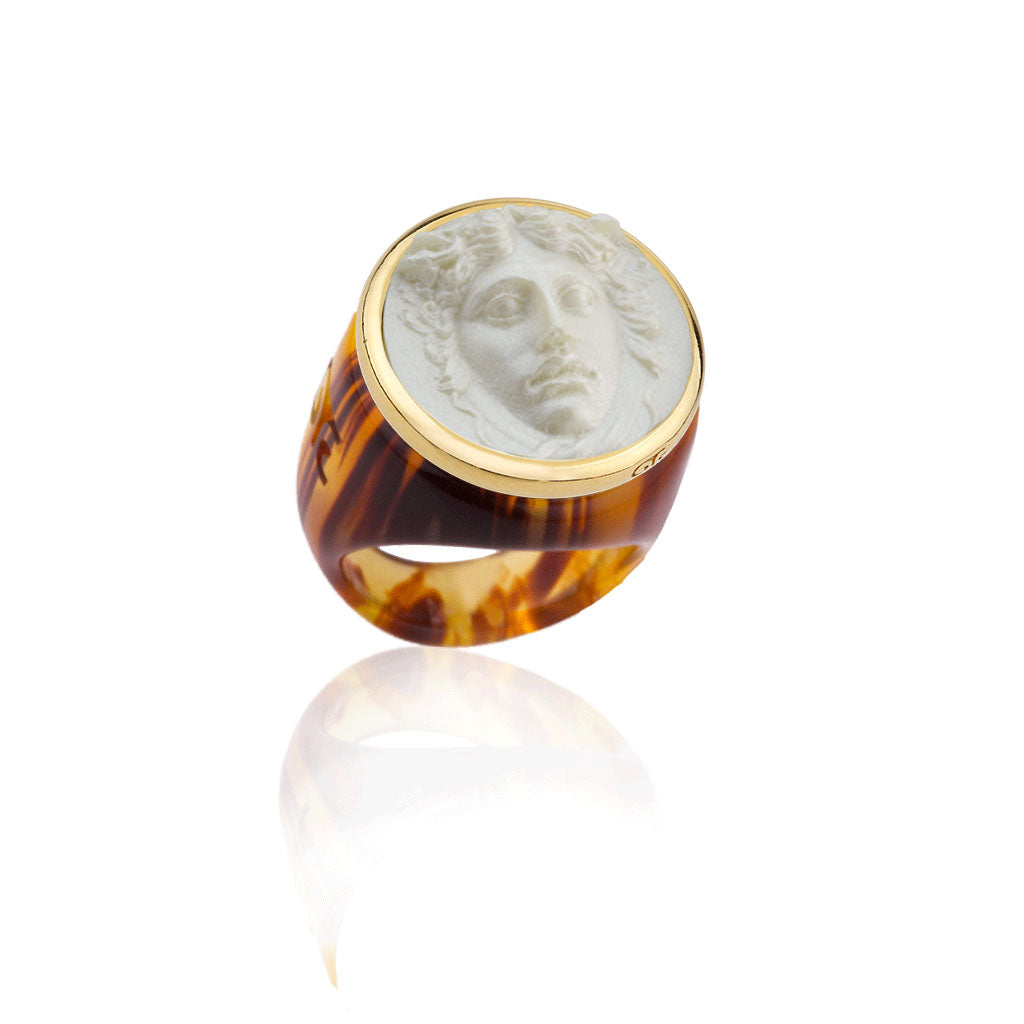
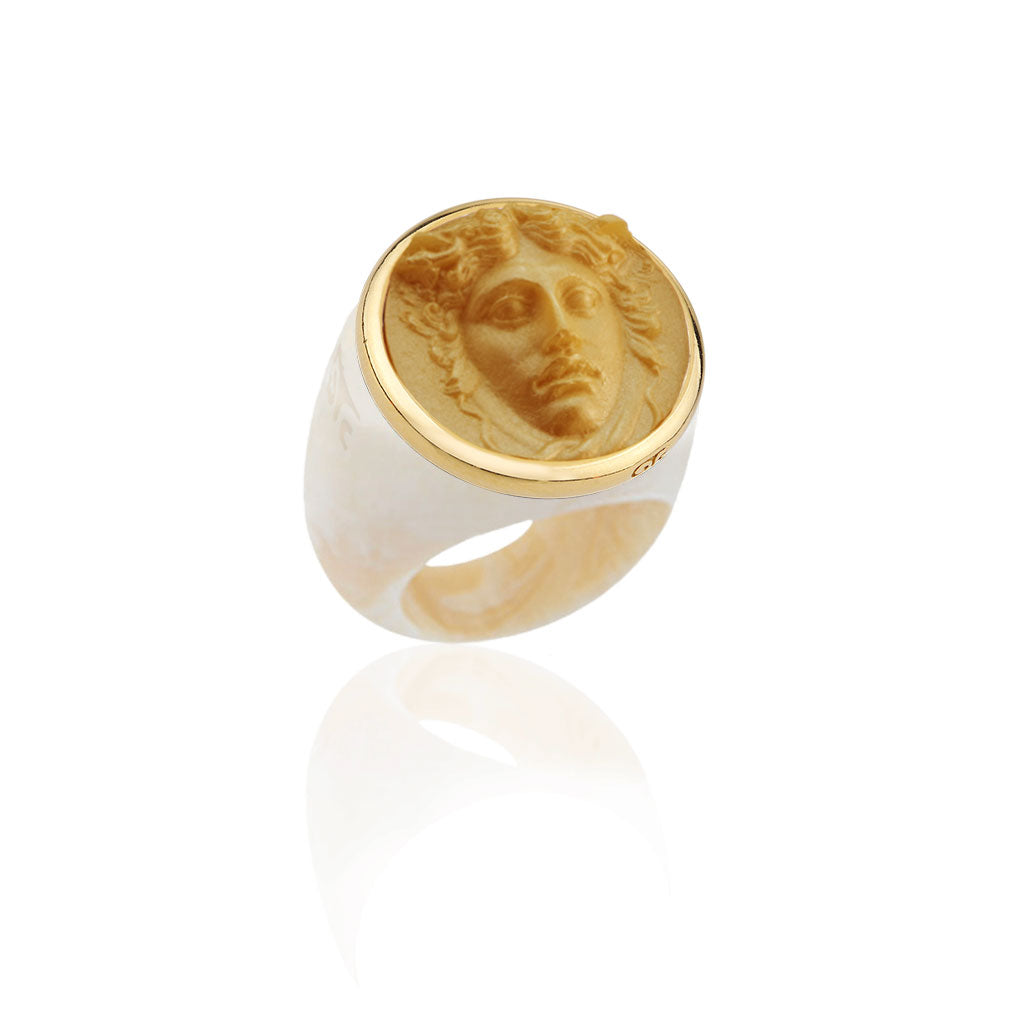
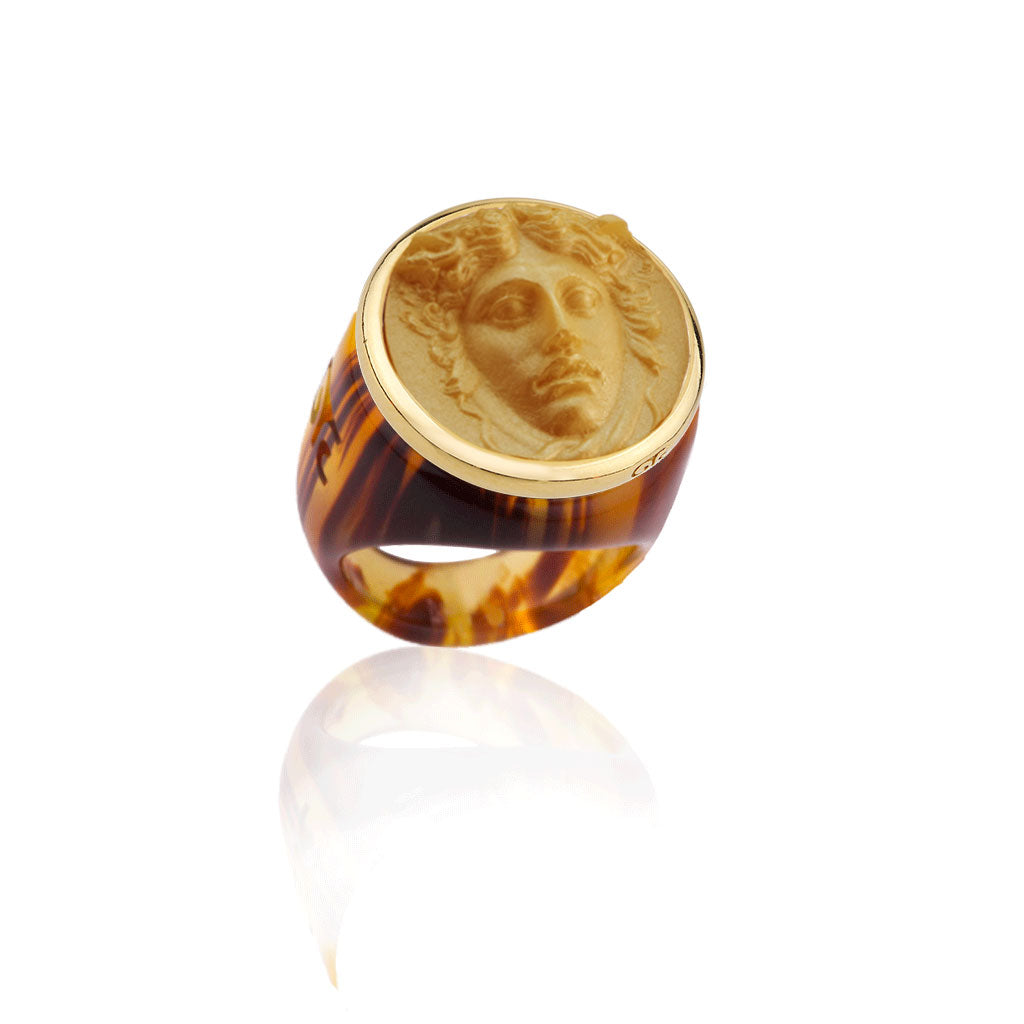
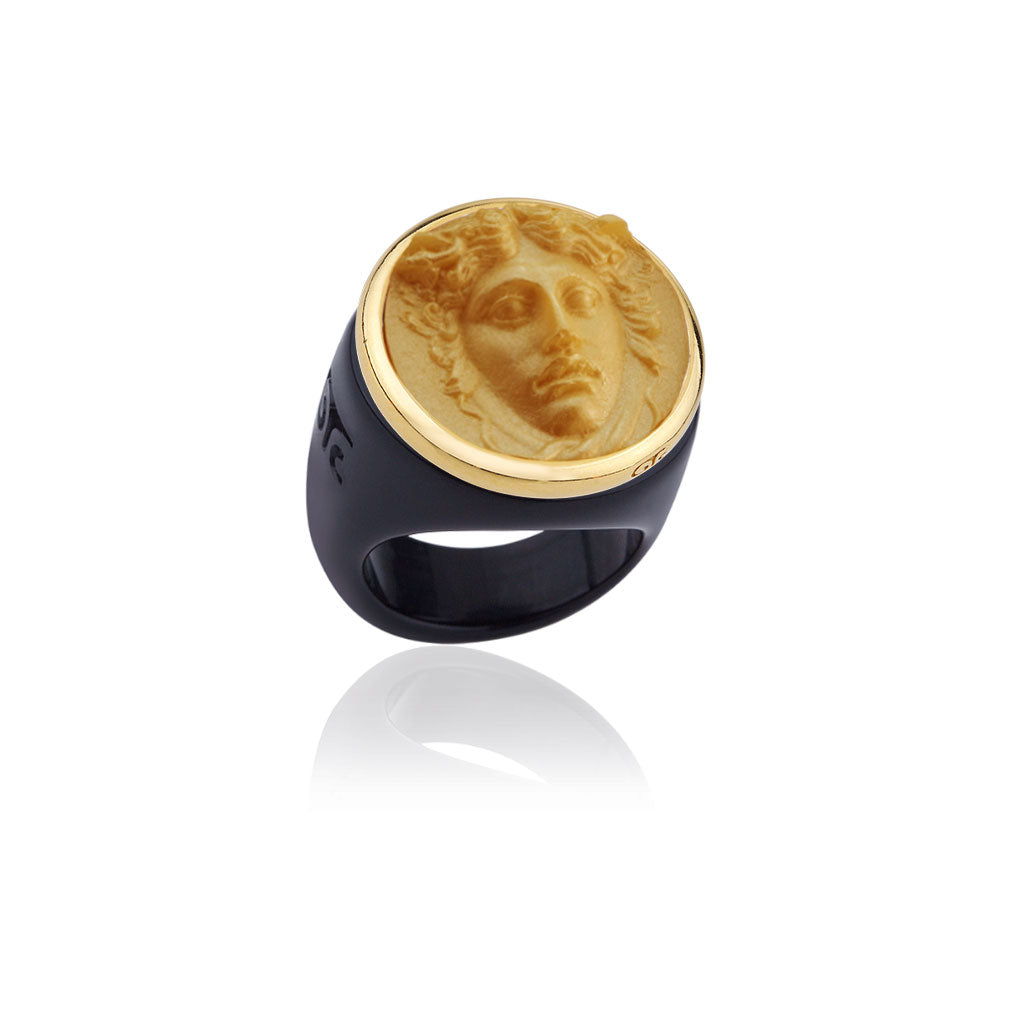
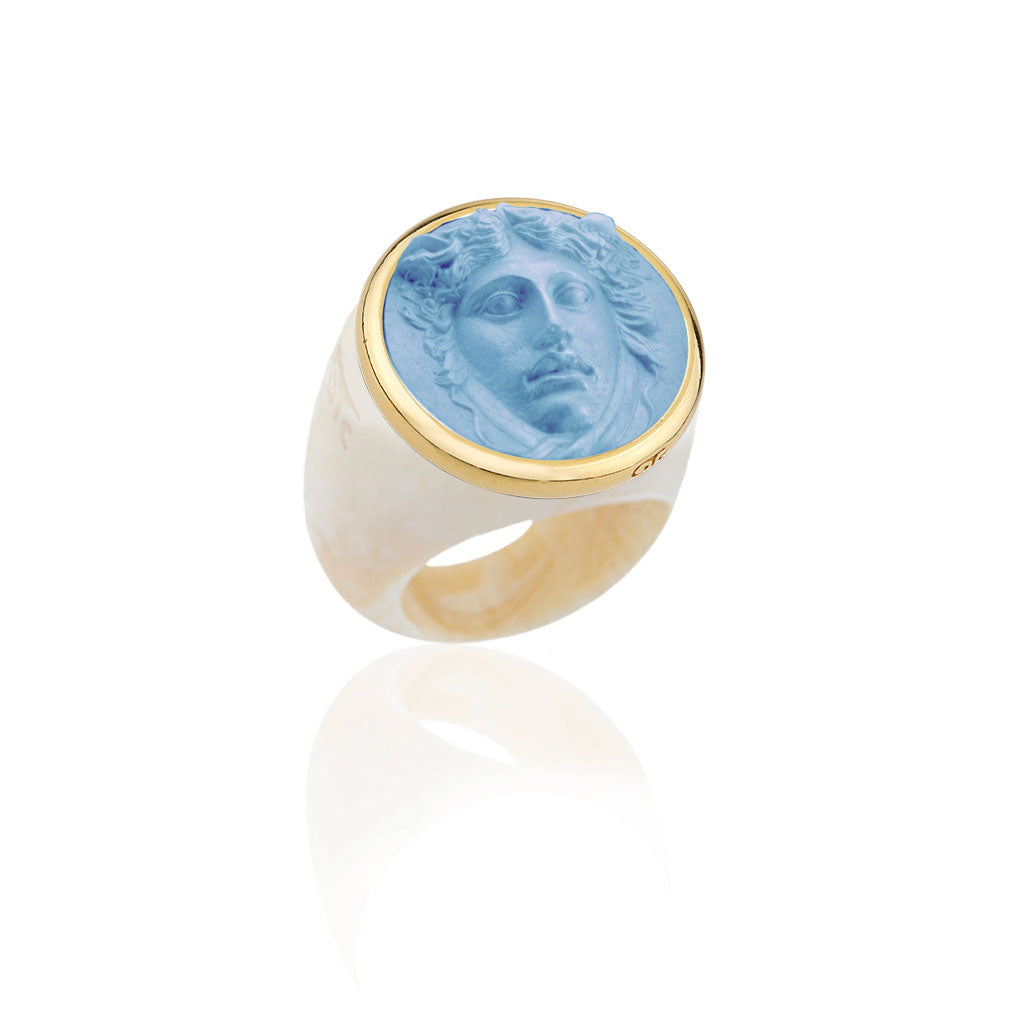
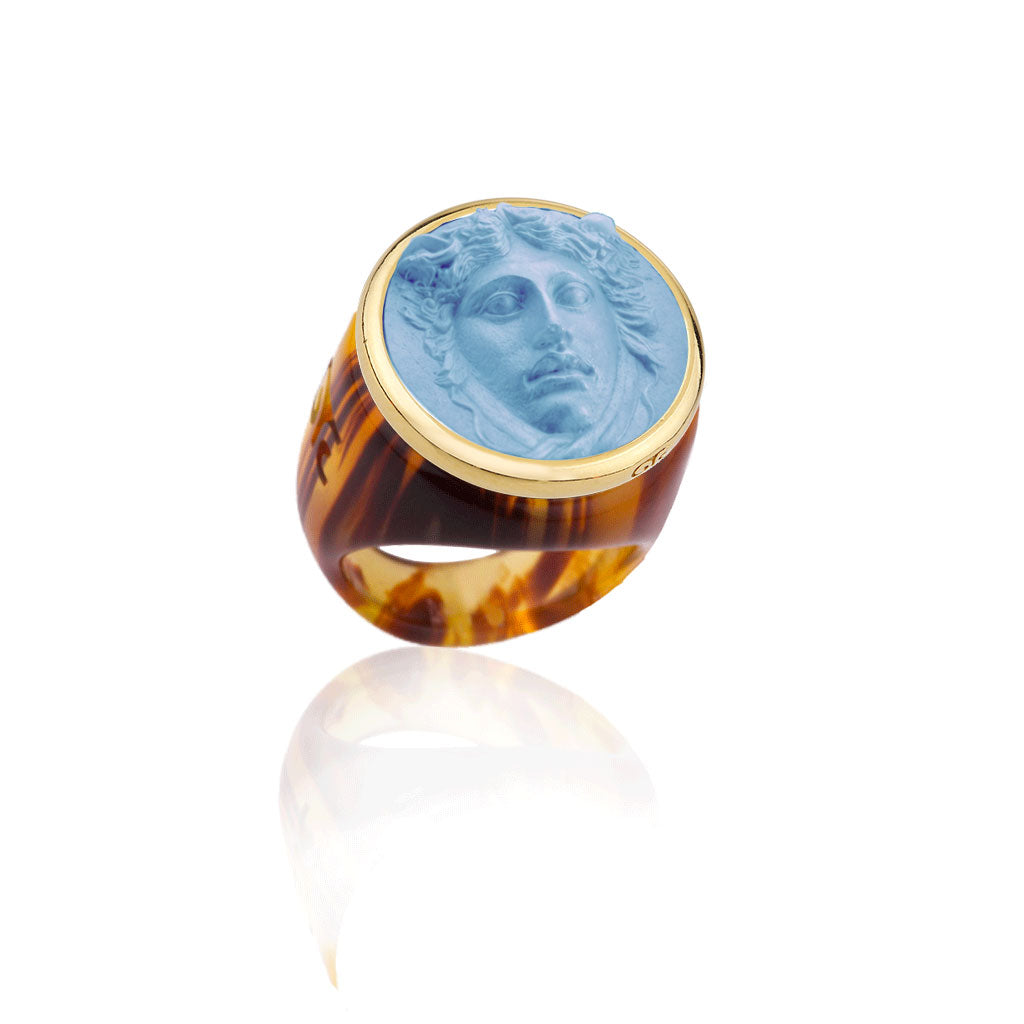
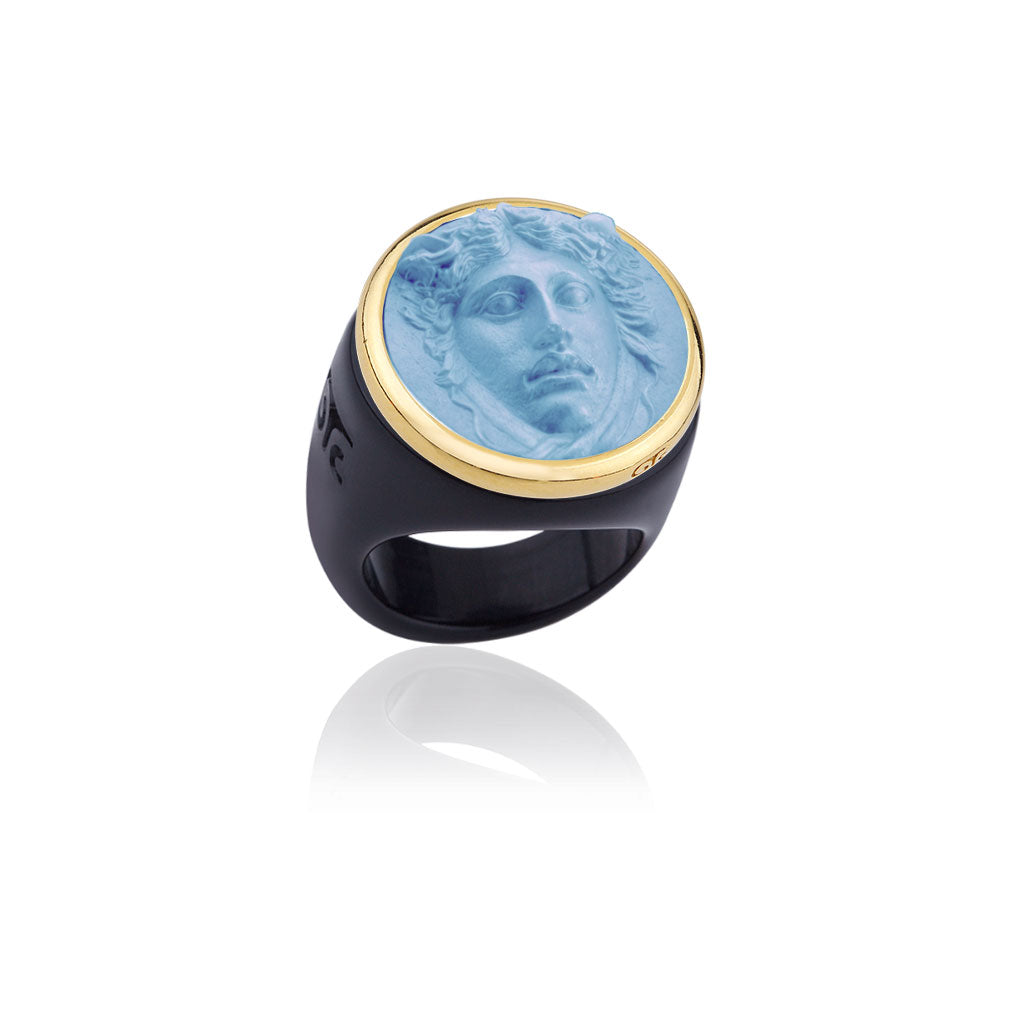
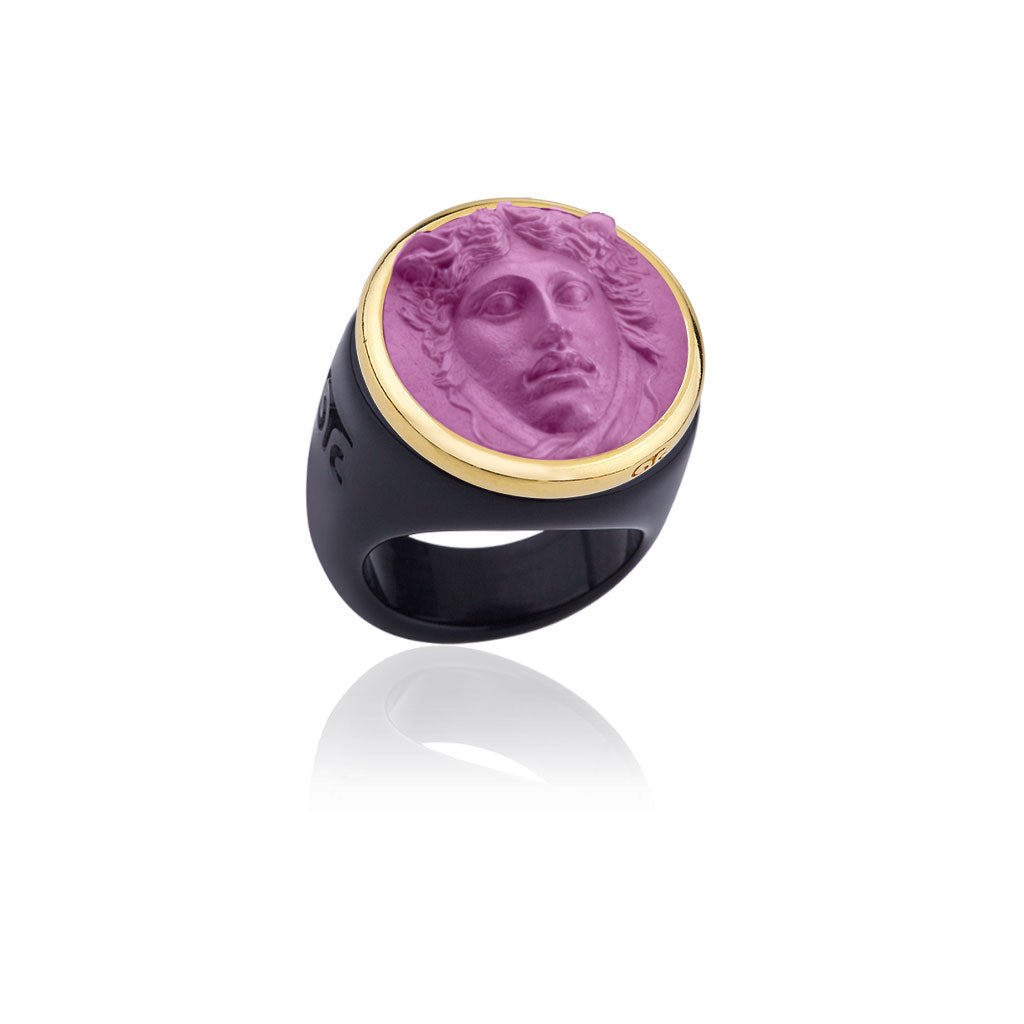
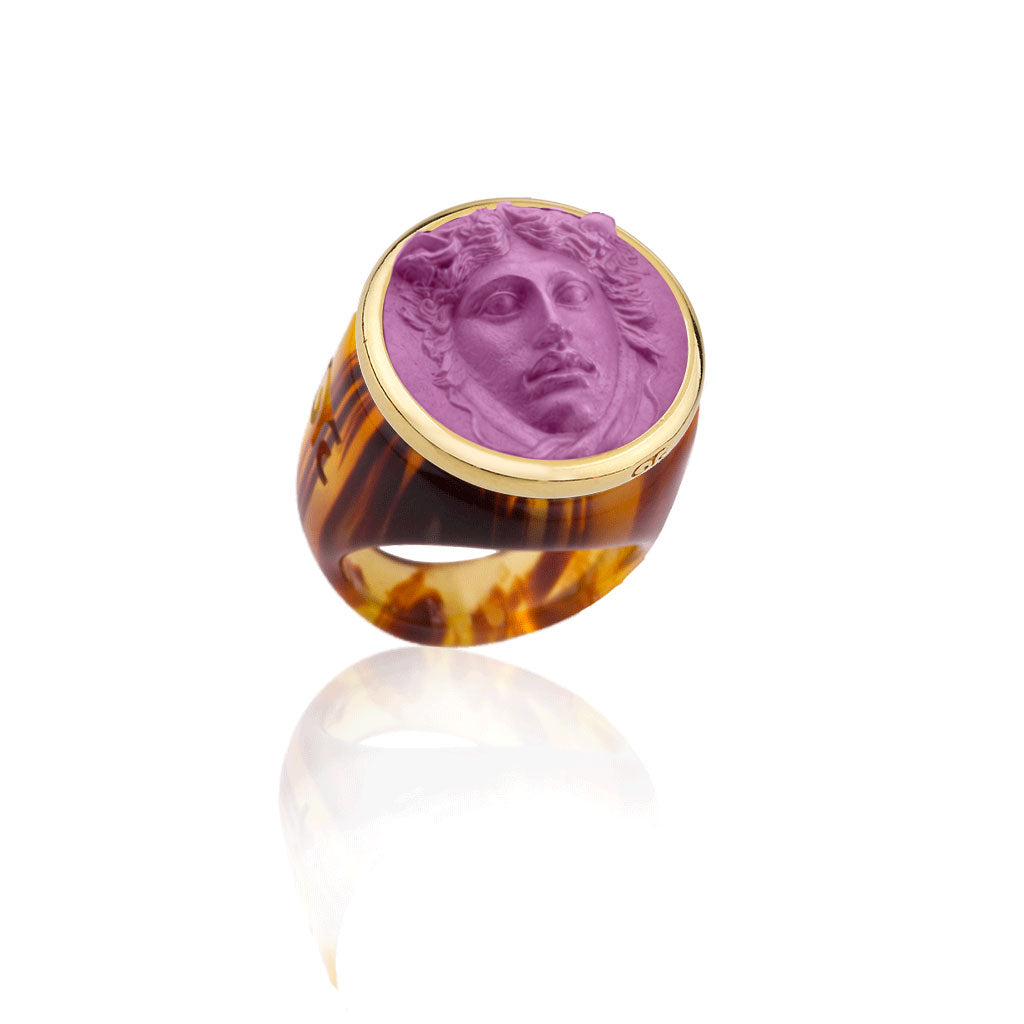
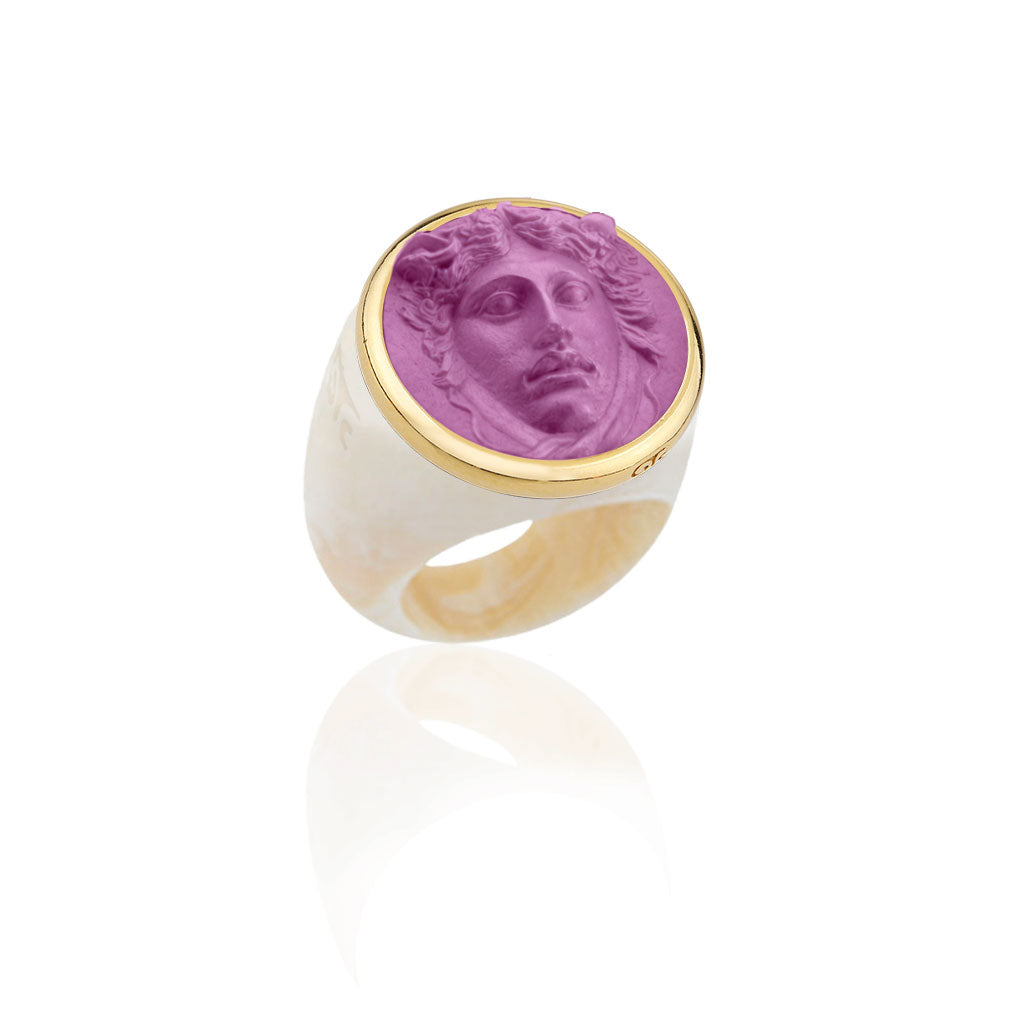
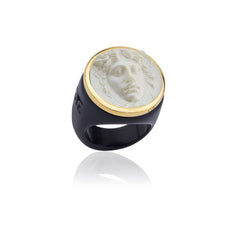
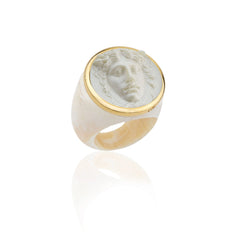
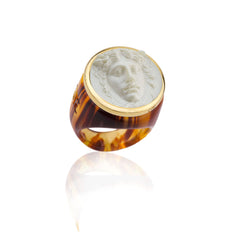
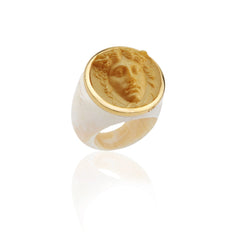
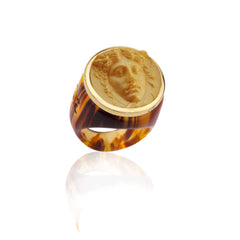
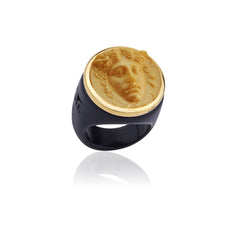
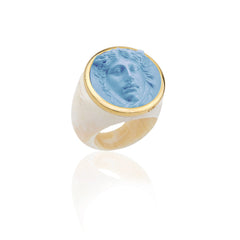
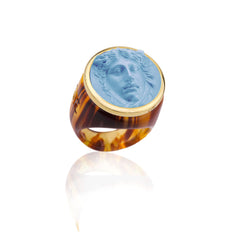
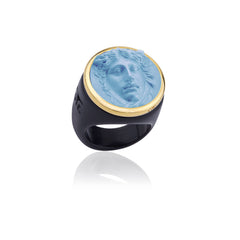
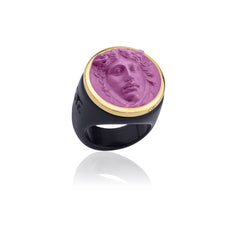
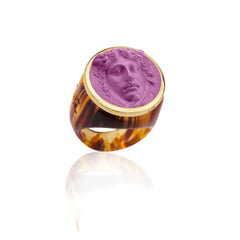
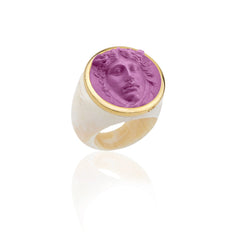
The same frontal gaze, the same declaration — but on a new material. Medusa in the AURA ring retains the sculptural precision of the 18kt gold-plated bronze relief — the intertwined serpents, the set of the lips, the line of the eyes — and rests it on a plexiglass base that changes the story. The ring body is light, contemporary, traversed by light. The weight surprises — the hand carries it with a new fluidity.
The round bezel distributes light uniformly across the entire relief — the scene reads from every angle. The GTc signature is engraved on the bezel.
On ivory, the warm tone carries the scene through gradations that shift in every piece: light blue fresh and clear; gold in warm consonance; pearl intimate; violet introducing depth. On black, the bronze lifts with graphic force that amplifies the forward gaze — a dark void making Medusa more intense: light blue is early morning, Medusa softening in the gentle dawn light; gold is the full dialogue between metal and relief, tone on tone, the face becoming all light; pearl diffuses quiet reflections, the most intimate version; violet is introspection, the threshold between matter and spirit. On tortoiseshell, the veins of the plexiglass change from piece to piece — tight and defined or soft and diffused, the striations creating harmonies with the intaglio colours: light blue opens towards morning; gold warms; pearl redistributes the light of the face; violet wraps in mystery. Every combination renews the expression.
The gaze that does not lower — carried forward by the lightness of a material that reveals what solid bronze kept within.
Notas importantes
The jewels' colors in the photo may look different from the original one. This depends from the resolution. Each object is handmade and has unique characteristics.Tabla de tallas

SIZE GUIDE
Find your size
Simple steps to measure the correct size of your finger:
- Measure your finger at the end of the day;
- Do not measure your finger when it is either too hot or too cold;
- Don’t forget that our hands are not identical, and that a ring that might fit on a finger on our left hand might not fit on the same finger on our right hand;
- Please be sure to check that your selected size slides along the full length of your finger.
To measure the circumference of your finger, you can use a taylor’s tape measure, or take a look at our video demonstration for another technique (which will require a ring that fits on your selected finger.) This size corresponds to the circumference, which you must use to find your corresponding appropriate size. (S - M - L - XL)
| Size | Italy | USA | France | Diameter (mm) | Circumference (mm) |
|---|---|---|---|---|---|
| S | 12 > 13 | 6 > 6,5 | 52 > 53 | 16,5 > 16,9 | 52 > 53 |
| M | 14 > 15 | 7 > 7 1/4 | 54 > 55 | 17,2 > 17,4 | 54 > 55 |
| L | 16 > 17 | 7,5 > 8 | 56 > 57 | 17,8 > 18,1 | 56 > 57 |
| XL | 18 > 19 | 8, 5 > 9 | 58 > 59 | 18,5 > 18,8 | 58 > 59 |
| 2XL | 20 | 9 | 60 | 19,1 | 60 |
| 3XL | 22 | 10 | 62 | 19,7 | 62 |
| 4XL | 24 | 10 3/4 | 64 | 20,4 | 64 |
| 5XL | 26 | 11 3/4 | 66 | 21 | 66 |

Medusa Rondanini
The so-called “Rondanini Medusa”. Marble, Roman copy of a 5th-century BC Greek original by Phidias, which was set on the shield of Athena Parthenos. The Munich Glyptothek’s Medusa Rondanini is possibly a 5th-century BC work, and the oldest-known ”beautiful gorgoneion” sculpture. The design may have been copied from a gilded bronze aegis that once hung in the Acropolis, where it would have been meant to ward off evil and bad luck. A revision of the grotesque, disk-shaped death masks of older gorgoneia, the Medusa Rondanini appears to borrow the idealized likeness of Athena of Velletri, wreathed in decorative snakes and delicate owl wings—Chthonic dread and death mixed with Olympian beauty and cunning. While on display in the Palazzo Rondanini in Rome, it was noticed and first brought to the attention of Northern European art connoisseurs in the 1780s by Johann Wolfgang von Goethe, who wrote, “I would say something about it if everything one could say about such a work were not a waste of breath.” Located in the Glyptotheum of Munich
Show all products- Al elegir una selección, se actualiza la página completa.