
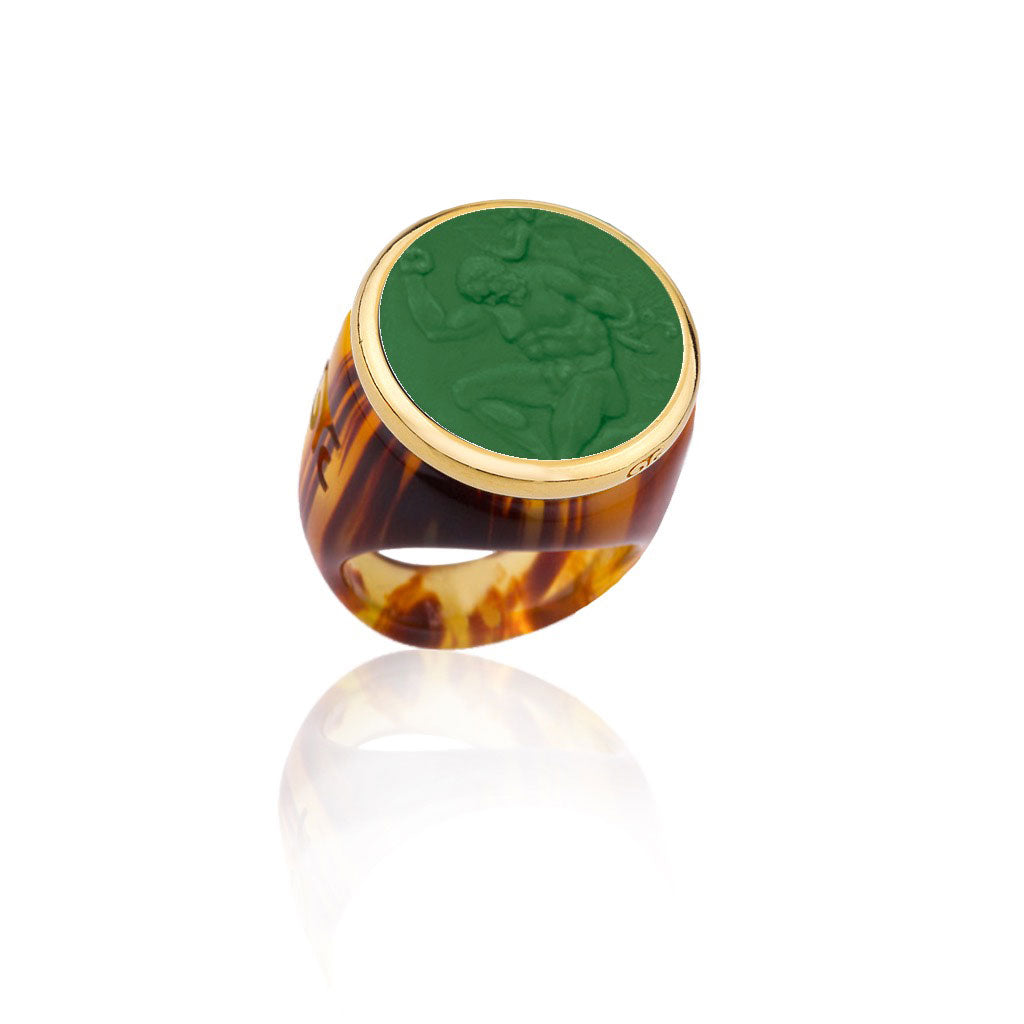
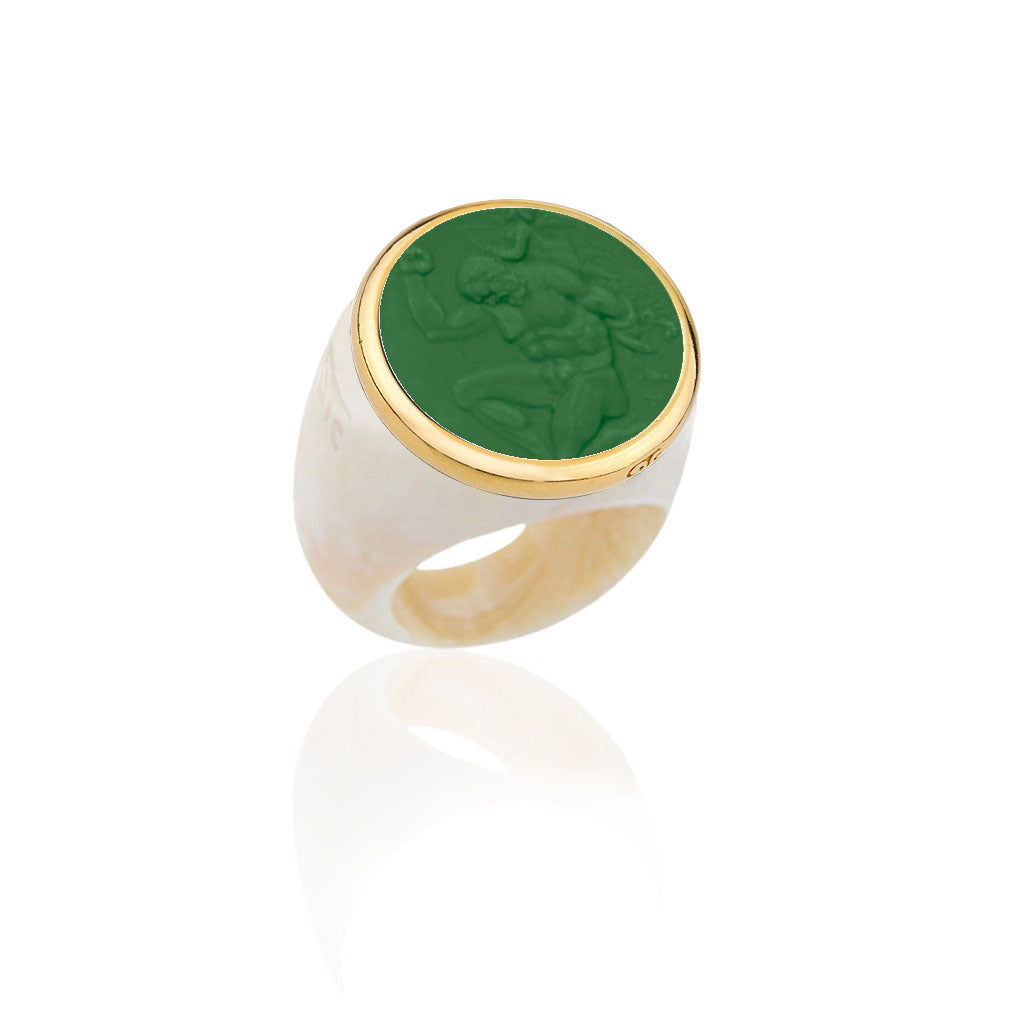
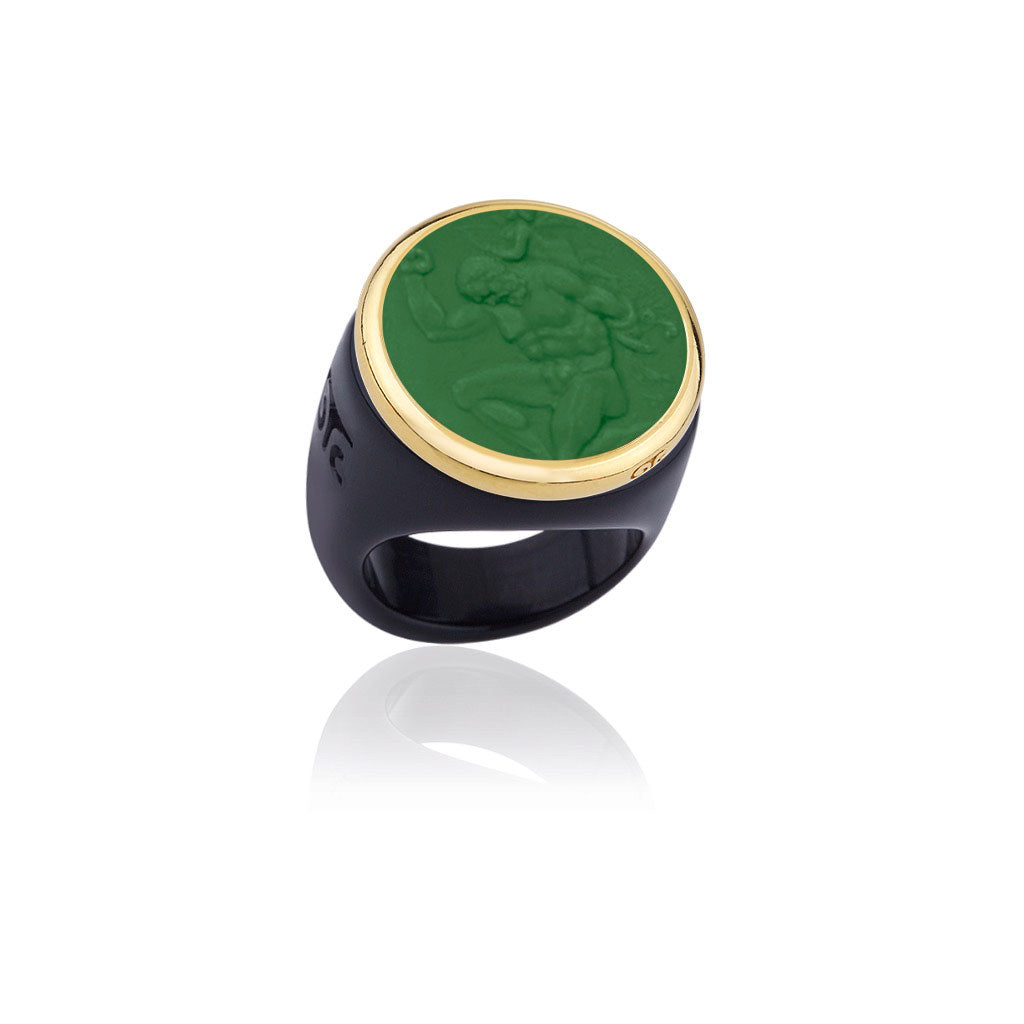
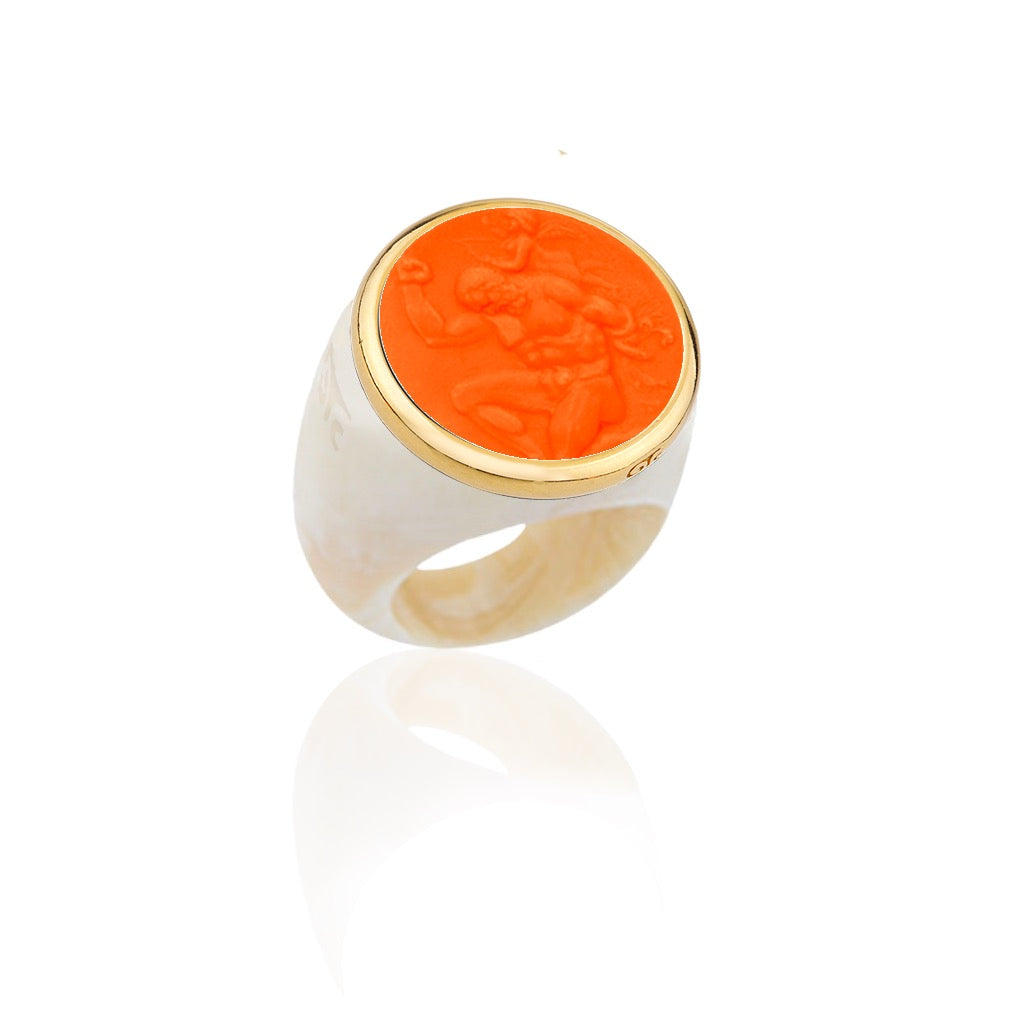
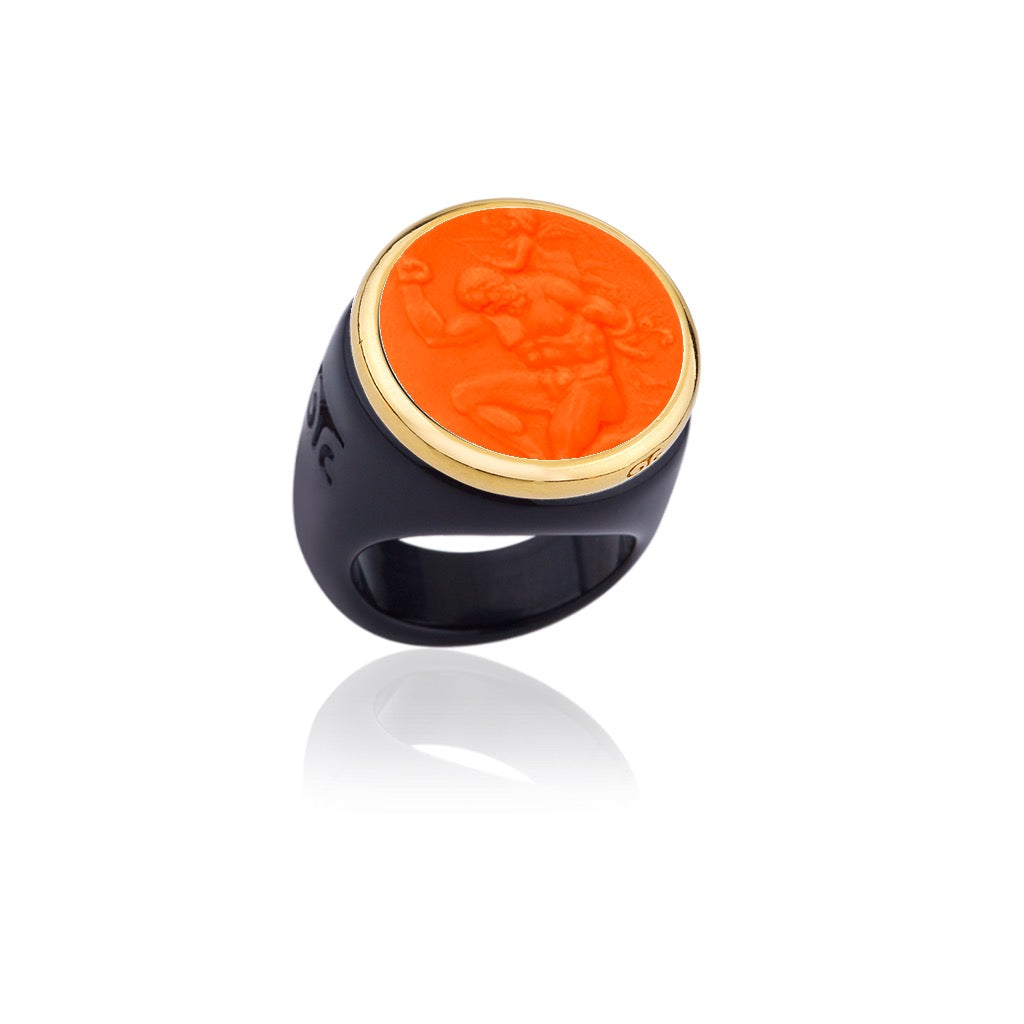
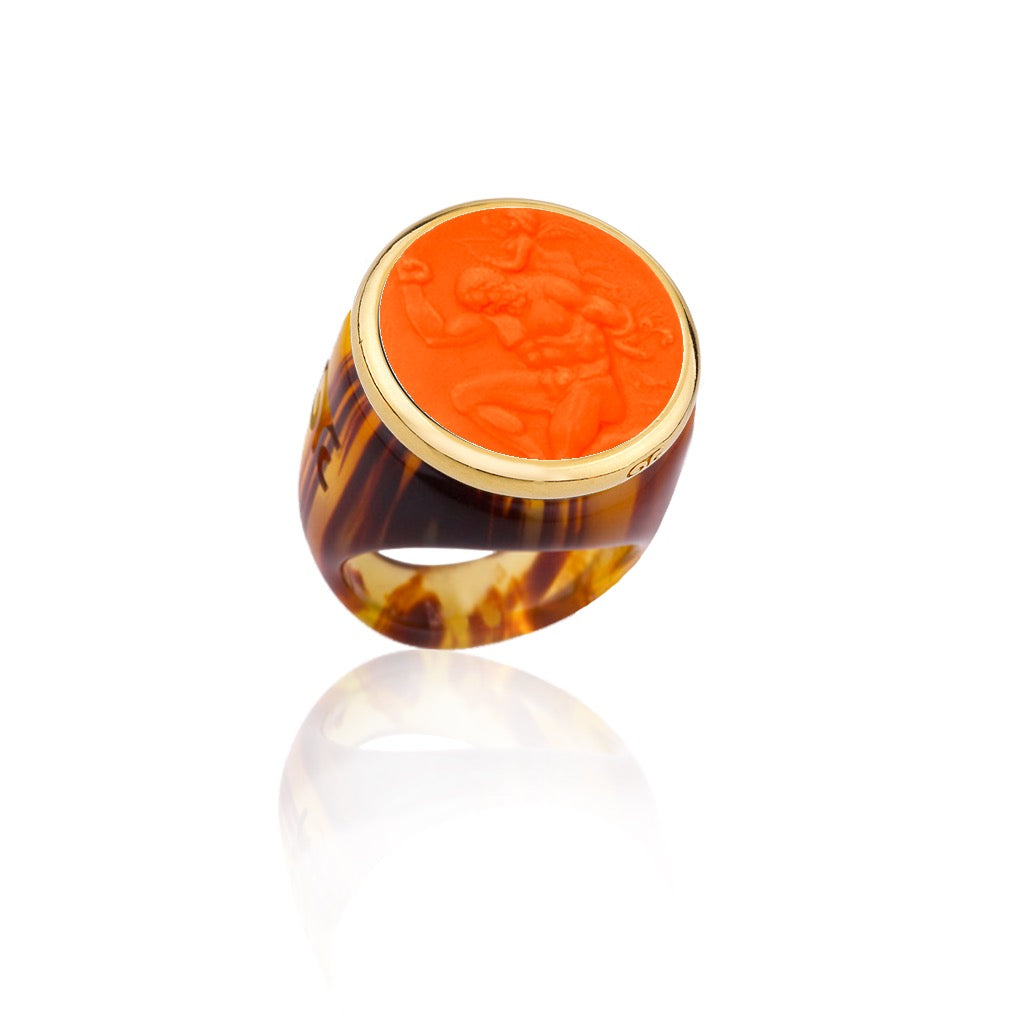
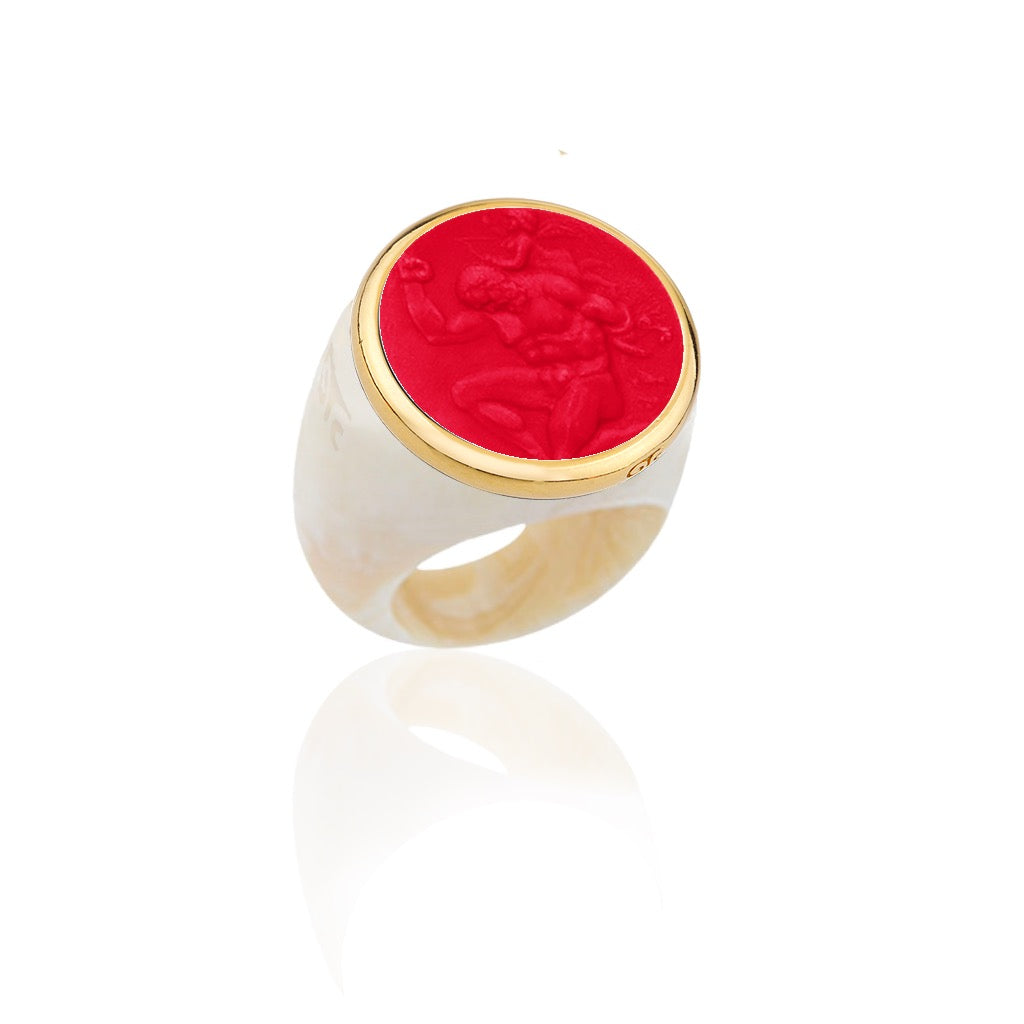
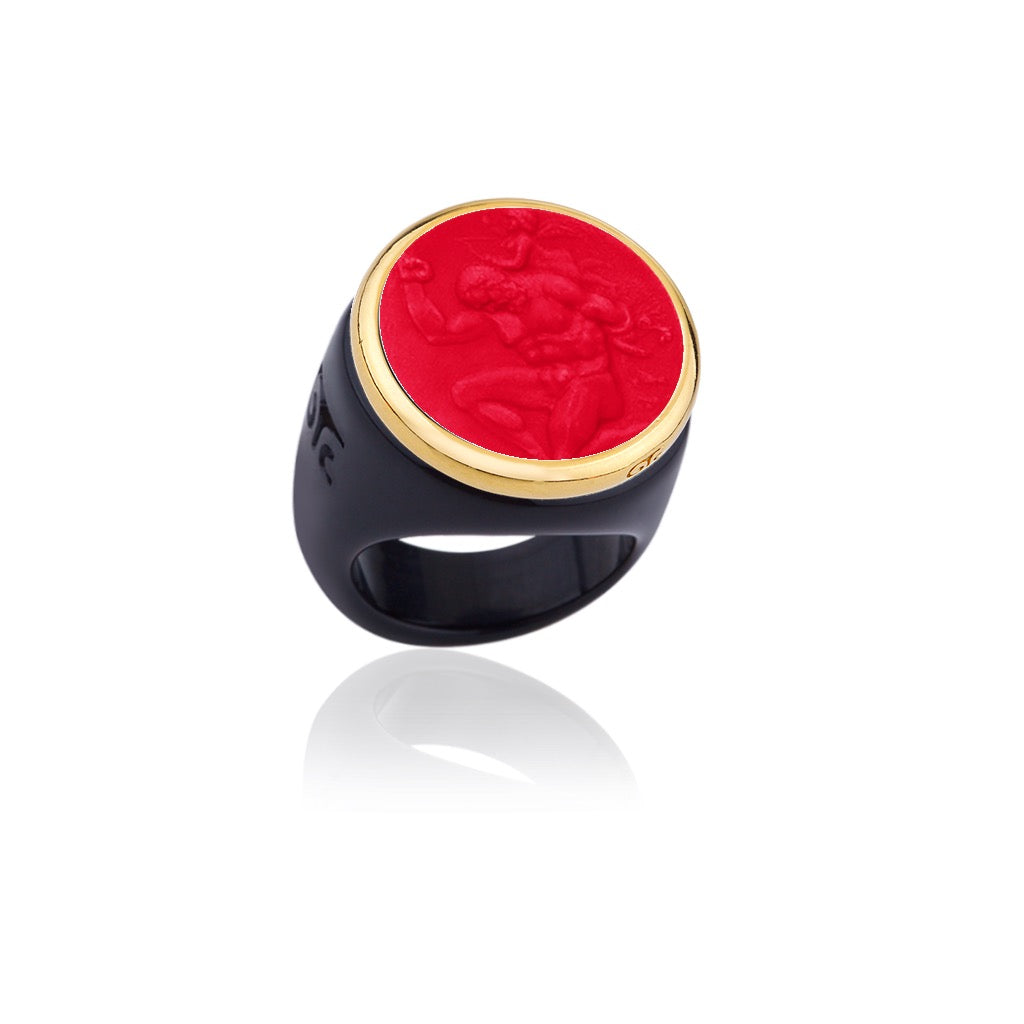
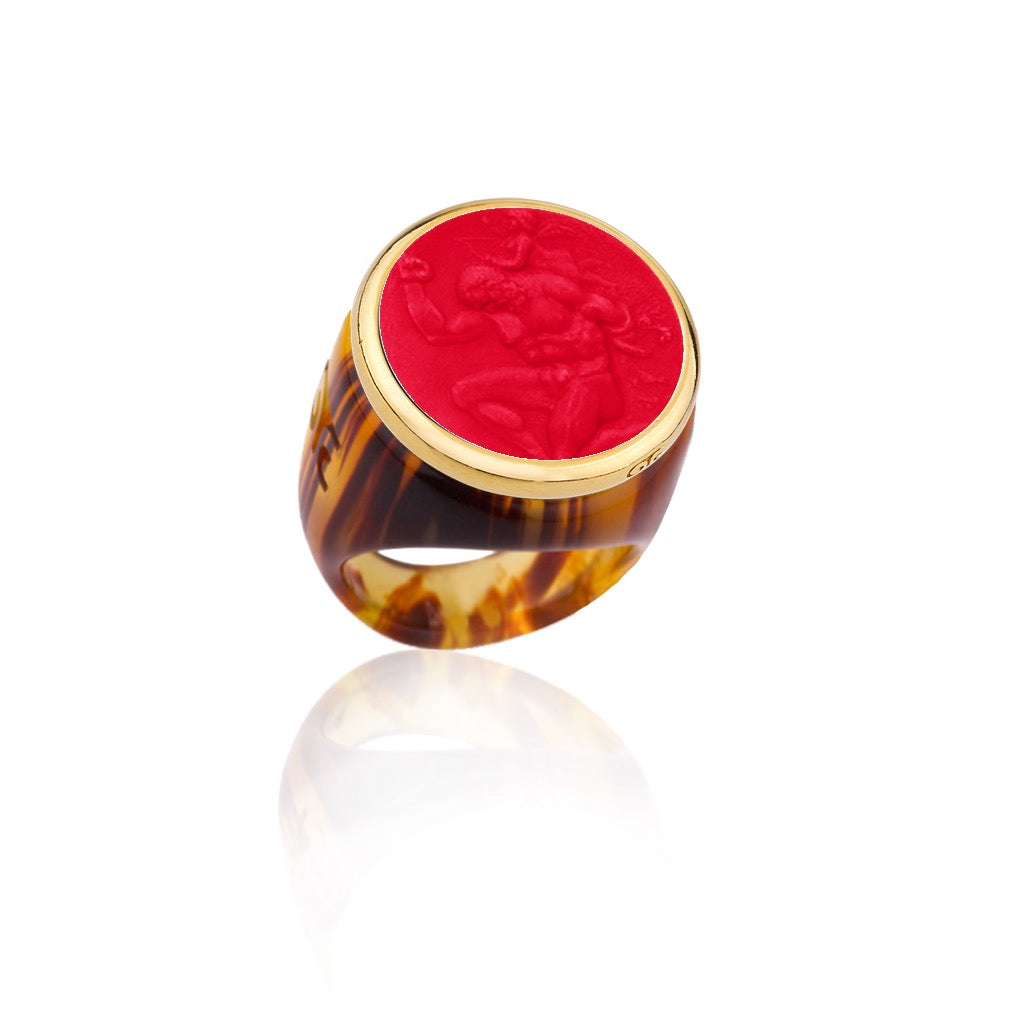
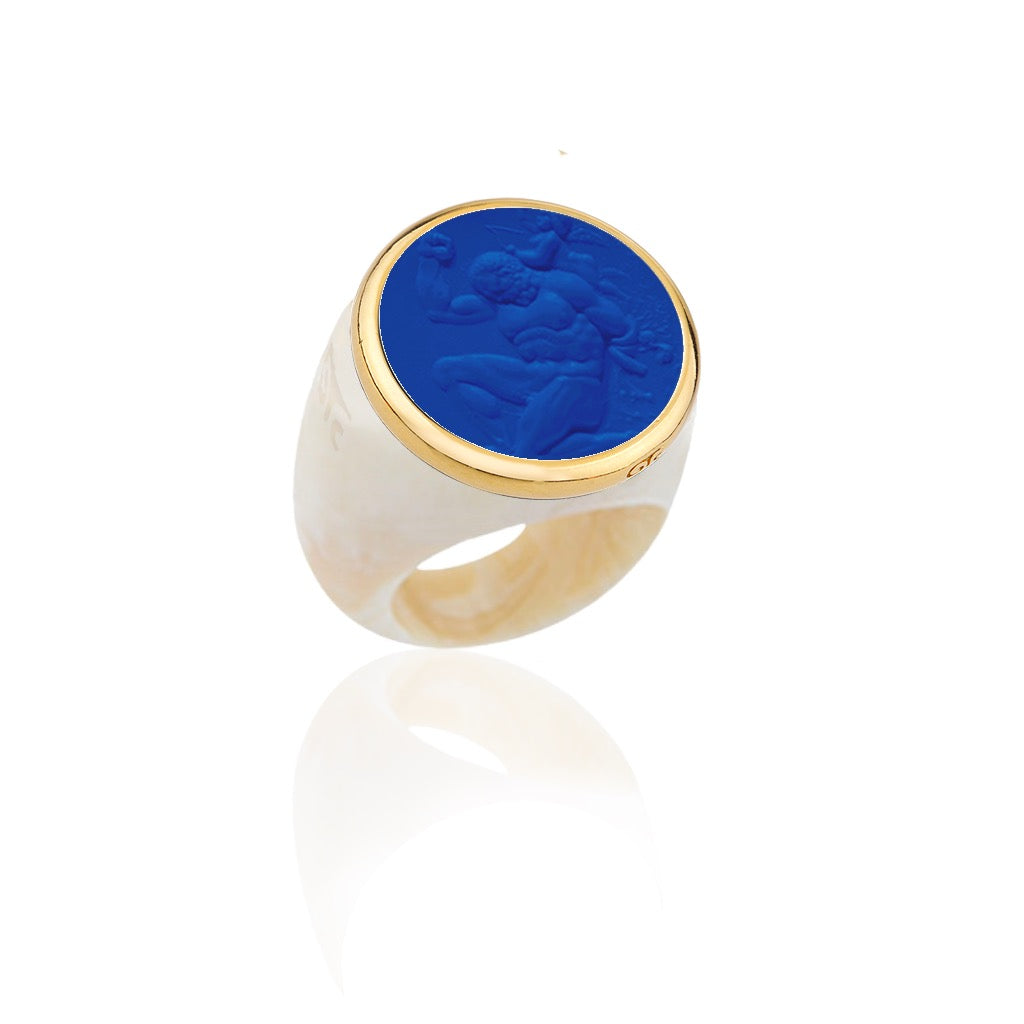
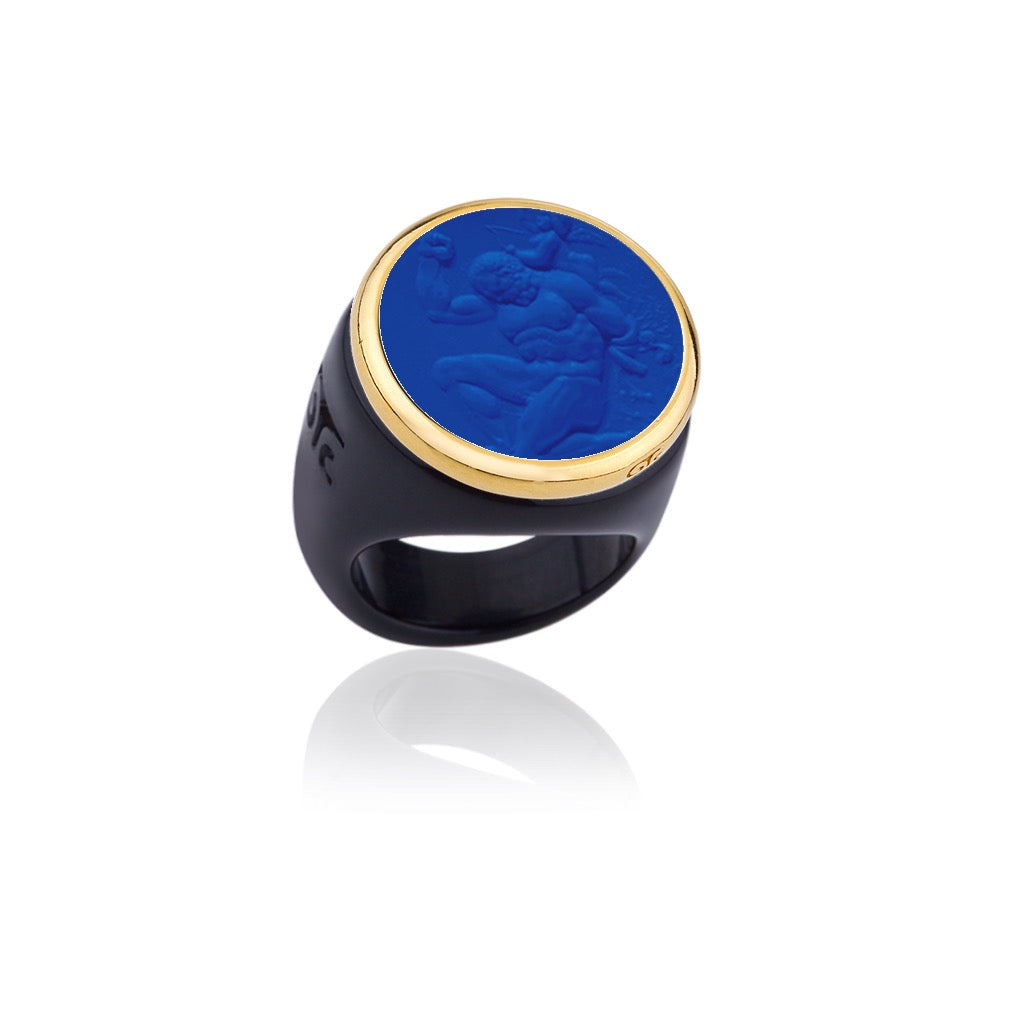
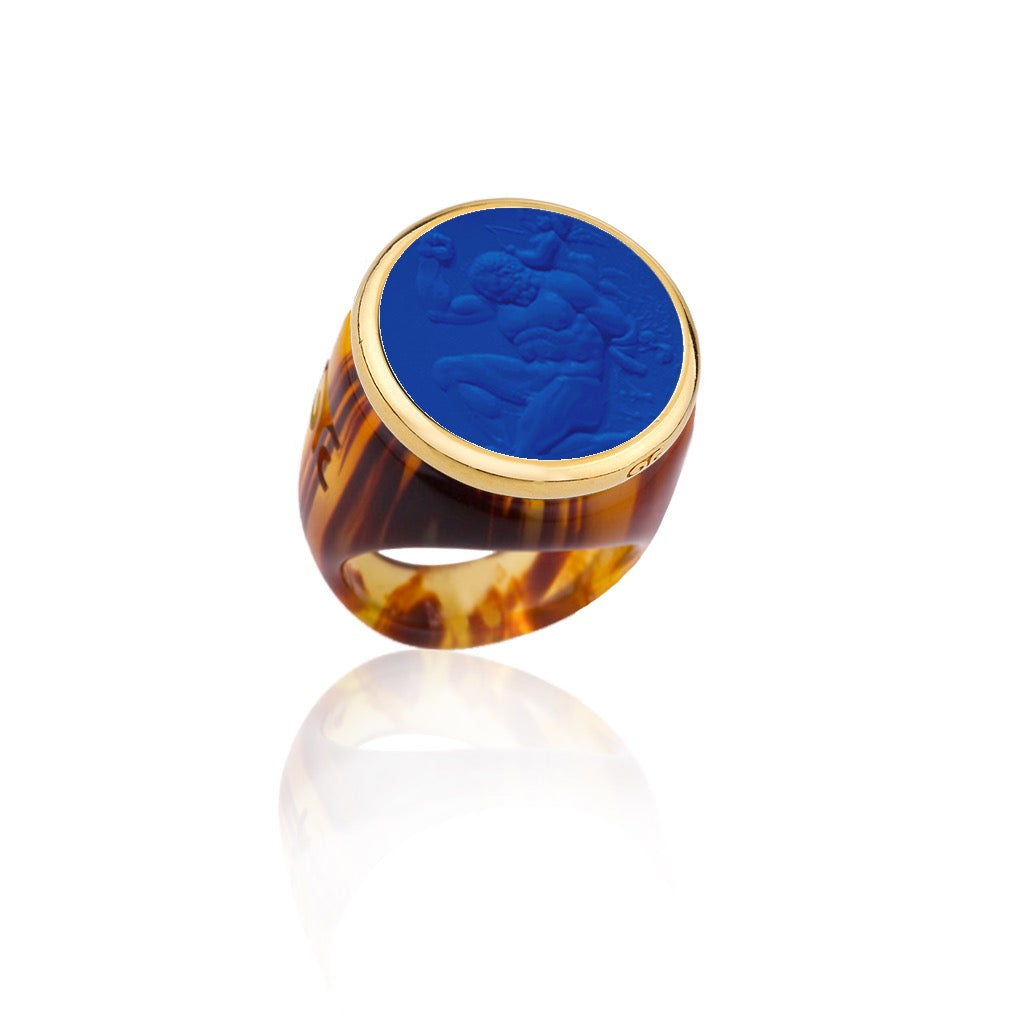
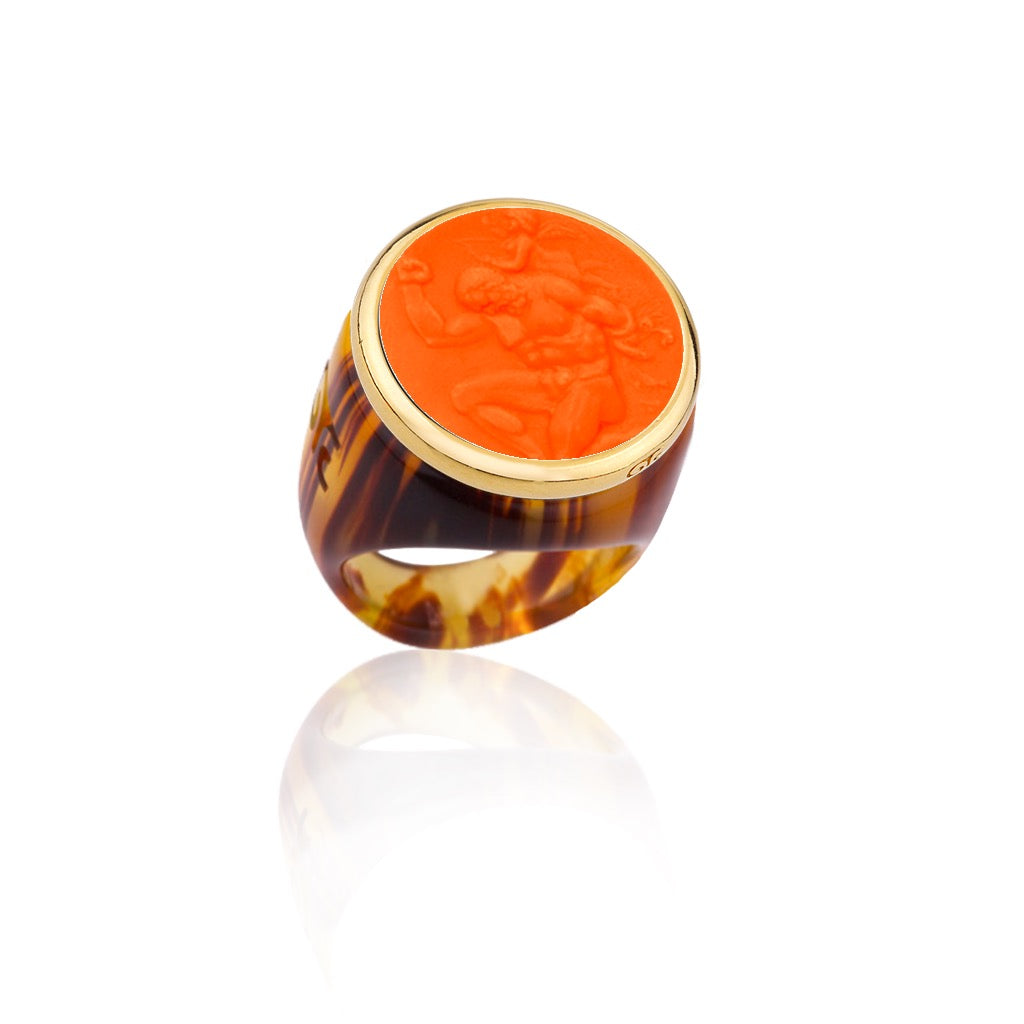
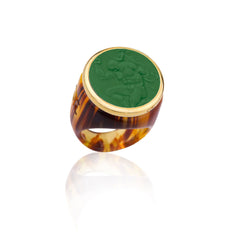
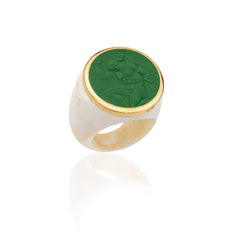
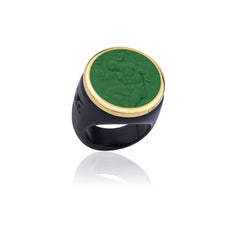
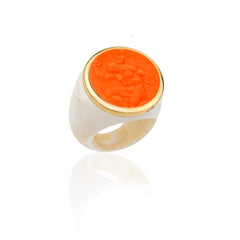
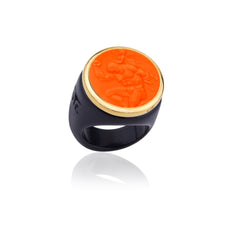
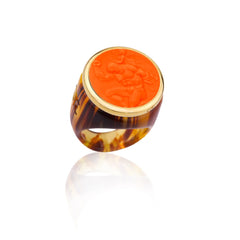
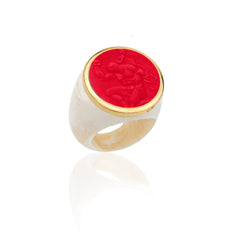
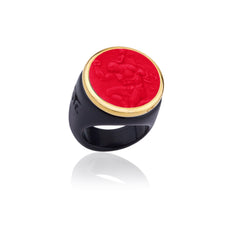
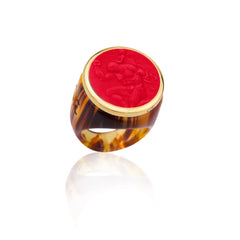
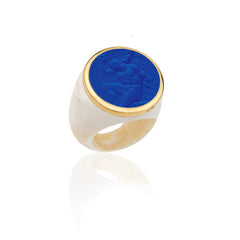
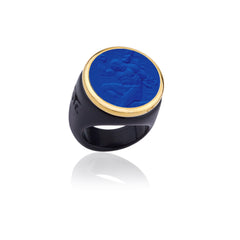
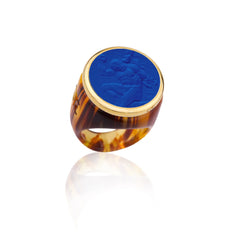
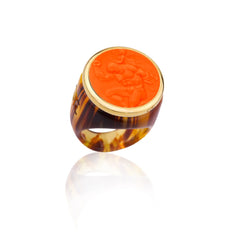
Cupid swoops above, his bow barely visible in the relief. Hercules is on his knees below: arm raised, fist clenched, head bowed. The round bezel is full of this tension — Hercules' muscles press toward the bezel edge, Cupid opens toward the sky. Low relief, high energy: every line in motion, every curve under pressure. The 18kt gold-plated bronze carries all the narrative weight; the plexiglass body carries the lightness that belongs to Cupid.
The round bezel distributes the composition so both figures read from every angle on the finger — Hercules low and gathered, Cupid high and open, the difference in posture visible from any position. The GTc signature is engraved on the bezel.
On black the contrast is at its maximum: the figures emerge sharp, every muscle of Hercules and every feather of Cupid in full definition — orange is the solar energy Hercules still carries in his raised fist, blue is the sky from which Cupid descends, red is the passion already fulfilled, green is the woodland from which the whole story comes. On tortoiseshell each piece carries its own veining — an organic naturalness that moves and lives, different in every piece; against this warm, animated ground orange intensifies further, blue deepens to lapis lazuli, red softens, green takes root in the veining. On ivory the light is even and still — the colours sit clear and precise, Cupid's lightness rises freely above the white.
The bow is almost hidden in the intaglio — almost unnecessary. The grace of love is pure force, and Hercules bows.
Notas importantes
The jewels' colors in the photo may look different from the original one. This depends from the resolution. Each object is handmade and has unique characteristics.Tabla de tallas

SIZE GUIDE
Find your size
Simple steps to measure the correct size of your finger:
- Measure your finger at the end of the day;
- Do not measure your finger when it is either too hot or too cold;
- Don’t forget that our hands are not identical, and that a ring that might fit on a finger on our left hand might not fit on the same finger on our right hand;
- Please be sure to check that your selected size slides along the full length of your finger.
To measure the circumference of your finger, you can use a taylor’s tape measure, or take a look at our video demonstration for another technique (which will require a ring that fits on your selected finger.) This size corresponds to the circumference, which you must use to find your corresponding appropriate size. (S - M - L - XL)
| Size | Italy | USA | France | Diameter (mm) | Circumference (mm) |
|---|---|---|---|---|---|
| S | 12 > 13 | 6 > 6,5 | 52 > 53 | 16,5 > 16,9 | 52 > 53 |
| M | 14 > 15 | 7 > 7 1/4 | 54 > 55 | 17,2 > 17,4 | 54 > 55 |
| L | 16 > 17 | 7,5 > 8 | 56 > 57 | 17,8 > 18,1 | 56 > 57 |
| XL | 18 > 19 | 8, 5 > 9 | 58 > 59 | 18,5 > 18,8 | 58 > 59 |
| 2XL | 20 | 9 | 60 | 19,1 | 60 |
| 3XL | 22 | 10 | 62 | 19,7 | 62 |
| 4XL | 24 | 10 3/4 | 64 | 20,4 | 64 |
| 5XL | 26 | 11 3/4 | 66 | 21 | 66 |
Hercules and Cupid
The mythological hero Hercules (or Herakles) was famed for his great strength and endurance and celebrated as an extraordinary mortal who, through success in seemingly impossible labors, won his immortal place amongst the Olympian gods. Being the greatest of Greek mythological heroes, he has been ascribed a multitude of adventures and heroic exploits over the centuries which were probably originally connected to lesser, more local figures. In mythology it was Zeus who lay with Alkmene and so fathered Hercules, explaining the origin of Hercules’ great strength. Hera, the wife of Zeus, was (understandably) always jealous of Hercules and made life difficult for him from an early age. The goddess delayed his birth so that his cousin Eurystheus would be born first and so become the ruler of Greece according to Zeus’ decree. Hera also sent two snakes to kill the newborn Hercules, but the baby easily strangled them. Hercules enjoyed divine favour from the Olympian gods and he was particularly favoured by Athena. Ercole Farnese, Napoli, Museo Archeologico Nazionale.
Show all products- Al elegir una selección, se actualiza la página completa.