
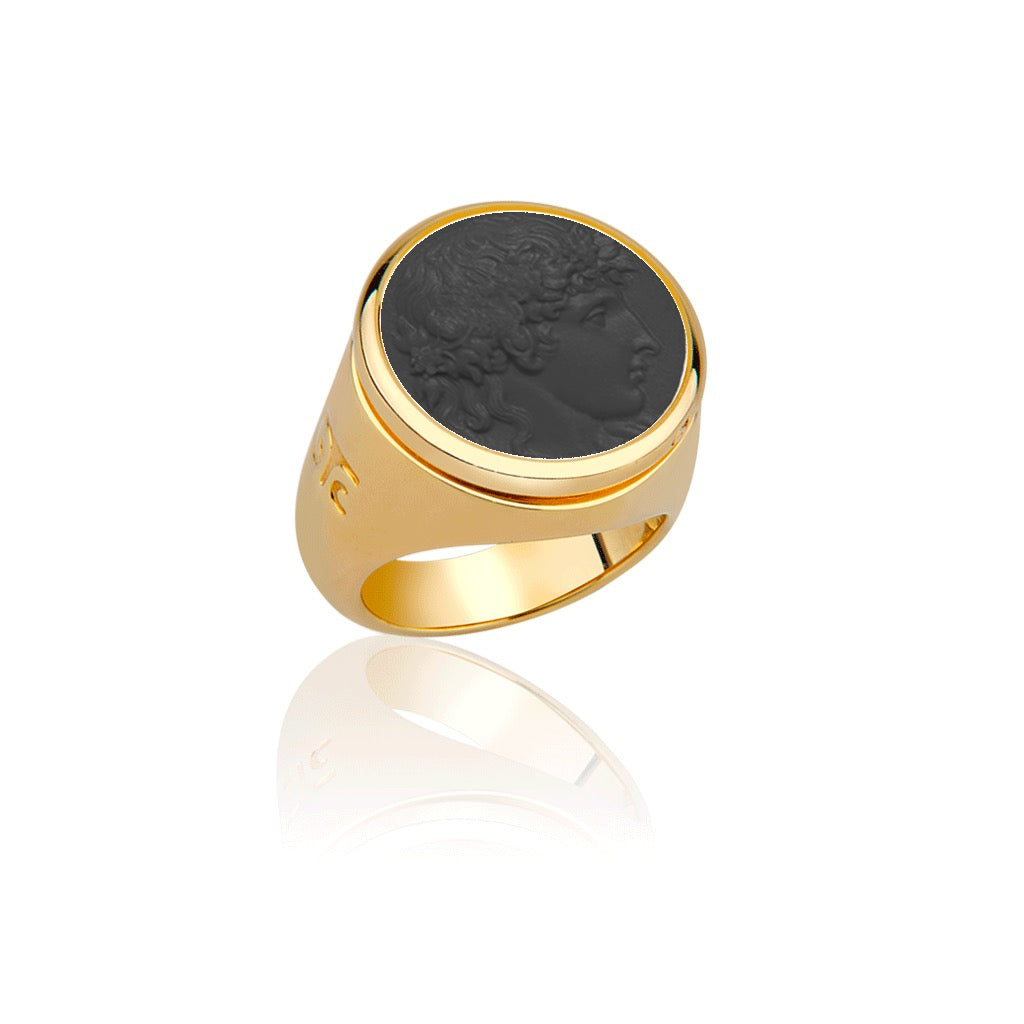
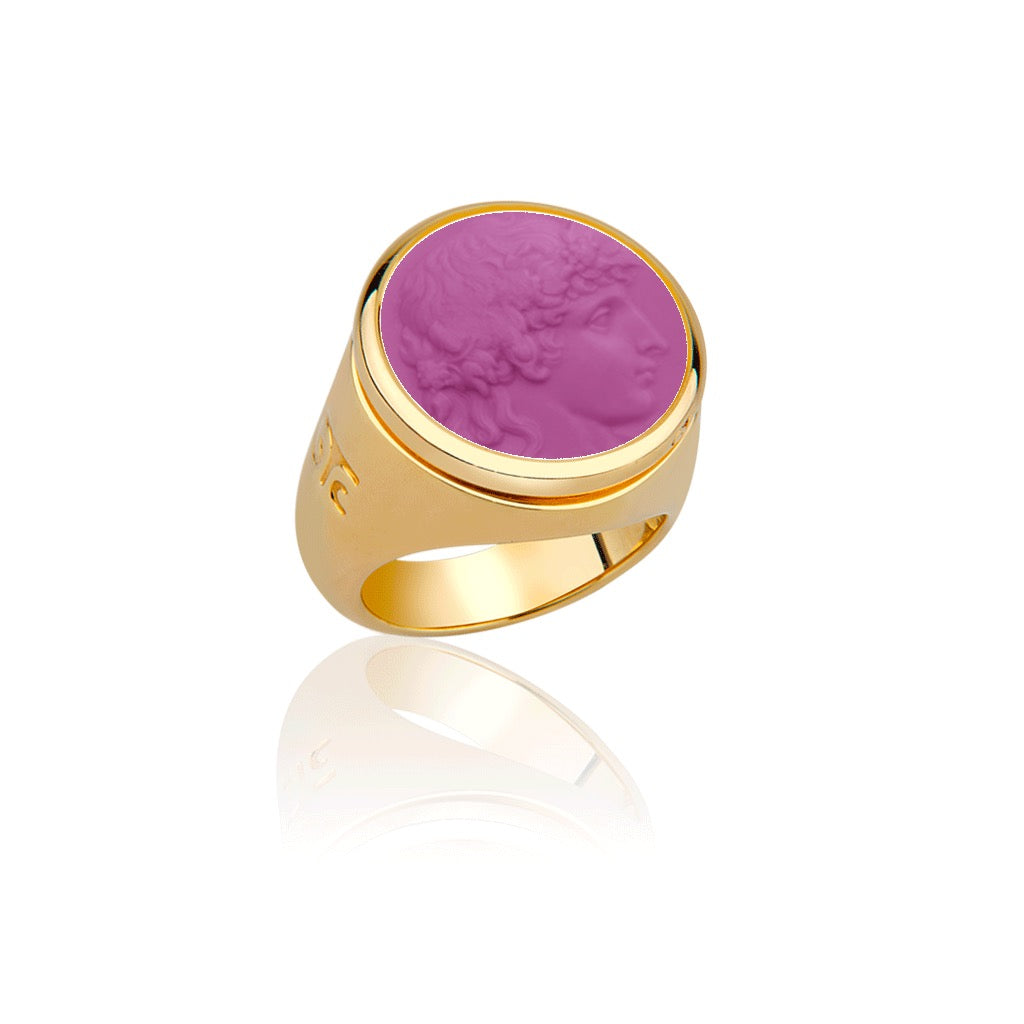


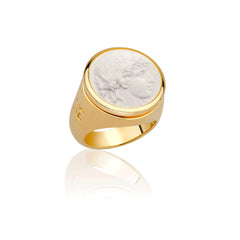
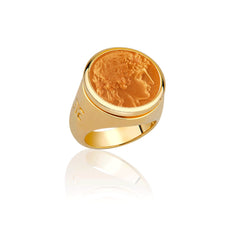
El anillo LUXOR recibe este retrato en su bisel redondo — una miniatura que el relieve representa con fluidez natural. La frente lisa, la nariz recta, los rizos que se mueven alrededor del rostro: es Antínoo, el joven que vivió junto al emperador Adriano en la espléndida Villa de Tivoli. Un rostro que ha seguido conmoviendo a lo largo de los siglos, tan contemporáneo hoy como en el momento en que fue tallado.
Fundido en bronce dorado de 18 quilates mediante el proceso de cera perdida, este anillo otorga al retrato la gravedad que merece. El peso total de la pieza se siente desde el primer instante en la mano — la forma de sello llevada a su expresión más madura. Antínoo se sienta en primer plano, sin ocultarse. El metal tiene una vida orgánica que se percibe al tacto: cada curva dibujada y refinada para que llevarlo sea tanto un placer como una presencia.
En este anillo nos sumergimos en la vida cotidiana de la villa en Tivoli donde Antínoo vivió con Adriano. El blanco habla de las esculturas que lo retrataban — el mármol que guardó ese rostro para siempre. El negro es el basalto de las estatuas egipcias, Antínoo más allá del tiempo, sagrado e intenso. El dorado recuerda la luz sobre los bronces y mosaicos, el atardecer dorado de una villa que miraba hacia Roma. El Violeta son los jardines, las telas imperiales, los paseos entre las columnatas. Cada variante de este anillo nos transporta a una de esas habitaciones, a una de esas atmósferas.
Antínoo atraviesa los siglos. Este anillo es su presente.
Notas importantes
Los colores de las joyas en la foto pueden parecer diferentes a los originales. Esto depende de la resolución. Cada pieza está hecha a mano y tiene características únicas.Tabla de tallas

GUÍA DE TALLAS
Encuentra tu talla
Pasos sencillos para medir la talla correcta de tu dedo:
- Mide tu dedo al final del día;
- No midas tu dedo cuando esté demasiado caliente o demasiado frío;
- No olvides que nuestras manos no son idénticas, y que un anillo que puede ajustarse a un dedo de la mano izquierda puede no ajustarse al mismo dedo de la mano derecha;
- Por favor, asegúrate de que la talla seleccionada se deslice a lo largo de toda la longitud de tu dedo.
Para medir la circunferencia de tu dedo, puedes usar una cinta métrica de sastre o ver nuestro video demostrativo para otra técnica (que requerirá un anillo que te quede en el dedo seleccionado). Esta talla corresponde a la circunferencia, que debes usar para encontrar tu talla adecuada correspondiente. (S - M - L - XL)
| Talla | Italia | Estados Unidos | Francia | Diámetro (mm) | Circunferencia (mm) |
|---|---|---|---|---|---|
| S | 12 > 13 | 6 > 6,5 | 52 > 53 | 16,5 > 16,9 | 52 > 53 |
| M | 14 > 15 | 7 > 7 1/4 | 54 > 55 | 17,2 > 17,4 | 54 > 55 |
| L | 16 > 17 | 7,5 > 8 | 56 > 57 | 17,8 > 18,1 | 56 > 57 |
| XL | 18 > 19 | 8, 5 > 9 | 58 > 59 | 18,5 > 18,8 | 58 > 59 |
| 2XL | 20 | 9 | 60 | 19,1 | 60 |
| 3XL | 22 | 10 | 62 | 19,7 | 62 |
| 4XL | 24 | 10 3/4 | 64 | 20,4 | 64 |
| 5XL | 26 | 11 3/4 | 66 | 21 | 66 |
Antinoo
El amor recordado nunca se pierde.
Antínoo (también Antinoo o Antinoös; 27 de noviembre, c. 111 – antes del 30 de octubre de 130) fue un joven griego de Bitinia y favorito, o amante, del emperador romano Adriano. Fue deificado tras su muerte, siendo venerado tanto en el Oriente griego como en el Occidente latino, a veces como un dios (theos) y otras simplemente como un mortal deificado (heros). Antínoo se asoció con la homosexualidad en la cultura occidental, apareciendo en la obra de Oscar Wilde y del poeta portugués Fernando Pessoa.
Ver todos los productos- Al elegir una selección, se actualiza la página completa.