


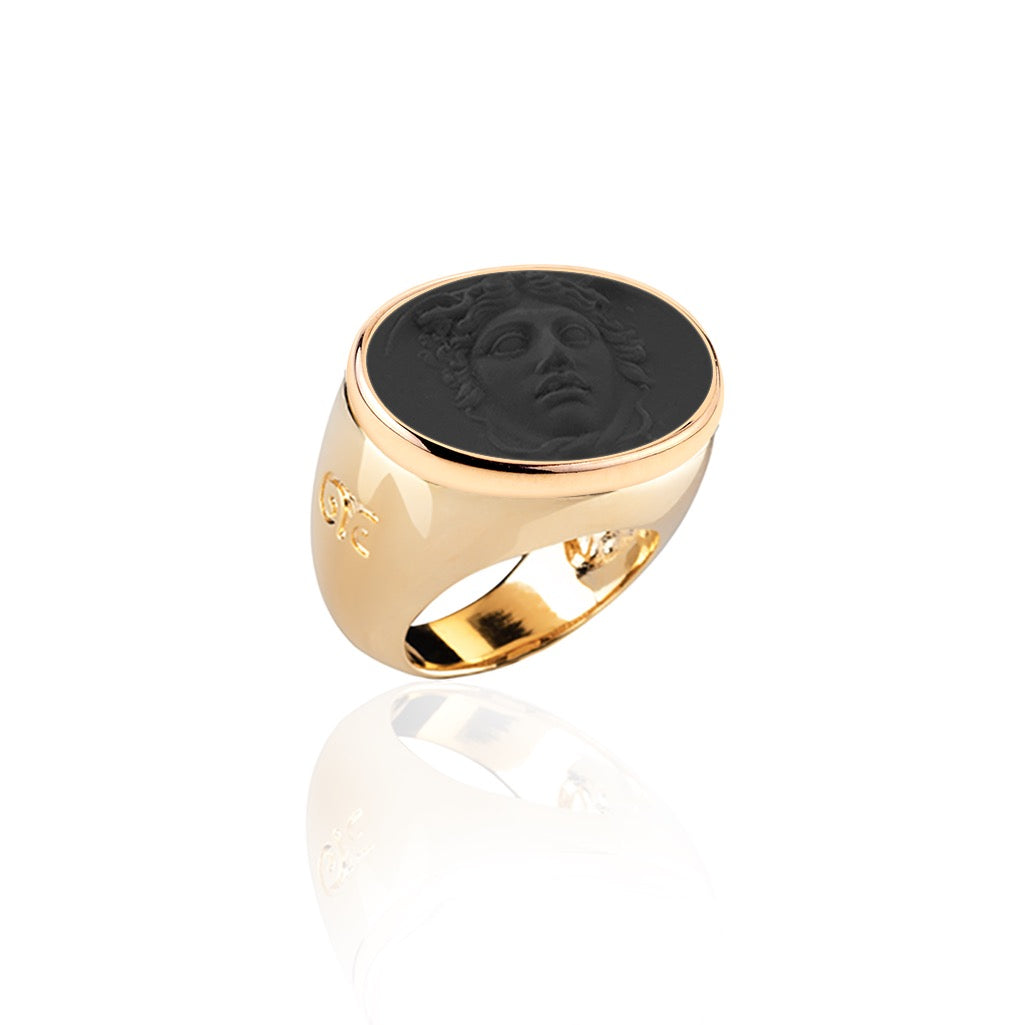


El rostro de Medusa se presenta con una claridad que impacta a primera vista. El intaglio emerge con calma de la superficie dorada del anillo Lux: cada línea está definida, cada volumen en su lugar, y el conjunto proyecta una tranquilidad que se siente de inmediato. El diseño limpio del bronce bañado en oro de 18 kt amplifica esta sensación: la base lisa y luminosa refleja el motivo, y los dos elementos encuentran un acuerdo tan natural que parece inevitable.
En la mano, el anillo tiene una presencia sólida y reconfortante. La superficie pulida responde a la luz con reflejos continuos que animan el intaglio con cada movimiento. Se siente el peso, el metal es cálido, y Medusa mira desde el bisel con esa firmeza tranquila que solo poseen quienes conocen su propia fuerza. Es una joya que comunica algo que las palabras apenas pueden tocar: una belleza tan directa que solo hace falta mirar.
La primera vez que vimos este anillo en alguien, lo que habíamos imaginado se volvió realidad. Un motivo como Medusa, que habíamos logrado representar de una manera totalmente inesperada a través de materiales muy contemporáneos, había encontrado aquí una nueva forma de expresión. La persona que lo eligió quería sentir su peso y al mismo tiempo tener un anillo dramático, con proporciones imponentes. Quería verlo y sentirlo, a través del metal y del color. La foto que tomamos de esa mano con este anillo — esa persona aún lo conserva.
Los colores hacen el resto, y lo hacen de maneras completamente únicas. Celeste aporta una serenidad límpida y aérea, como si la mirada de Medusa se abriera hacia un horizonte infinito. El blanco define cada detalle del cabello y los rasgos con pura serenidad. El negro hace la mirada aún más magnética y profunda, cargando el relieve con una densidad que atrae. El rosa suaviza toda la composición con una gracia inesperada, aportando brillo y vida a la firmeza del rostro — una mirada que nunca deja de sorprender.
Notas importantes
Los colores de las joyas en la foto pueden parecer diferentes a los originales. Esto depende de la resolución. Cada pieza está hecha a mano y tiene características únicas.Tabla de tallas

GUÍA DE TALLAS
Encuentra tu talla
Pasos sencillos para medir la talla correcta de tu dedo:
- Mide tu dedo al final del día;
- No midas tu dedo cuando esté demasiado caliente o demasiado frío;
- No olvides que nuestras manos no son idénticas, y que un anillo que puede ajustarse a un dedo de la mano izquierda puede no ajustarse al mismo dedo de la mano derecha;
- Por favor, asegúrate de que la talla seleccionada se deslice a lo largo de toda la longitud de tu dedo.
Para medir la circunferencia de tu dedo, puedes usar una cinta métrica de sastre o ver nuestro video demostrativo para otra técnica (que requerirá un anillo que te quede en el dedo seleccionado). Esta talla corresponde a la circunferencia, que debes usar para encontrar tu talla adecuada correspondiente. (S - M - L - XL)
| Talla | Italia | Estados Unidos | Francia | Diámetro (mm) | Circunferencia (mm) |
|---|---|---|---|---|---|
| S | 12 > 13 | 6 > 6,5 | 52 > 53 | 16,5 > 16,9 | 52 > 53 |
| M | 14 > 15 | 7 > 7 1/4 | 54 > 55 | 17,2 > 17,4 | 54 > 55 |
| L | 16 > 17 | 7,5 > 8 | 56 > 57 | 17,8 > 18,1 | 56 > 57 |
| XL | 18 > 19 | 8, 5 > 9 | 58 > 59 | 18,5 > 18,8 | 58 > 59 |
| 2XL | 20 | 9 | 60 | 19,1 | 60 |
| 3XL | 22 | 10 | 62 | 19,7 | 62 |
| 4XL | 24 | 10 3/4 | 64 | 20,4 | 64 |
| 5XL | 26 | 11 3/4 | 66 | 21 | 66 |

Medusa Rondanini
La verdadera fuerza reside en ser uno mismo
La llamada “Medusa Rondanini”. Mármol, copia romana de un original griego del siglo V a.C. obra de Fidias, que se colocó en el escudo de Atenea Partenos. La Medusa Rondanini de la Glyptothek de Múnich es posiblemente una obra del siglo V a.C. y la escultura de “gorgoneion bello” más antigua conocida. El diseño podría haberse copiado de un égida de bronce dorado que una vez colgó en la Acrópolis, donde se suponía que debía alejar el mal y la mala suerte. Una revisión de las máscaras mortuorias grotescas y en forma de disco de los gorgoneia más antiguos, la Medusa Rondanini parece tomar prestada la imagen idealizada de Atenea de Velletri, rodeada de serpientes decorativas y delicadas alas de búho: terror y muerte ctónicos mezclados con la belleza y astucia olímpicas. Mientras estaba expuesta en el Palazzo Rondanini en Roma, fue notada y llevada por primera vez a la atención de los conocedores del arte del norte de Europa en la década de 1780 por Johann Wolfgang von Goethe, quien escribió: “Diría algo al respecto si todo lo que se pudiera decir sobre una obra así no fuera una pérdida de aliento.” Se encuentra en el Glyptotheum de Múnich.
Ver todos los productos- Al elegir una selección, se actualiza la página completa.