
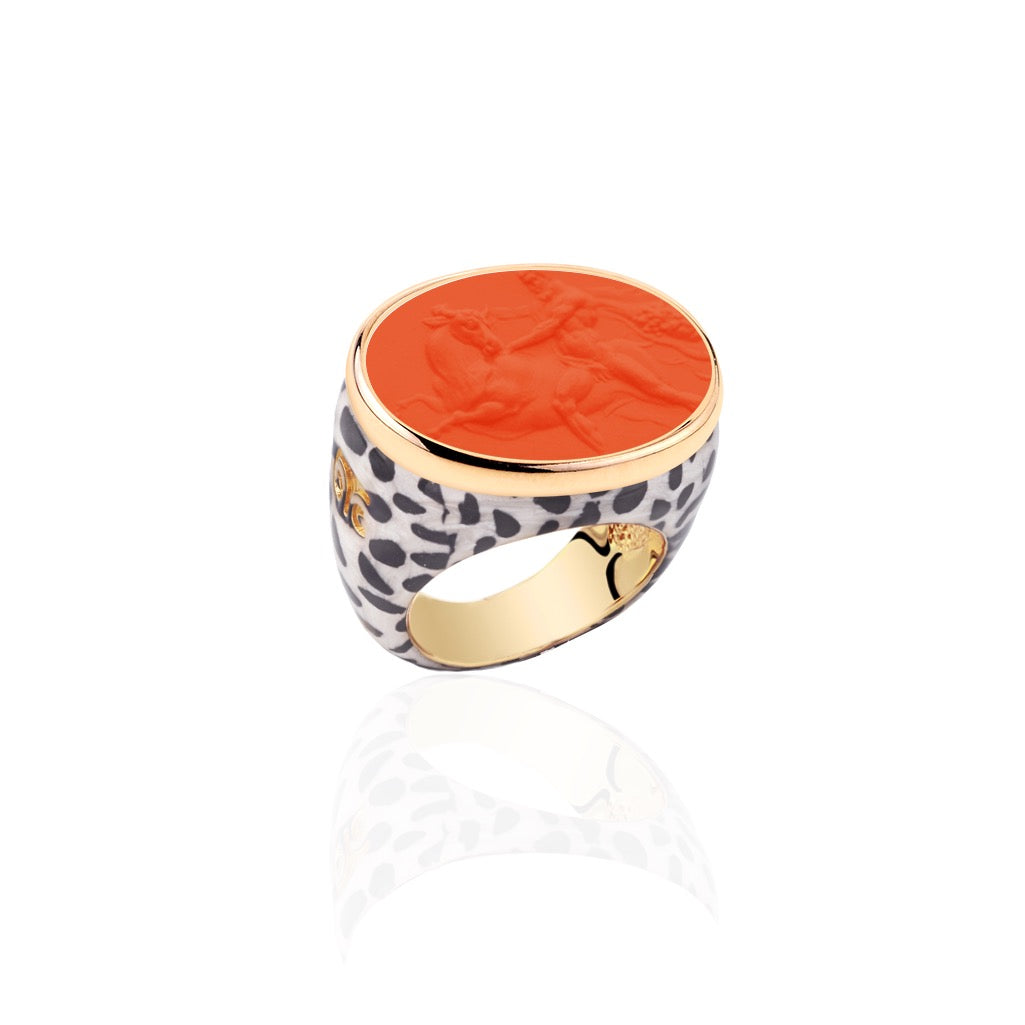
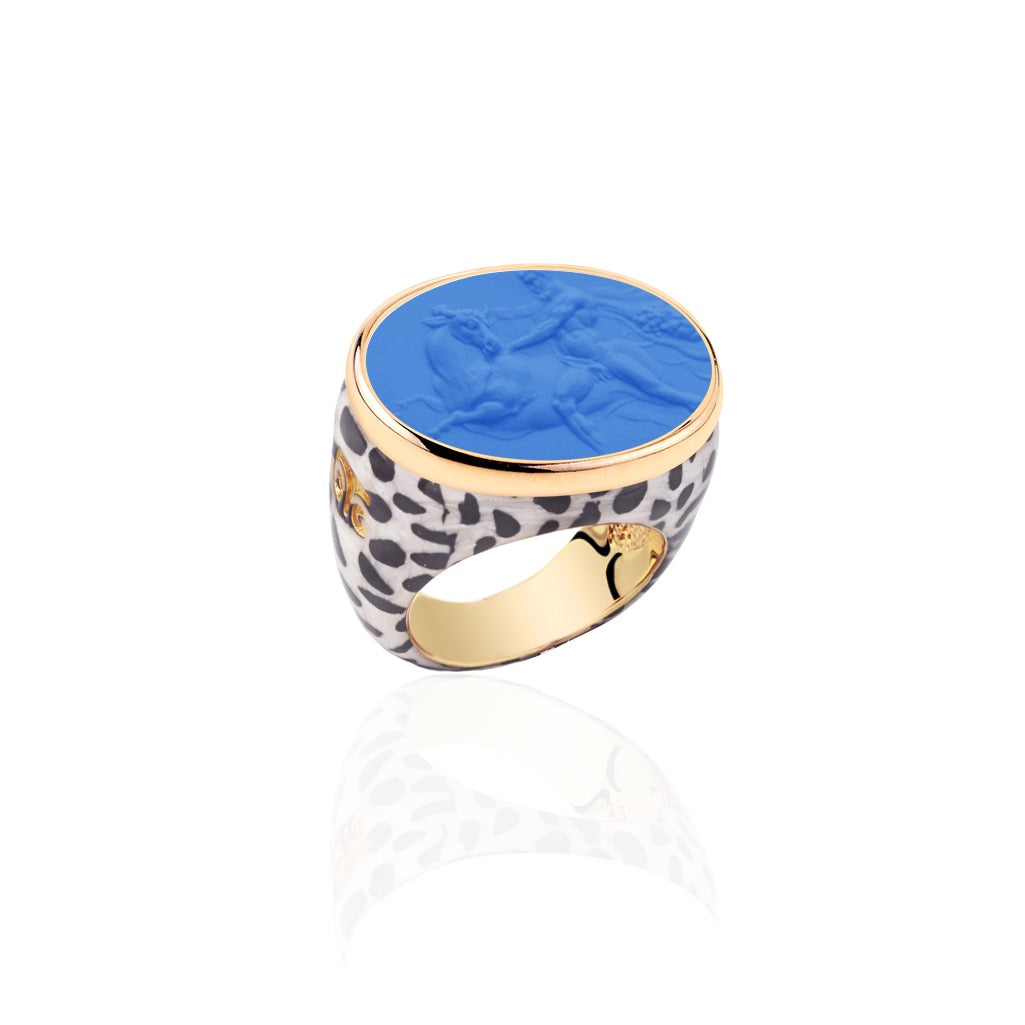
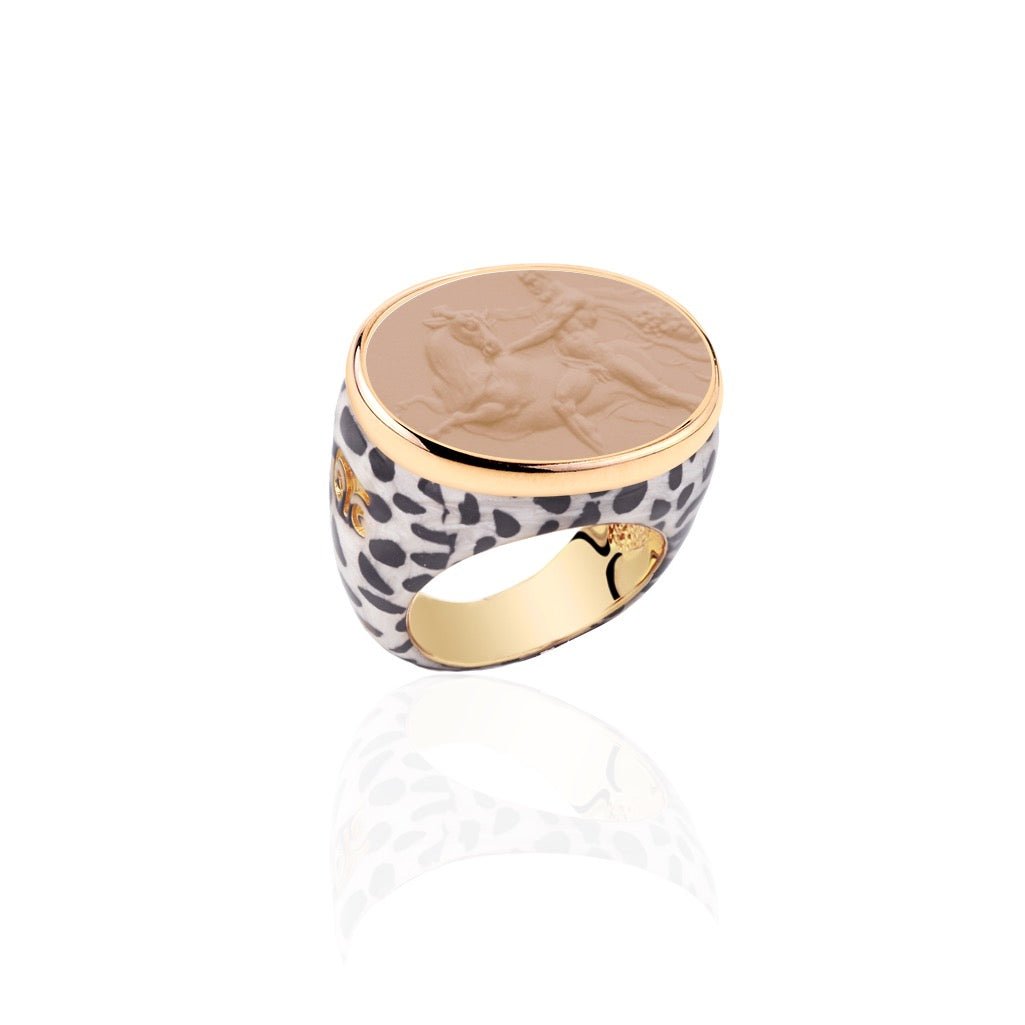
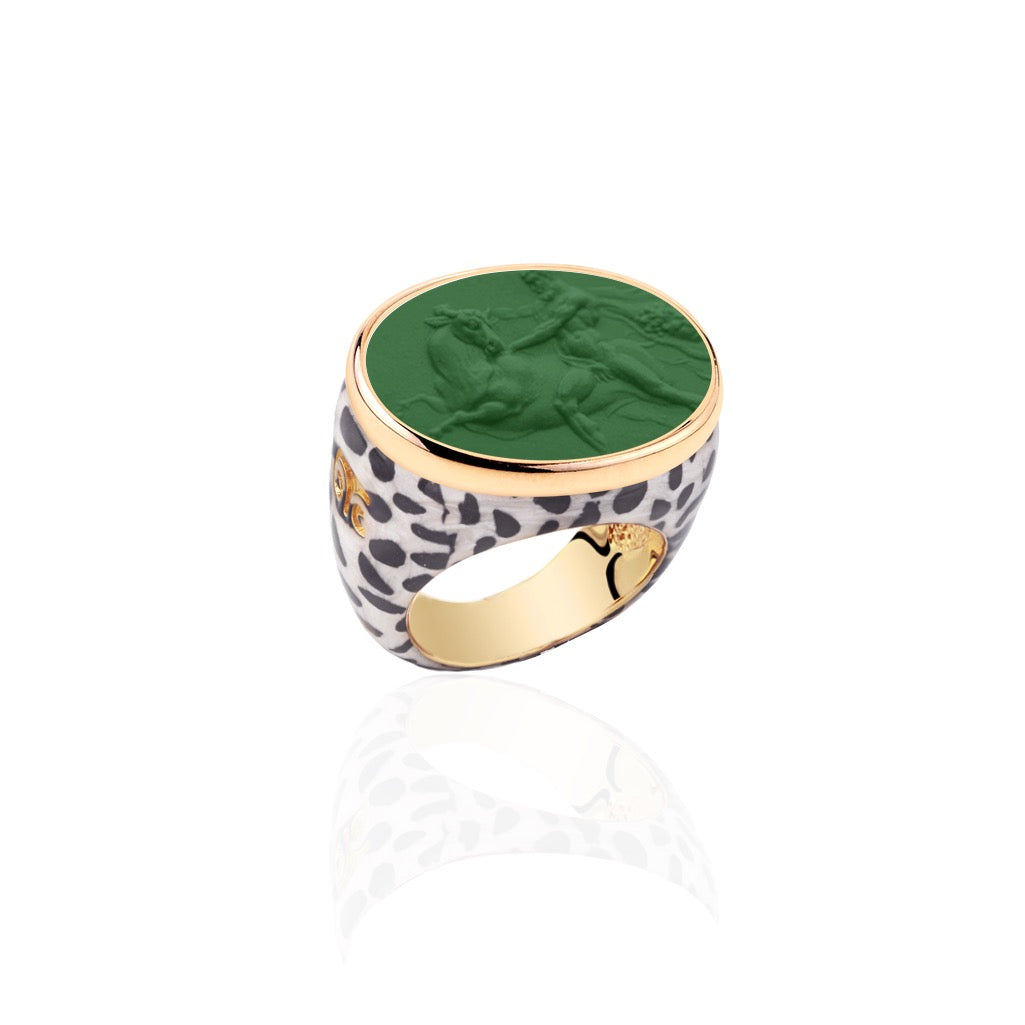
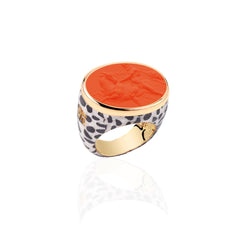
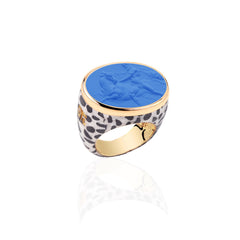
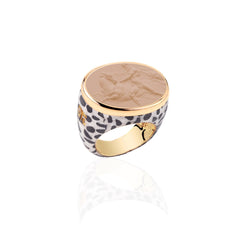
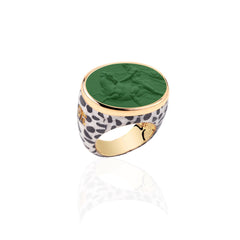
Un modelo de gran personalidad: el camafeo tallado con tanta precisión y ritmo amplifica cada juego de color. Hércules y el Toro en el anillo dálmata — un intaglio que narra el encuentro entre el héroe y el animal. El camafeo es puramente neoclásico, hecho con muy pocas pinceladas — ligeros indicios que transmiten toda la fuerza del mito. Hércules conduce al animal fuera de la ciudad y el animal lo sigue, y cada uno de sus gestos es claro, al igual que lo que logra.
Es una escena donde el movimiento está en todas partes — incluso la pausa es un ritmo. Este mismo dinamismo está en la base: el esmalte blanco y las manchas negras parecen perseguirse, encontrarse, alinearse — tal como sucede en la escena. La decoración moteada envuelve el mito con un contraste gráfico que amplifica la tensión — en diálogo con la fuerza de los volúmenes, la torsión de los cuerpos, cada músculo representado por el intaglio.
El Toro cretense, enloquecido por Poseidón, necesita la ayuda de alguien para encontrar su libertad. Y aquí se percibe con extrema precisión el momento del acuerdo entre las fuerzas. Hay un gran juego de curvas y diagonales, realzado por el blanco y negro del patrón de la joya — sonido tras sonido, casi se puede leer el mito a través de la elocuencia de los efectos visuales que se multiplican con los colores, y la emoción es palpable.
Los colores hacen el resto. La base en blanco y negro con naranja produce un acento audaz y cálido — la escena vibra. El azul claro es fresco y distintivo. La arena acaricia la talla — un tono natural, una nota discreta entre las manchas. El verde, decisivo y nuevo, enciende el patrón casi geométrico y realza el movimiento del relieve.
Notas importantes
Los colores de las joyas en la foto pueden parecer diferentes a los originales. Esto depende de la resolución. Cada pieza está hecha a mano y tiene características únicas.Tabla de tallas

GUÍA DE TALLAS
Encuentra tu talla
Pasos sencillos para medir la talla correcta de tu dedo:
- Mide tu dedo al final del día;
- No midas tu dedo cuando esté demasiado caliente o demasiado frío;
- No olvides que nuestras manos no son idénticas, y que un anillo que puede ajustarse a un dedo de la mano izquierda puede no ajustarse al mismo dedo de la mano derecha;
- Por favor, asegúrate de que la talla seleccionada se deslice a lo largo de toda la longitud de tu dedo.
Para medir la circunferencia de tu dedo, puedes usar una cinta métrica de sastre o ver nuestro video demostrativo para otra técnica (que requerirá un anillo que te quede en el dedo seleccionado). Esta talla corresponde a la circunferencia, que debes usar para encontrar tu talla adecuada correspondiente. (S - M - L - XL)
| Talla | Italia | Estados Unidos | Francia | Diámetro (mm) | Circunferencia (mm) |
|---|---|---|---|---|---|
| S | 12 > 13 | 6 > 6,5 | 52 > 53 | 16,5 > 16,9 | 52 > 53 |
| M | 14 > 15 | 7 > 7 1/4 | 54 > 55 | 17,2 > 17,4 | 54 > 55 |
| L | 16 > 17 | 7,5 > 8 | 56 > 57 | 17,8 > 18,1 | 56 > 57 |
| XL | 18 > 19 | 8, 5 > 9 | 58 > 59 | 18,5 > 18,8 | 58 > 59 |
| 2XL | 20 | 9 | 60 | 19,1 | 60 |
| 3XL | 22 | 10 | 62 | 19,7 | 62 |
| 4XL | 24 | 10 3/4 | 64 | 20,4 | 64 |
| 5XL | 26 | 11 3/4 | 66 | 21 | 66 |
Hércules y el toro
Enfrenta los desafíos con determinación.
El héroe mitológico Hércules (o Heracles) fue famoso por su gran fuerza y resistencia, y celebrado como un mortal extraordinario que, a través del éxito en labores aparentemente imposibles, ganó su lugar inmortal entre los dioses olímpicos. Siendo el más grande de los héroes mitológicos griegos, se le han atribuido una multitud de aventuras y hazañas heroicas a lo largo de los siglos, que probablemente estaban originalmente conectadas con figuras menores y más locales. En la mitología, fue Zeus quien se unió con Alcmene y así engendró a Hércules, explicando el origen de su gran fuerza. Hera, la esposa de Zeus, estaba (comprensiblemente) siempre celosa de Hércules y le hizo la vida difícil desde una edad temprana. La diosa retrasó su nacimiento para que su primo Euristeo naciera primero y así se convirtiera en el gobernante de Grecia según el decreto de Zeus. Hera también envió dos serpientes para matar al recién nacido Hércules, pero el bebé las estranguló fácilmente. Hércules disfrutó del favor divino de los dioses olímpicos y fue especialmente favorecido por Atenea. Hércules, Nápoles, Museo Arqueológico Nacional.
Ver todos los productos- Al elegir una selección, se actualiza la página completa.