
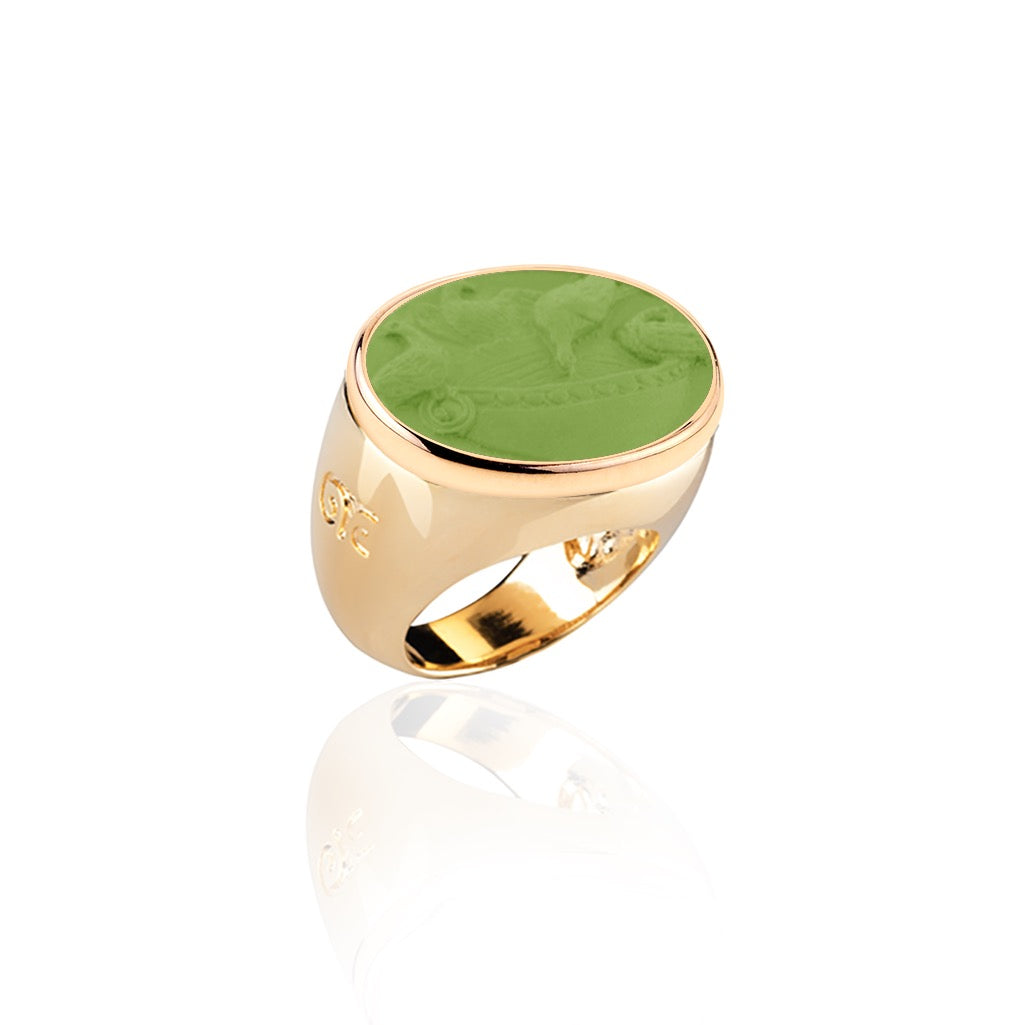
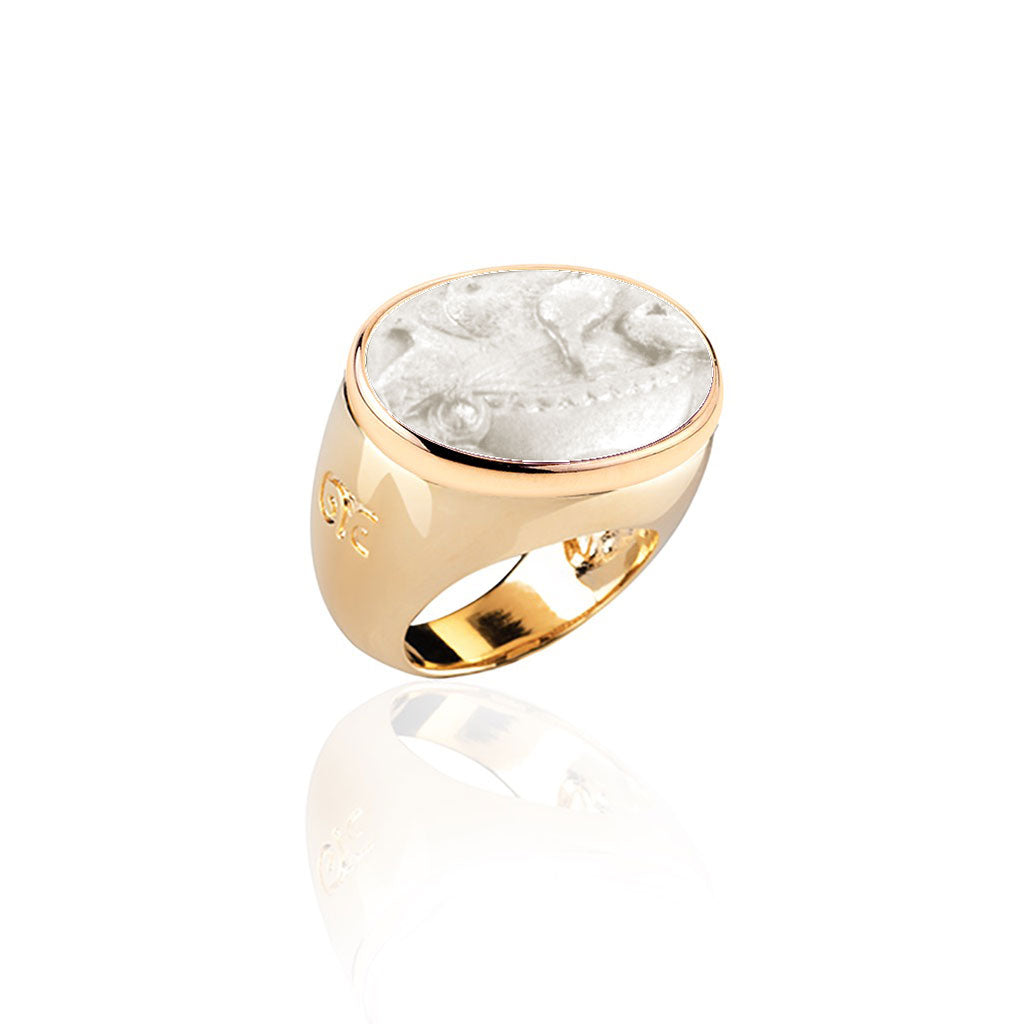
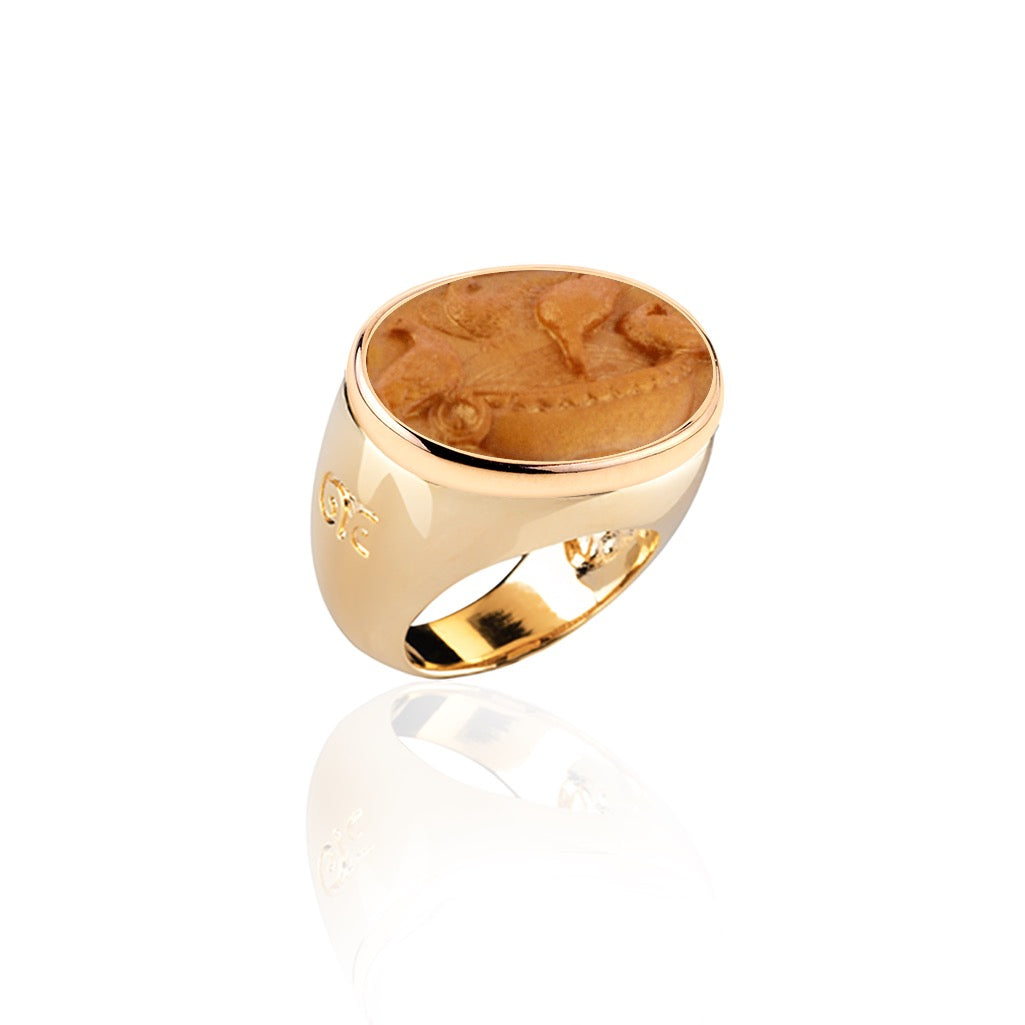
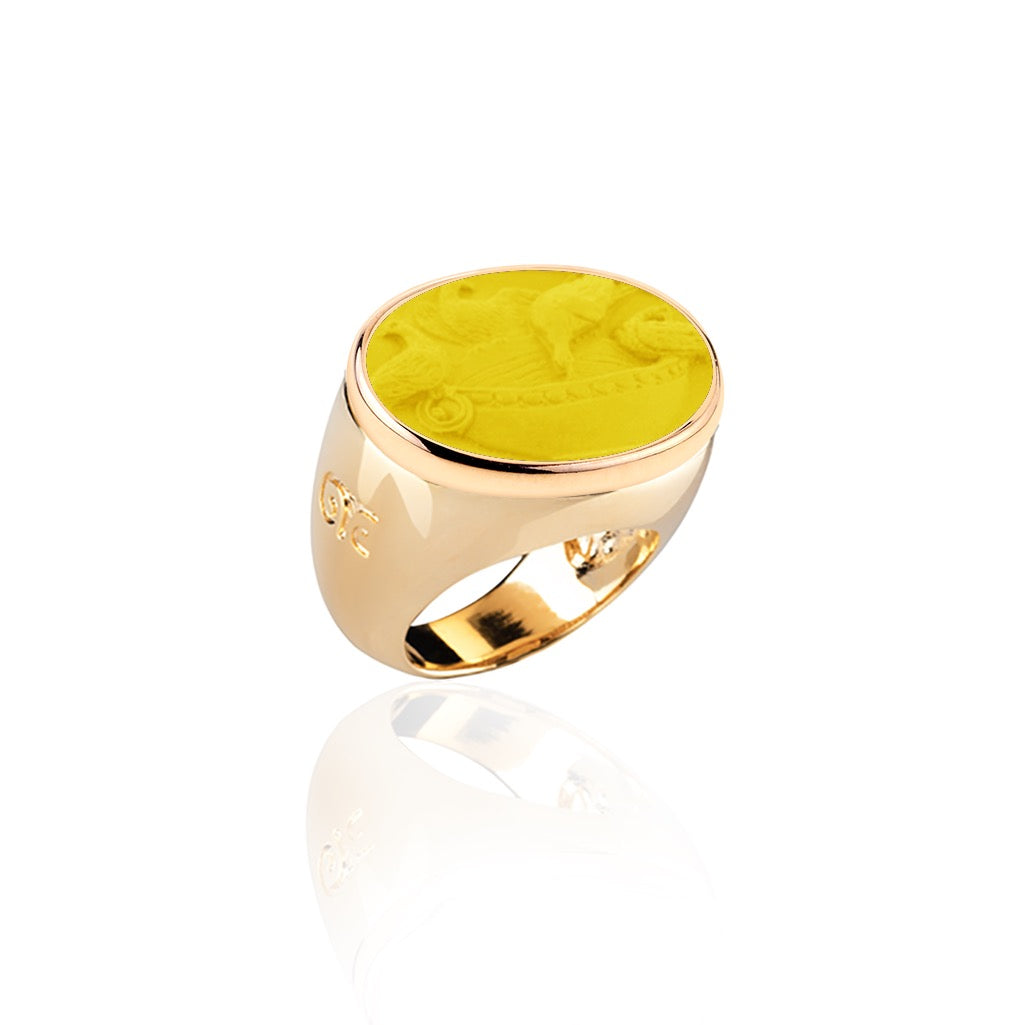
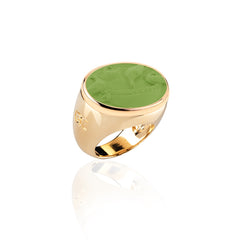
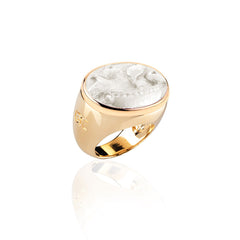
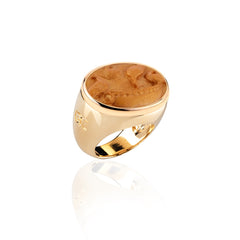
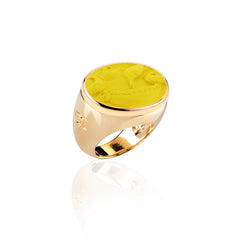
Four doves gathered around a cup, each in a different pose, fill the oval bezel with a vitality that seems almost to overflow from the gold-plated bronze. The Lux Ring embraces this millennia-old subject — the one Pliny admired for its perfection — and brings it into full light through the 18 kt gold plating. The intaglio is generous in its volumes: each dove has its own space yet all touch one another, creating a contained and vibrant scene that reads in an instant. The birds’ bodies, their wings just folded, their beaks turned towards the water convey a moment of pure sharing where calm is the true protagonist.
The ring is smooth, luminous, with a full roundness that accompanies the hand and conveys an immediate sensation of pleasure. The hand-polished surface reflects light with precise quality, and the contrast between the gold-plated bronze and the depth of the engraving gives the jewel an unexpected presence. One has the impression of wearing a fragment of ancient mosaic that has preserved its joy intact — the warm metal and the subject declare themselves as parts of the same narrative, where the pleasure of the moment is all that matters.
Each colour offers a different aspect of this convivial scene. Gold creates a total accord with the gilded base: the doves appear made of the same material as the ring, an intimate and magnificent dialogue. Pearl draws out every detail of the engraving with a soft luminosity that reveals the feathers and the curves of the bodies. Yellow is playful and luminous — it brings the immediate sense of a shared joy, a luminous moment to be lived together. Light Green introduces a fresh note that soothes and calms, like a garden welcoming the ritual of the cup.
Harmony multiplies when it is shared.
Important Notes
The jewels' colors in the photo may look different from the original one. This depends from the resolution. Each object is handmade and has unique characteristics.Size chart

SIZE GUIDE
Find your size
Simple steps to measure the correct size of your finger:
- Measure your finger at the end of the day;
- Do not measure your finger when it is either too hot or too cold;
- Don’t forget that our hands are not identical, and that a ring that might fit on a finger on our left hand might not fit on the same finger on our right hand;
- Please be sure to check that your selected size slides along the full length of your finger.
To measure the circumference of your finger, you can use a taylor’s tape measure, or take a look at our video demonstration for another technique (which will require a ring that fits on your selected finger.) This size corresponds to the circumference, which you must use to find your corresponding appropriate size. (S - M - L - XL)
| Size | Italy | USA | France | Diameter (mm) | Circumference (mm) |
|---|---|---|---|---|---|
| S | 12 > 13 | 6 > 6,5 | 52 > 53 | 16,5 > 16,9 | 52 > 53 |
| M | 14 > 15 | 7 > 7 1/4 | 54 > 55 | 17,2 > 17,4 | 54 > 55 |
| L | 16 > 17 | 7,5 > 8 | 56 > 57 | 17,8 > 18,1 | 56 > 57 |
| XL | 18 > 19 | 8, 5 > 9 | 58 > 59 | 18,5 > 18,8 | 58 > 59 |
| 2XL | 20 | 9 | 60 | 19,1 | 60 |
| 3XL | 22 | 10 | 62 | 19,7 | 62 |
| 4XL | 24 | 10 3/4 | 64 | 20,4 | 64 |
| 5XL | 26 | 11 3/4 | 66 | 21 | 66 |
Pliny’s Doves
Gentle hearts stay strong.
A mosaic from Hadrian’s Villa, now in the Capitoline Museums, depicts a group of doves on a round bowl. As described by Pliny, one dove is drinking while the others are sunning themselves. The Doves of Pliny, or the Capitoline Doves depicts the doves artistically but realistically. The mosaic is made only of cubes of colored marble, without any colored glass as in other mosaics. It was discovered in 1737 during excavations at Hadrian’s Villa led by Cardinal Giuseppe Alessandro Furietti, who thought it was the mosaic that Pliny had described, although other scholars think it is a copy of the original that was made for Hadrian. The Hadrian’s villa mosaic has in turn been copied many times in many formats. Musei Capitolini – Roma
Show all products- Choosing a selection results in a full page refresh.