







The grace of this intaglio is rare — the cameo is smooth yet rich in volume, every curl, every line renders Antinous perfectly. There is something in his gaze, so gentle and distant, that sits well with the weightlessness of the jewel. The Classic model lets the cameo speak through lightness rather than solidity — and gives us back the moments of joy of this young man, deeply loved in Rome and legendary across the Mediterranean.
The classical profile par excellence. Antinous, the young favourite of the Emperor Hadrian, was deified out of love and reproduced in every corner of the empire so that his face would endure and his presence continue to circulate through the world. His features express an ideal beauty beyond time, recognisable in every age, that tells of a perfect harmony between form and inner life.
In this ring the plexiglass gives the profile a new light, heightening its expressiveness. The coloured base converses with the intaglio and with the gold-plated bronze bezel: three elements that read together in a completely contemporary balance. The form belongs to the great historical collections; the material and the colours are today’s. A generous piece that surprises: a presence that captures the eye with a lightness that astonishes.
The bases build three distinct atmospheres: grey is the quietest, recalling antique prints; black produces the subject’s maximum intensity; green creates a fresh, unexpected note that opens the classical toward a more natural reading. White preserves the classicism, orange ignites a modern colour tension; sky blue gives air and distance, and pink reveals an unexpected tenderness. Every combination renews the expression.
Important Notes
The jewels' colors in the photo may look different from the original one. This depends from the resolution. Each object is handmade and has unique characteristics.Size chart

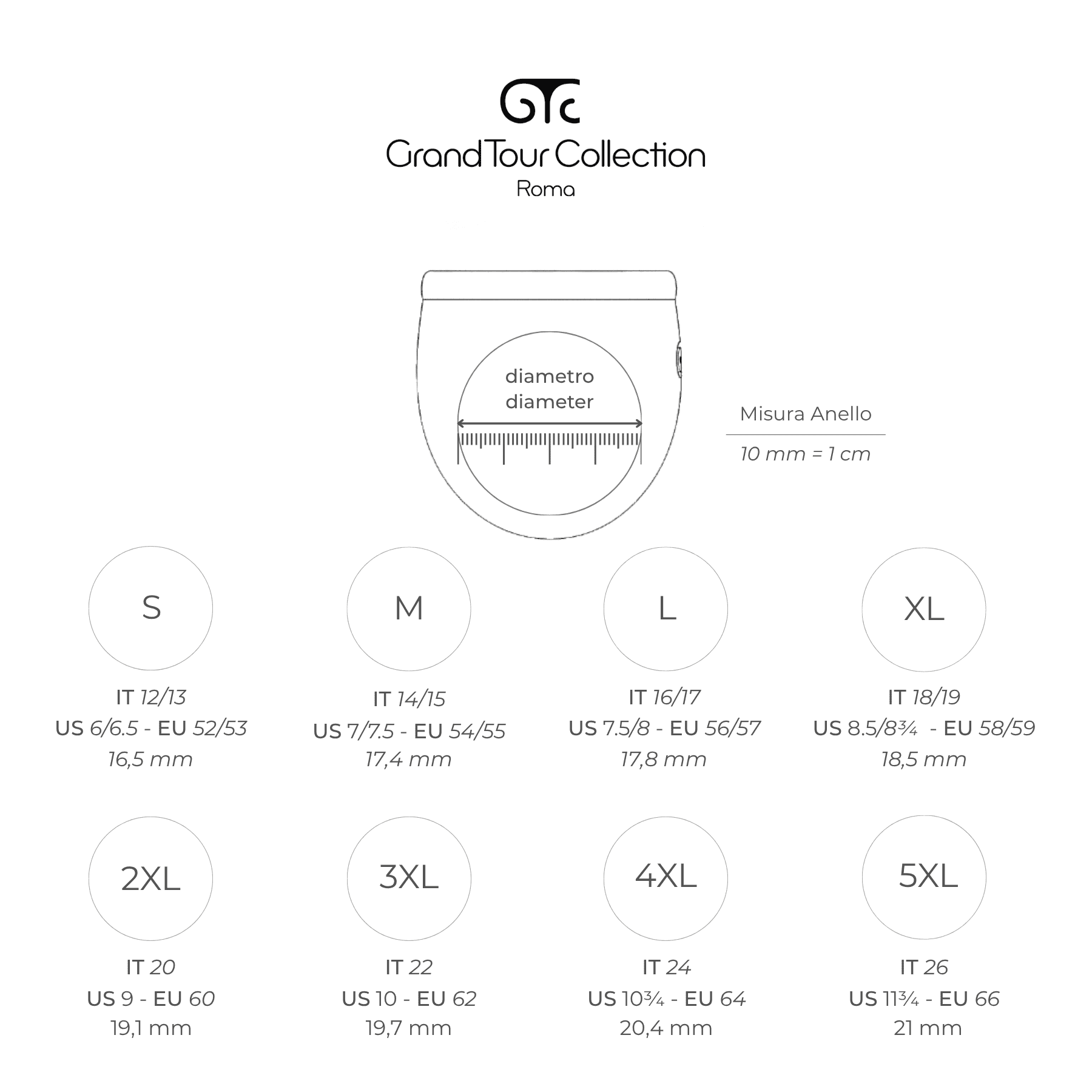
SIZE GUIDE
Find your size
Simple steps to measure the correct size of your finger:
- Measure your finger at the end of the day;
- Do not measure your finger when it is either too hot or too cold;
- Don’t forget that our hands are not identical, and that a ring that might fit on a finger on our left hand might not fit on the same finger on our right hand;
- Please be sure to check that your selected size slides along the full length of your finger.
To measure the circumference of your finger, you can use a taylor’s tape measure, or take a look at our video demonstration for another technique (which will require a ring that fits on your selected finger.) This size corresponds to the circumference, which you must use to find your corresponding appropriate size. (S - M - L - XL)
| Size | Italy | USA | France | Diameter (mm) | Circumference (mm) |
|---|---|---|---|---|---|
| S | 12 > 13 | 6 > 6,5 | 52 > 53 | 16,5 > 16,9 | 52 > 53 |
| M | 14 > 15 | 7 > 7 1/4 | 54 > 55 | 17,2 > 17,4 | 54 > 55 |
| L | 16 > 17 | 7,5 > 8 | 56 > 57 | 17,8 > 18,1 | 56 > 57 |
| XL | 18 > 19 | 8, 5 > 9 | 58 > 59 | 18,5 > 18,8 | 58 > 59 |
| 2XL | 20 | 9 | 60 | 19,1 | 60 |
| 3XL | 22 | 10 | 62 | 19,7 | 62 |
| 4XL | 24 | 10 3/4 | 64 | 20,4 | 64 |
| 5XL | 26 | 11 3/4 | 66 | 21 | 66 |
Antinous
Love remembered is never lost.
Antinous (also Antinoo or Antinoös; 27 November, c. 111 – before 30 October 130) was a Bithynian Greek youth and a favourite, or lover, of the Roman emperor Hadrian. He was deified after his death, being worshiped in both the Greek East and Latin West, sometimes as a god (theos) and sometimes merely as a deified mortal (heros). Antinous became associated with homosexuality in Western culture, appearing in the work of Oscar Wilde and the Portuguese poet Fernando Pessoa.
Show all products- Choosing a selection results in a full page refresh.