
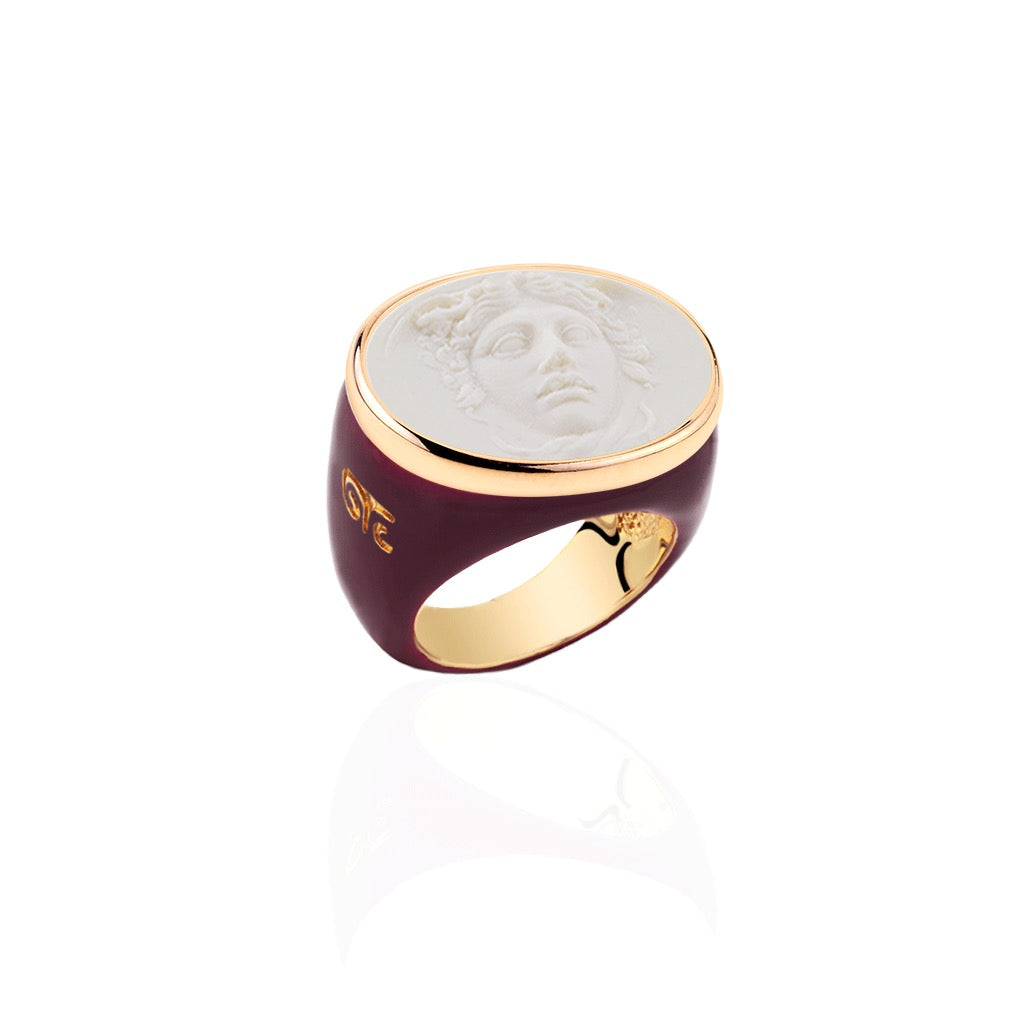
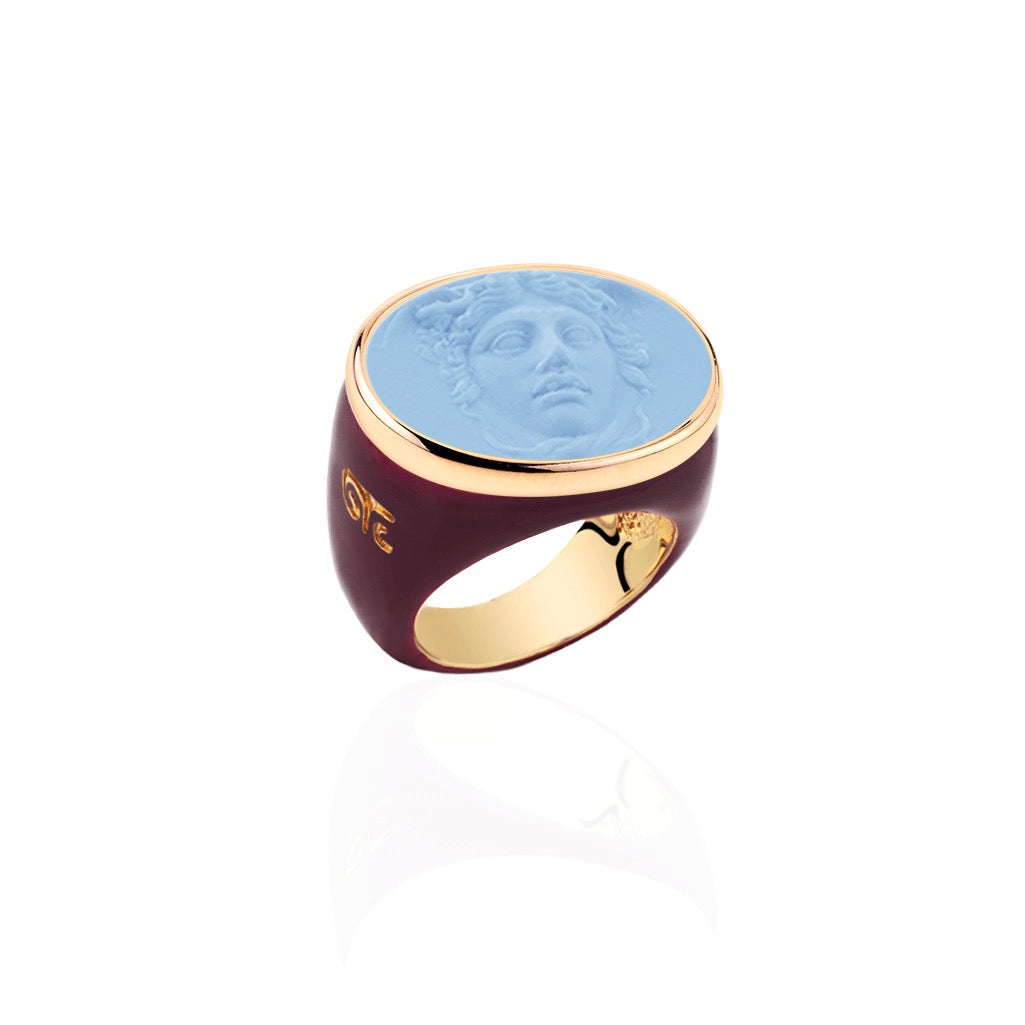
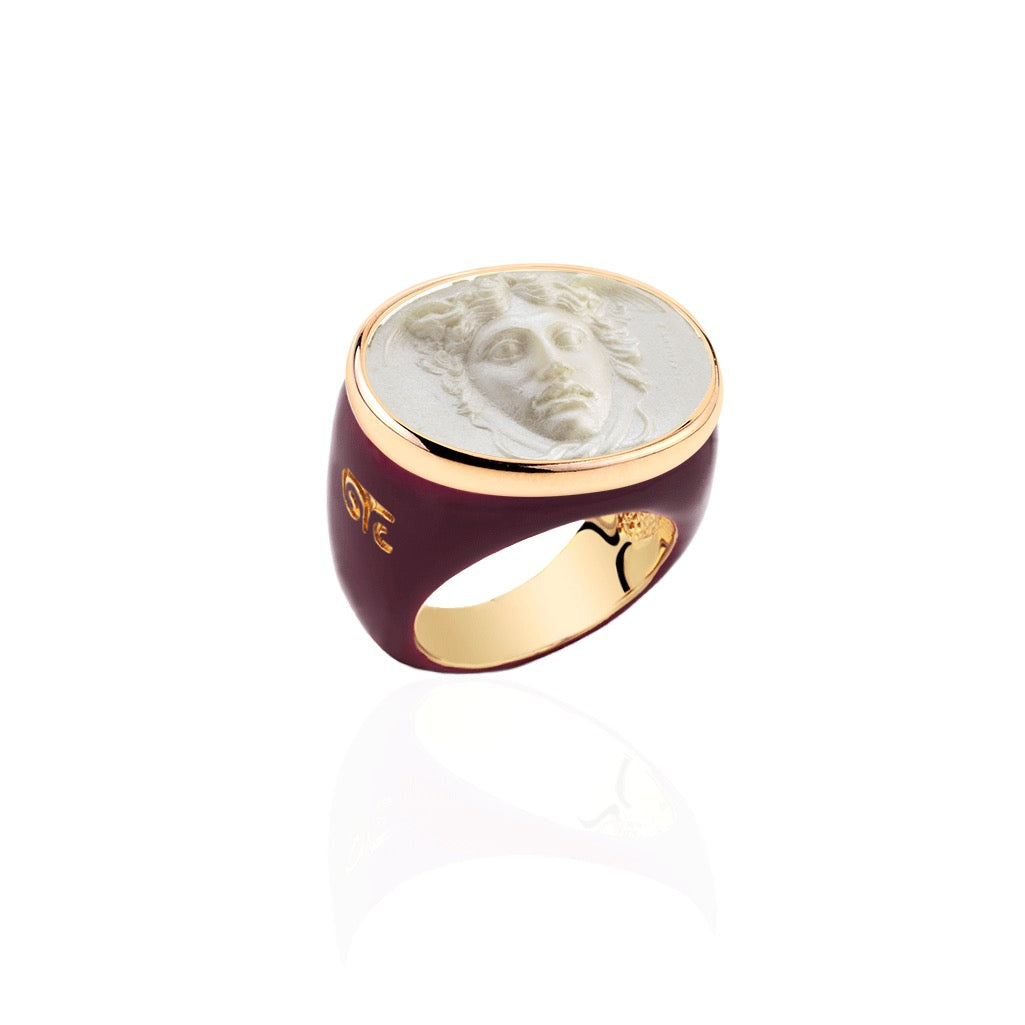
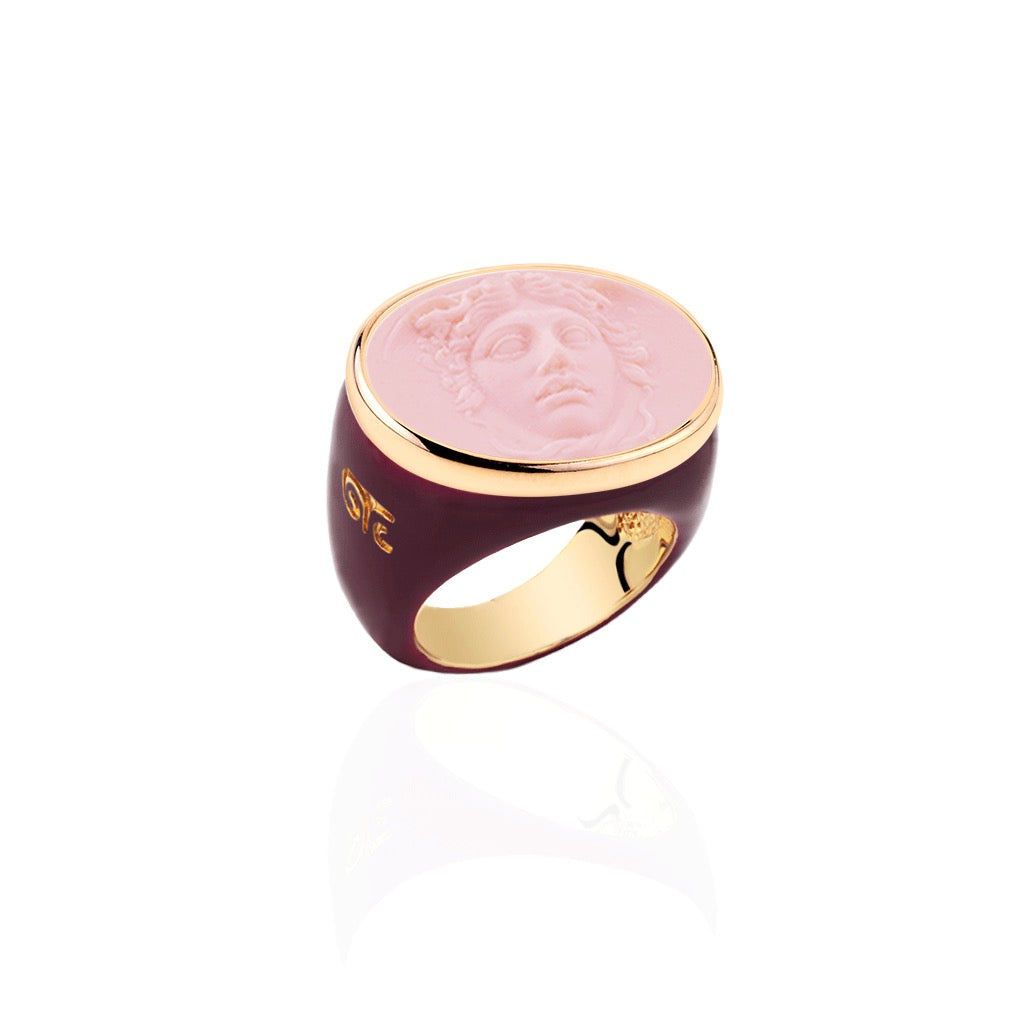
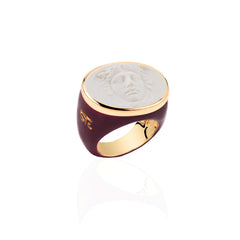
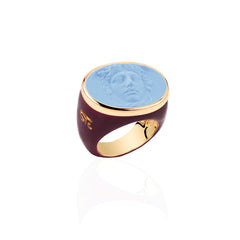
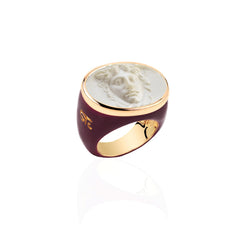
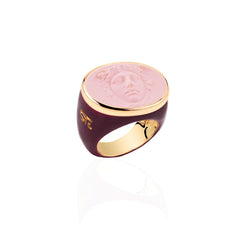
All the expressiveness of Medusa condenses into the oval form of the bezel of this ring. Calm, serene, seraphic. The face among the most moulded, sculpted and reproduced in existence — on this jewel it speaks intimately, to us. She is peaceful, enveloped, composed. She knows who she is, and carries with her the quietness of one who has no need to declare it. Her charisma is entirely inward. Her fascination lives in the steady, penetrating gaze she has always turned towards us.
The bordeaux enamel of this model envelops her, clothes her — almost a garment draped over this portrait. The most majestic and at the same time most placid aspect of her is perfectly expressed by this smooth enamel that coats the bronze with density. The ring has substance, has presence. The oval frame follows every line of the face — the symmetry of the Greek nose, the serpents becoming pure decoration. Remarkable how each colour renders her still more composed and steady. Including this bordeaux, which nourishes, which caresses.
White moulds her like plaster, like freshly worked kaolin — a mineral candour that defines her every feature, as though she had just been carved. Pearl gives her an iridescence that makes her almost live, almost speak, in an ever-calm tone — a smooth, soft and reflective voice through the lustre of pearls. Pale blue immerses her in a pure lightness — almost suspended, where everything is air, distance and a sense of freedom. Pink holds a tenderness of its own — a red that is being born, that is arriving, gentle and steady together, carrying within it all the essence of something that is blossoming. It is blooming.
Important Notes
The jewels' colors in the photo may look different from the original one. This depends from the resolution. Each object is handmade and has unique characteristics.Size chart

SIZE GUIDE
Find your size
Simple steps to measure the correct size of your finger:
- Measure your finger at the end of the day;
- Do not measure your finger when it is either too hot or too cold;
- Don’t forget that our hands are not identical, and that a ring that might fit on a finger on our left hand might not fit on the same finger on our right hand;
- Please be sure to check that your selected size slides along the full length of your finger.
To measure the circumference of your finger, you can use a taylor’s tape measure, or take a look at our video demonstration for another technique (which will require a ring that fits on your selected finger.) This size corresponds to the circumference, which you must use to find your corresponding appropriate size. (S - M - L - XL)
| Size | Italy | USA | France | Diameter (mm) | Circumference (mm) |
|---|---|---|---|---|---|
| S | 12 > 13 | 6 > 6,5 | 52 > 53 | 16,5 > 16,9 | 52 > 53 |
| M | 14 > 15 | 7 > 7 1/4 | 54 > 55 | 17,2 > 17,4 | 54 > 55 |
| L | 16 > 17 | 7,5 > 8 | 56 > 57 | 17,8 > 18,1 | 56 > 57 |
| XL | 18 > 19 | 8, 5 > 9 | 58 > 59 | 18,5 > 18,8 | 58 > 59 |
| 2XL | 20 | 9 | 60 | 19,1 | 60 |
| 3XL | 22 | 10 | 62 | 19,7 | 62 |
| 4XL | 24 | 10 3/4 | 64 | 20,4 | 64 |
| 5XL | 26 | 11 3/4 | 66 | 21 | 66 |

Medusa Rondanini
True strength is being yourself
The so-called “Rondanini Medusa”. Marble, Roman copy of a 5th-century BC Greek original by Phidias, which was set on the shield of Athena Parthenos. The Munich Glyptothek’s Medusa Rondanini is possibly a 5th-century BC work, and the oldest-known ”beautiful gorgoneion” sculpture. The design may have been copied from a gilded bronze aegis that once hung in the Acropolis, where it would have been meant to ward off evil and bad luck. A revision of the grotesque, disk-shaped death masks of older gorgoneia, the Medusa Rondanini appears to borrow the idealized likeness of Athena of Velletri, wreathed in decorative snakes and delicate owl wings—Chthonic dread and death mixed with Olympian beauty and cunning. While on display in the Palazzo Rondanini in Rome, it was noticed and first brought to the attention of Northern European art connoisseurs in the 1780s by Johann Wolfgang von Goethe, who wrote, “I would say something about it if everything one could say about such a work were not a waste of breath.” Located in the Glyptotheum of Munich
Show all products- Choosing a selection results in a full page refresh.