
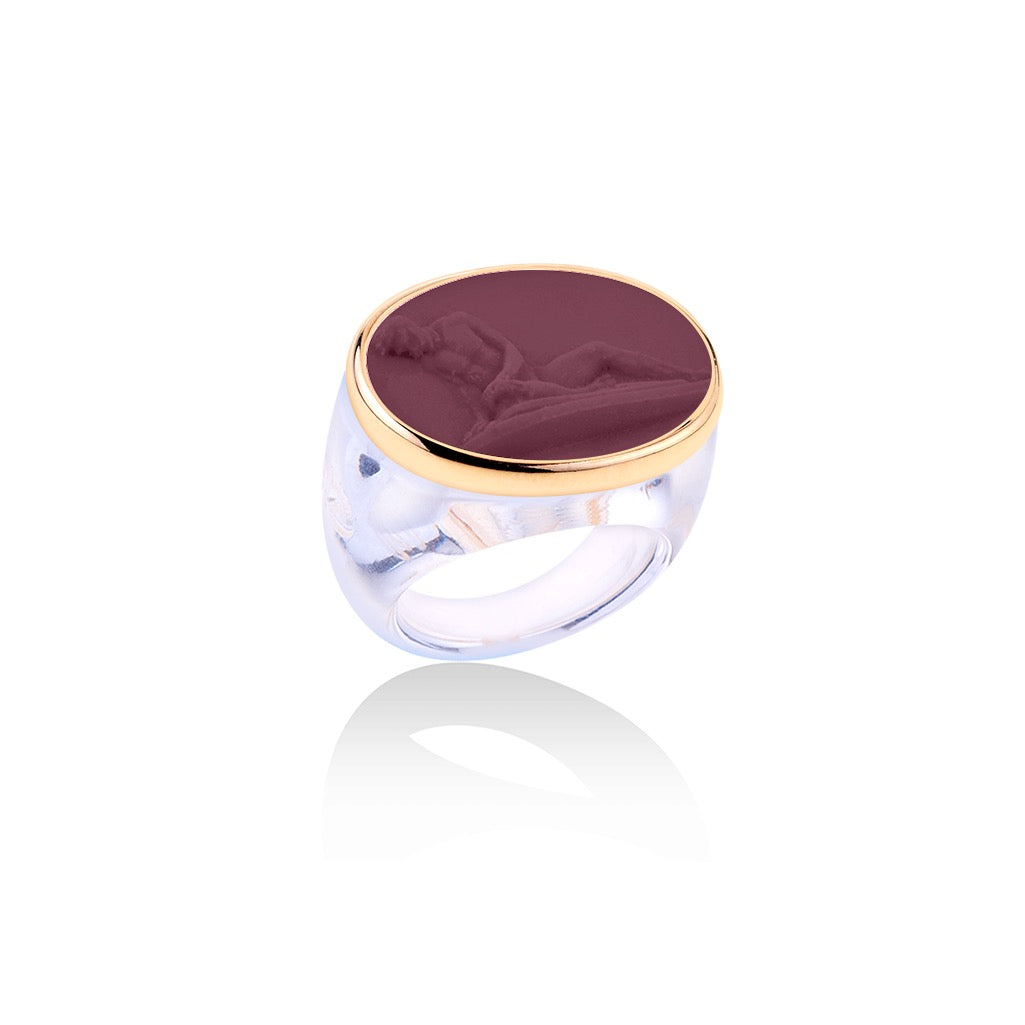
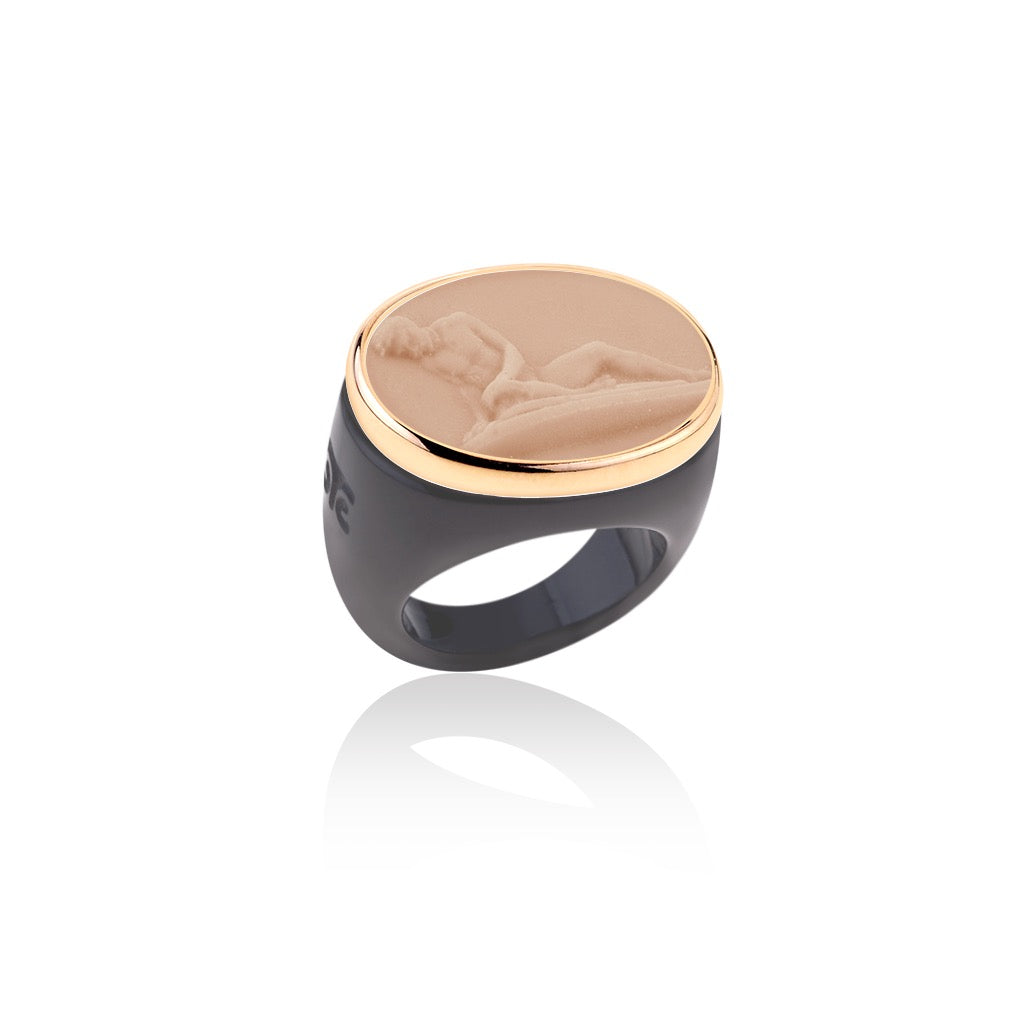
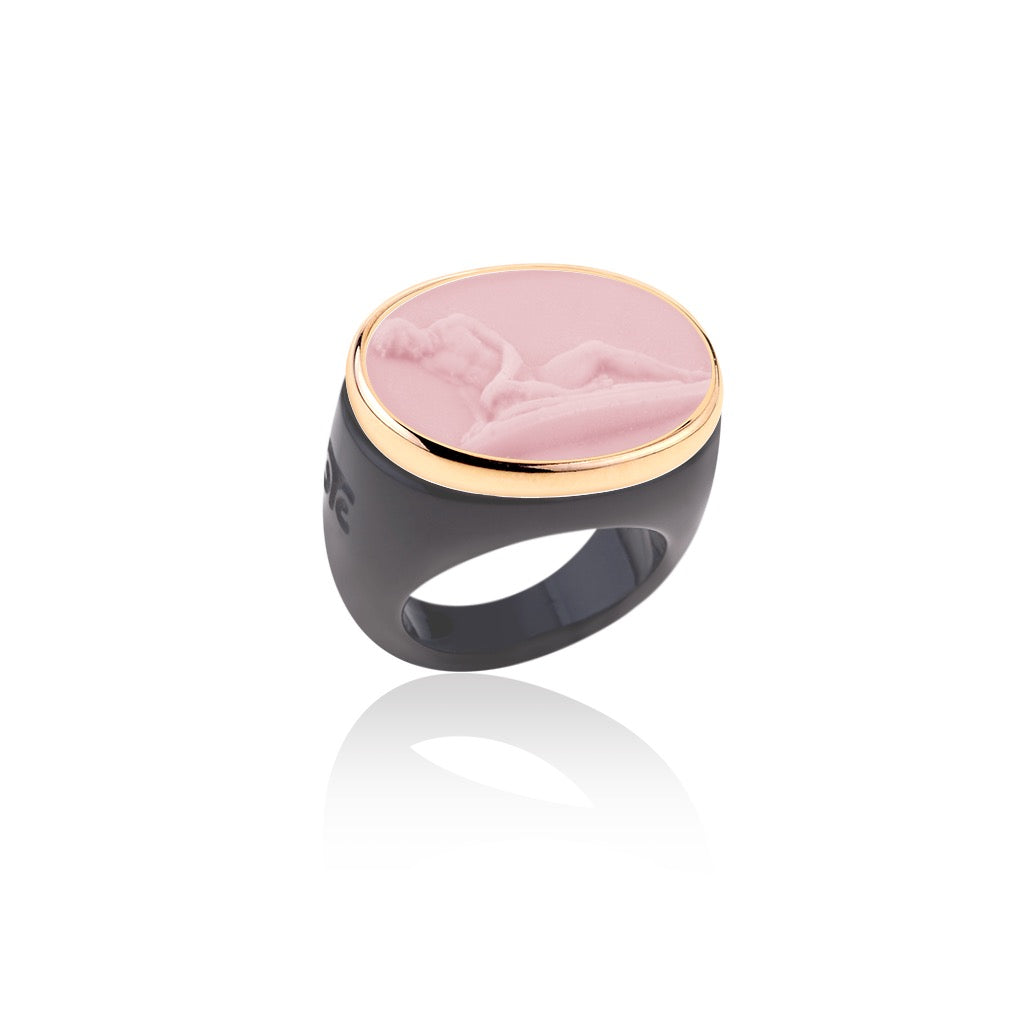
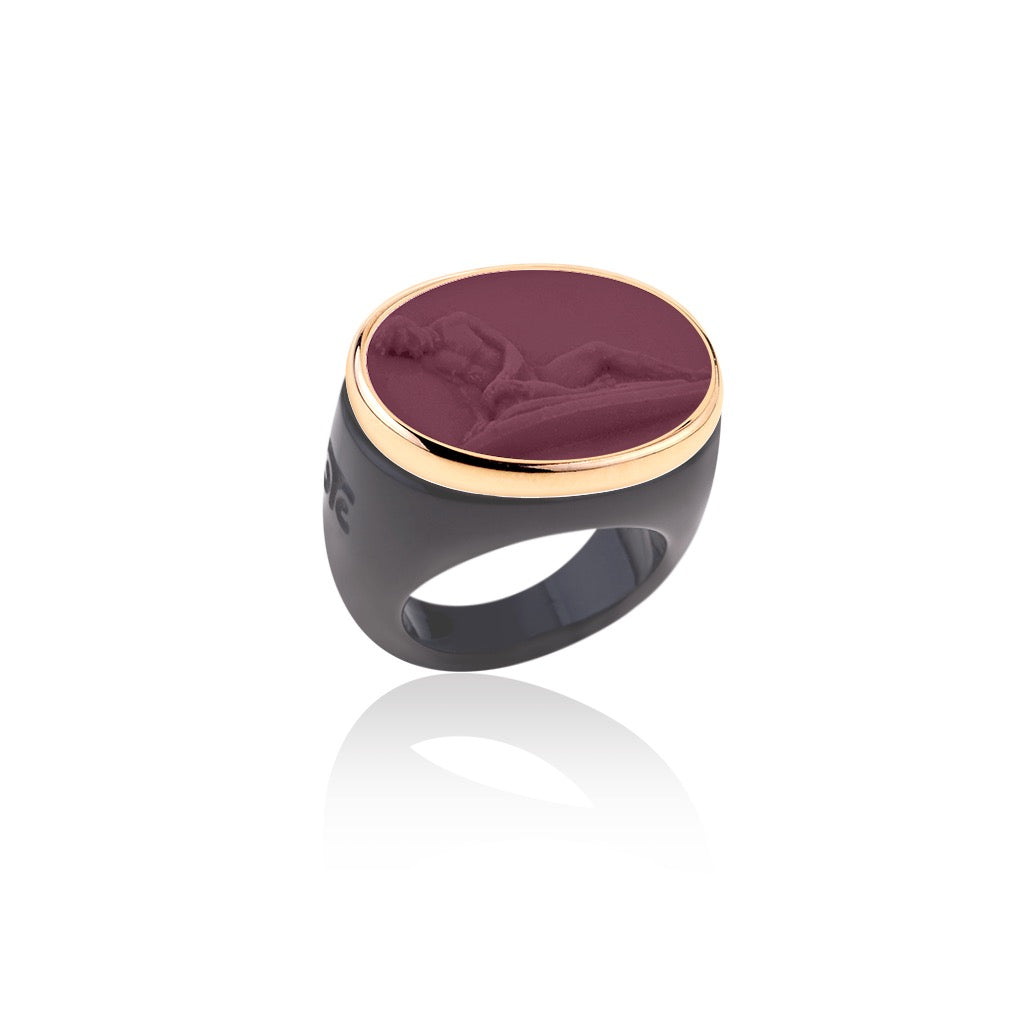
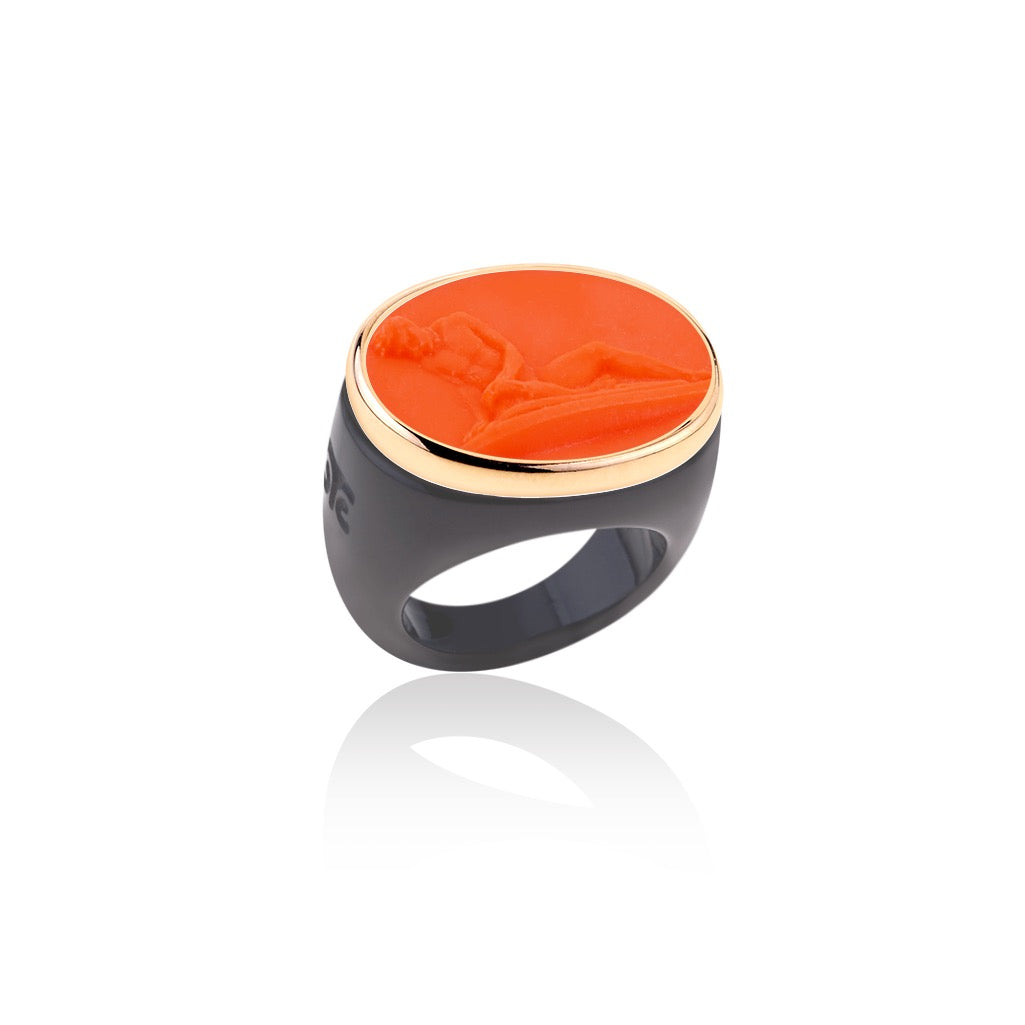
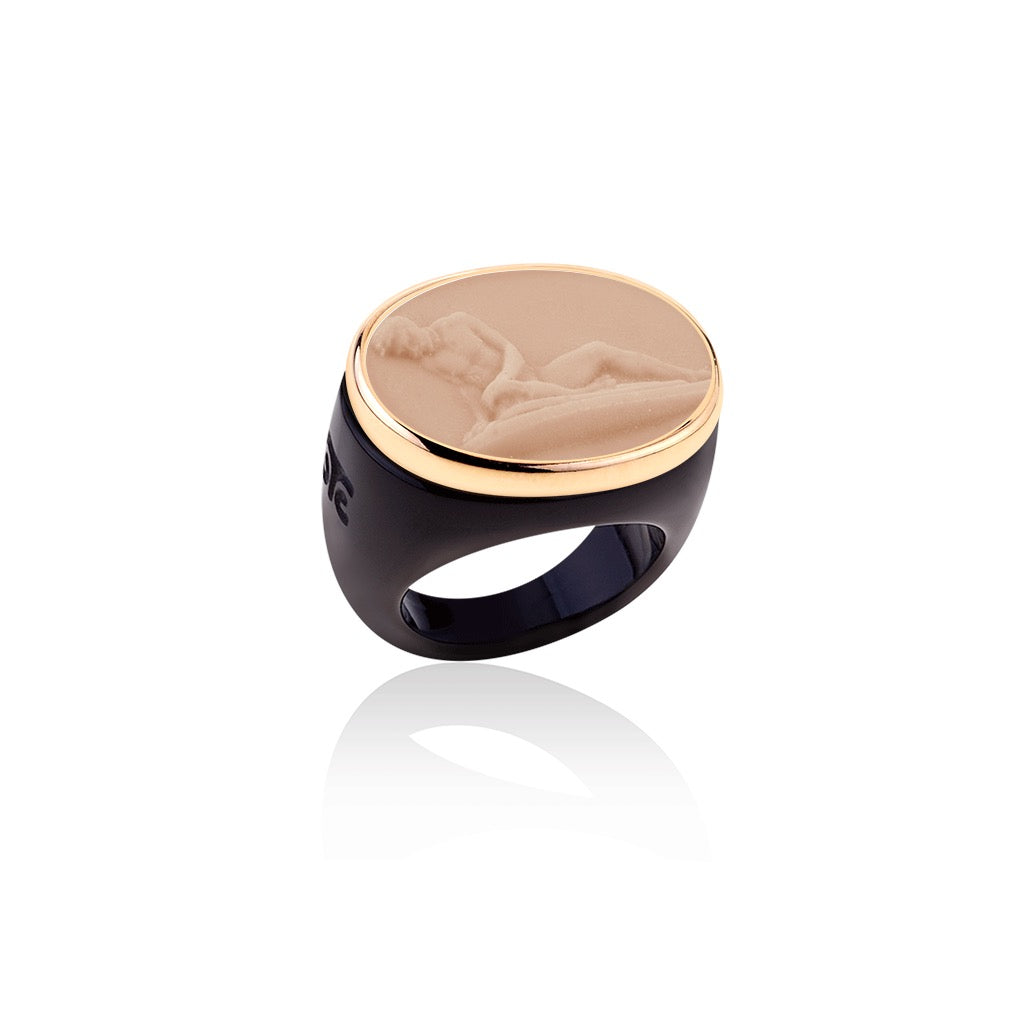
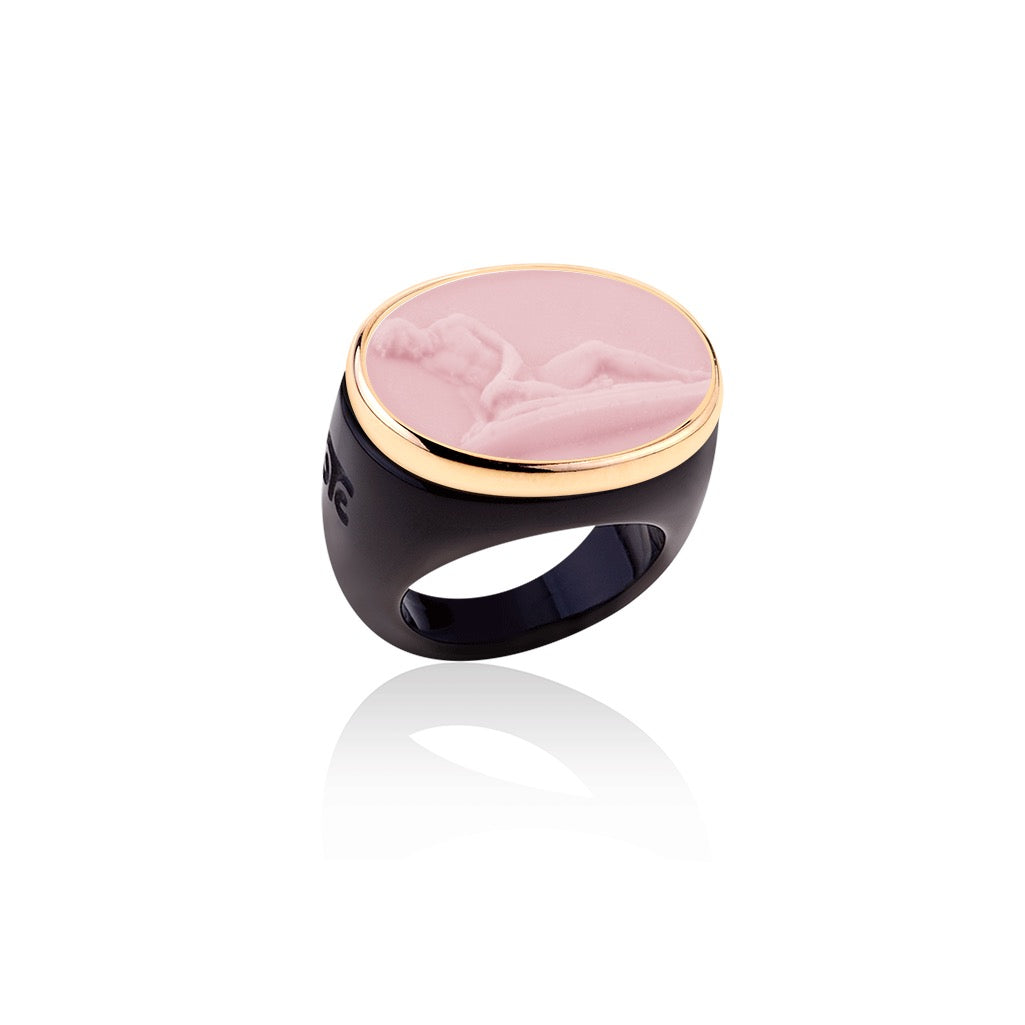
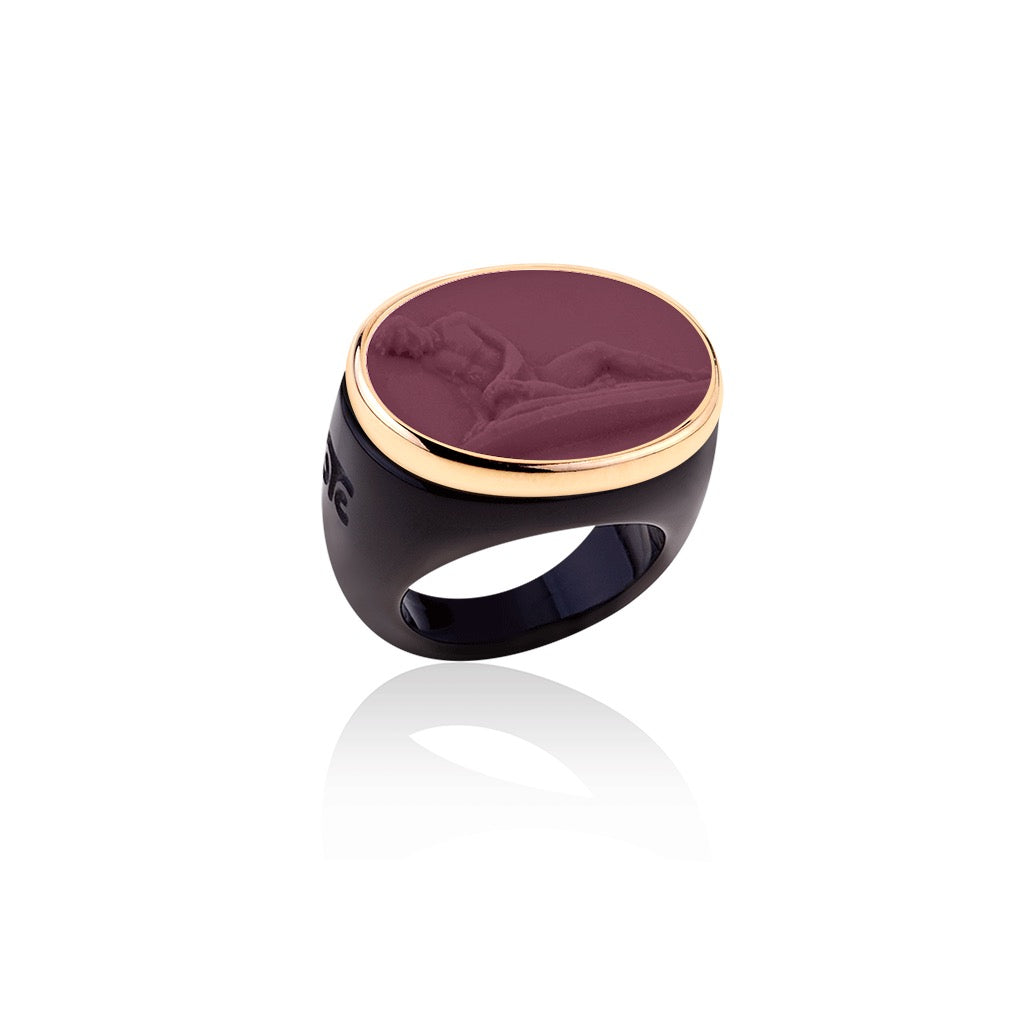
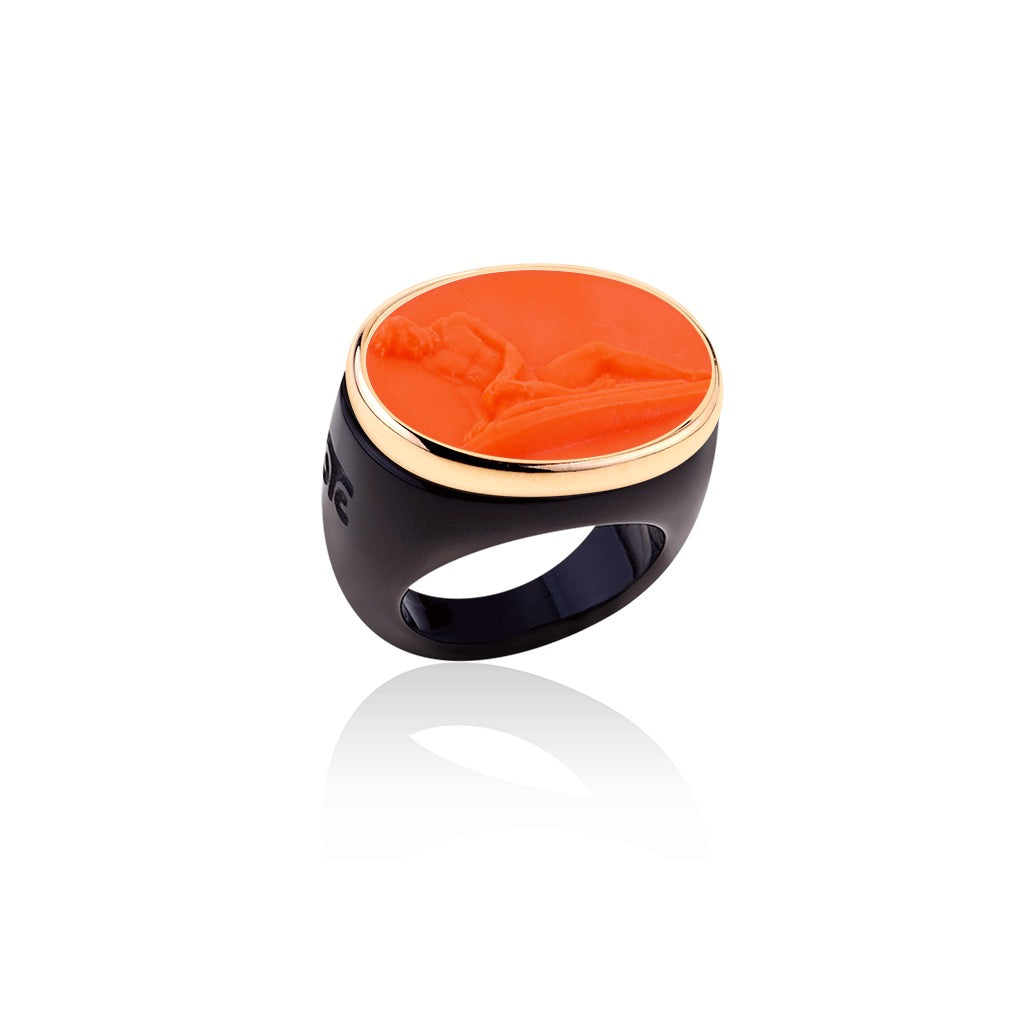
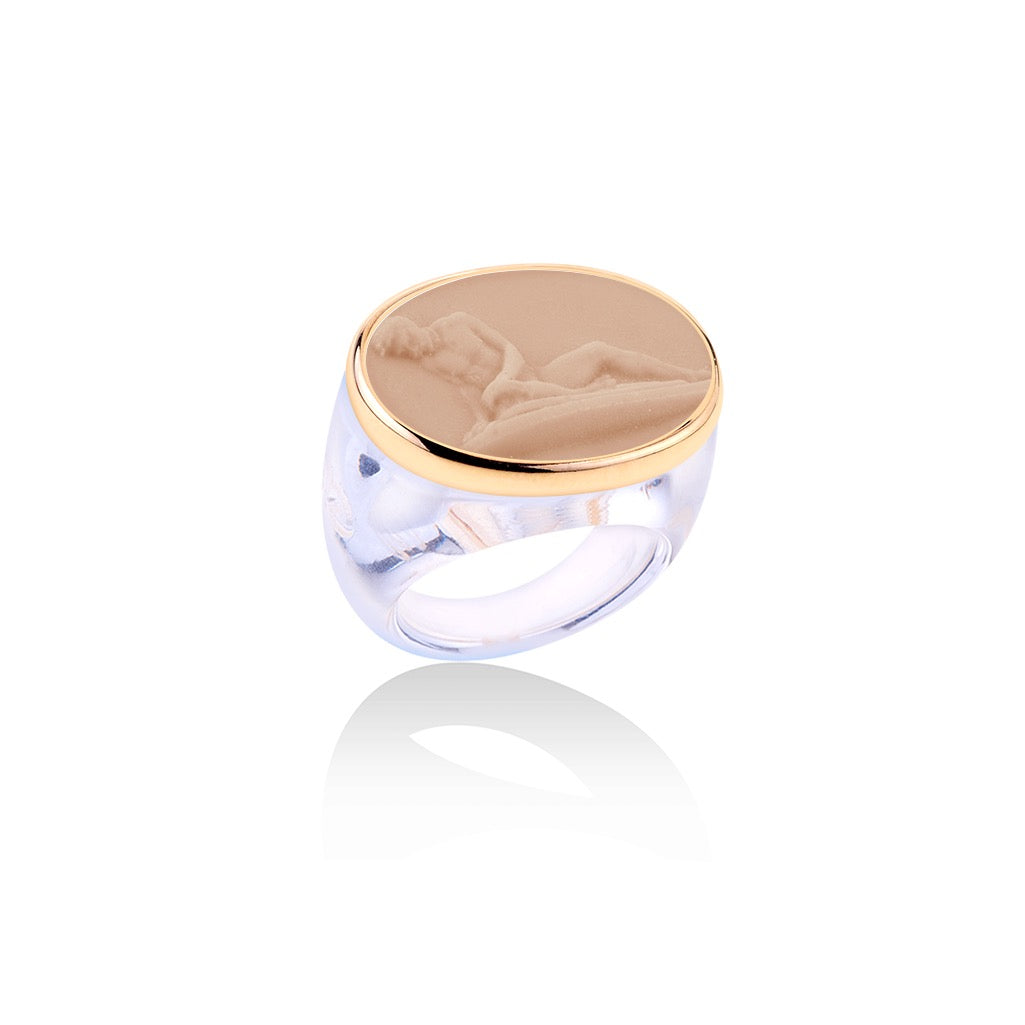
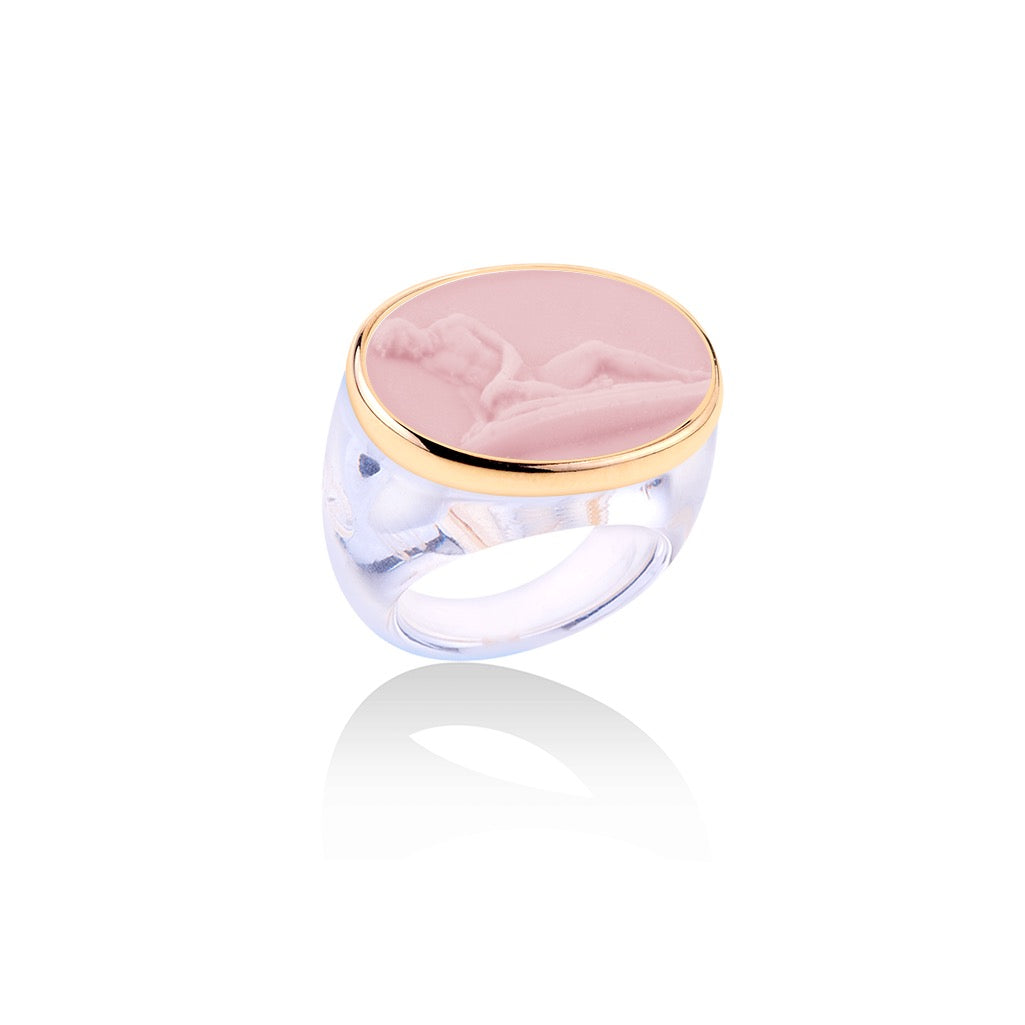
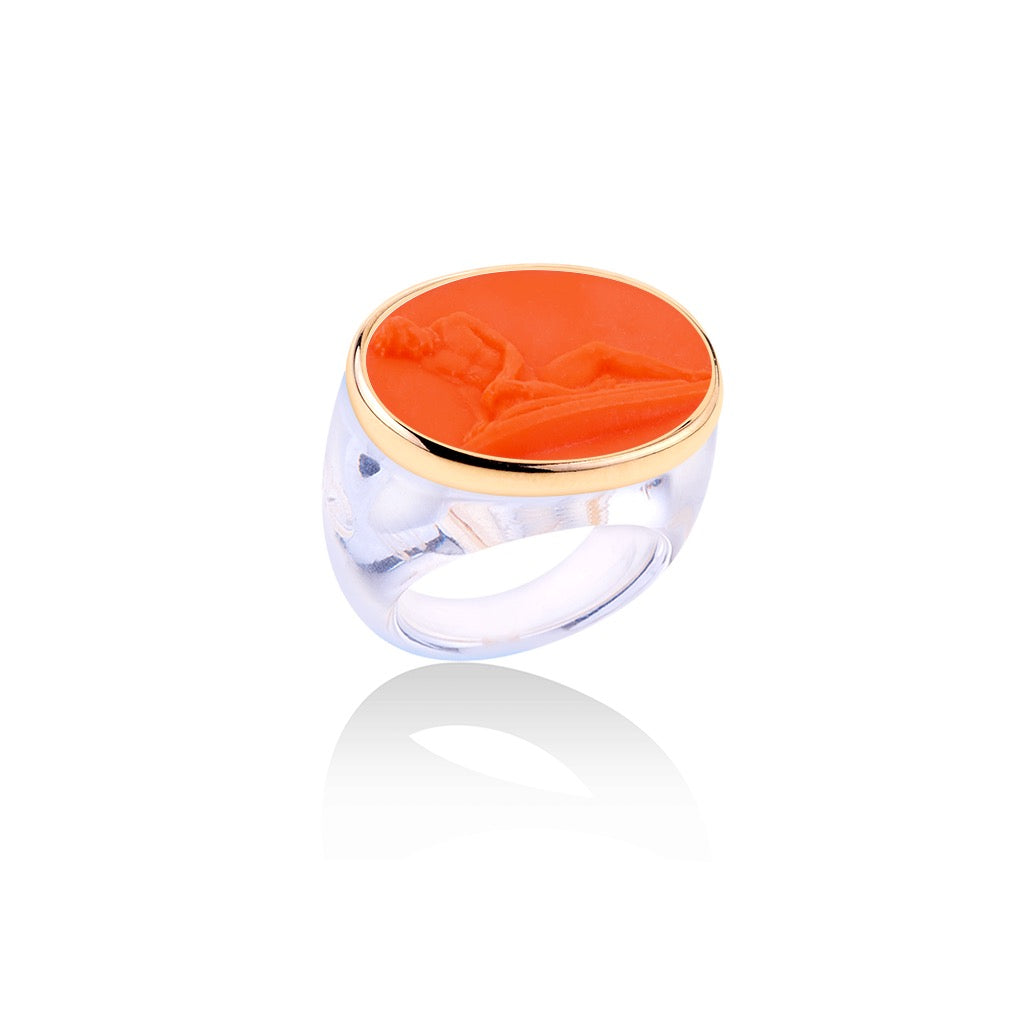
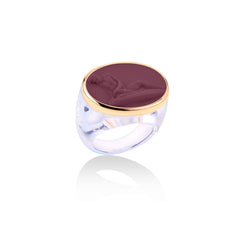
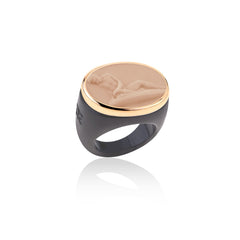
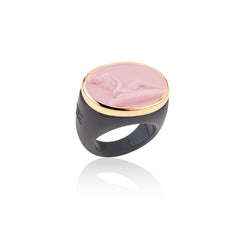
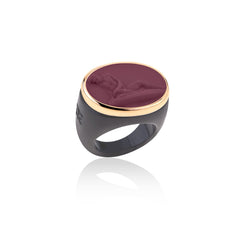
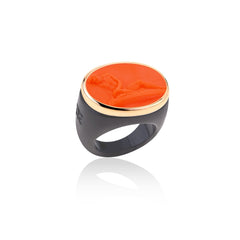
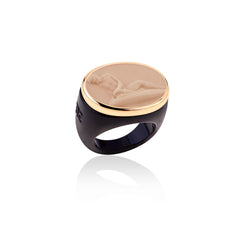
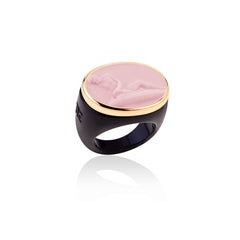
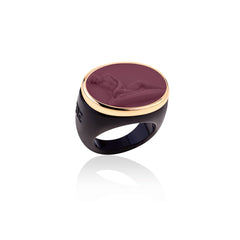
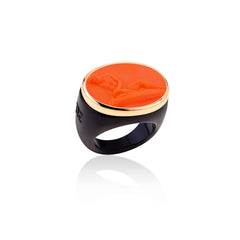
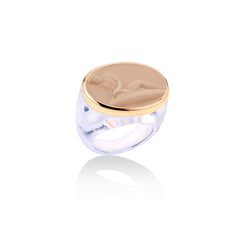
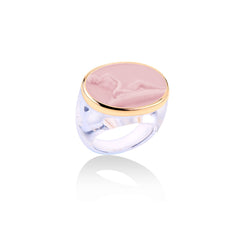
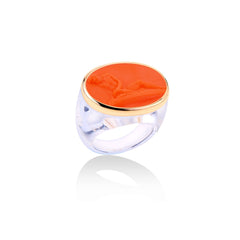
His identity is a mystery — and that is his most beautiful secret. The Gaul is a rare sculpture: unlike the busts and standing figures that dominate classical iconography. He was admired throughout the Grand Tour for the vigour of his body and the depth of his humanity — and he still is today. The lines are decisive, the head bowed. There is self-awareness, there is dignity. There is life within, whole and accepted.
In the intaglio the Gaul stretches across the full oval — every detail of the body is precise, every tension rendered by the engraver with mastery. A relief that communicates a silent, powerful strength, that tells how deeply human it is to feel life in every moment. The Gaul remains silent — and in that silence there is room for ourselves. This ring, with its glossy plexiglass, sets the cameo on a coloured ground that shifts its atmosphere each time. The gold-plated bronze bezel frames the scene with warmth — a strikingly contemporary jewel that makes so magnificent an intaglio all the more surprising. On the finger it reminds us of tenacity and self-worth.
The colours of this cameo are all tactile — porphyry, sand, orange, pink — natural tones that feel like stone. Three bases, three ways to welcome the Gaul. Grey is discreet — it accompanies the relief without overwhelming it; orange on grey is immediate vitality, sand on grey is ancient warmth. The black base draws the eye inward — porphyry on black becomes dark and sombre, orange on black bursts with energy. The transparent base is the most airy — the subject seems suspended in light; pink on transparent becomes weightless and unexpected, orange on transparent is pure colour floating. Porphyry wraps with the density of ancient stone. Sand evokes Mediterranean earth. Pink introduces a note that the strength of the intaglio transforms into something new.
Important Notes
The jewels' colors in the photo may look different from the original one. This depends from the resolution. Each object is handmade and has unique characteristics.Size chart

SIZE GUIDE
Find your size
Simple steps to measure the correct size of your finger:
- Measure your finger at the end of the day;
- Do not measure your finger when it is either too hot or too cold;
- Don’t forget that our hands are not identical, and that a ring that might fit on a finger on our left hand might not fit on the same finger on our right hand;
- Please be sure to check that your selected size slides along the full length of your finger.
To measure the circumference of your finger, you can use a taylor’s tape measure, or take a look at our video demonstration for another technique (which will require a ring that fits on your selected finger.) This size corresponds to the circumference, which you must use to find your corresponding appropriate size. (S - M - L - XL)
| Size | Italy | USA | France | Diameter (mm) | Circumference (mm) |
|---|---|---|---|---|---|
| S | 12 > 13 | 6 > 6,5 | 52 > 53 | 16,5 > 16,9 | 52 > 53 |
| M | 14 > 15 | 7 > 7 1/4 | 54 > 55 | 17,2 > 17,4 | 54 > 55 |
| L | 16 > 17 | 7,5 > 8 | 56 > 57 | 17,8 > 18,1 | 56 > 57 |
| XL | 18 > 19 | 8, 5 > 9 | 58 > 59 | 18,5 > 18,8 | 58 > 59 |
| 2XL | 20 | 9 | 60 | 19,1 | 60 |
| 3XL | 22 | 10 | 62 | 19,7 | 62 |
| 4XL | 24 | 10 3/4 | 64 | 20,4 | 64 |
| 5XL | 26 | 11 3/4 | 66 | 21 | 66 |
Galatian
Hold your head high, whatever comes.
The Galatians were a Celtic people of the Hellenistic period that lived mainly in the north central regions of Asia Minor or Anatolia, in what was known as Galatia, in today's Turkey. The originals who settled in Galatia came through Thrace. Galatians are known as famous and proud warriors. Romans and Greeks respected them for their personality. The Galatian Gladiator expresses courage, value and good military skills. Musei Capitolini - Roma
Show all products- Choosing a selection results in a full page refresh.