
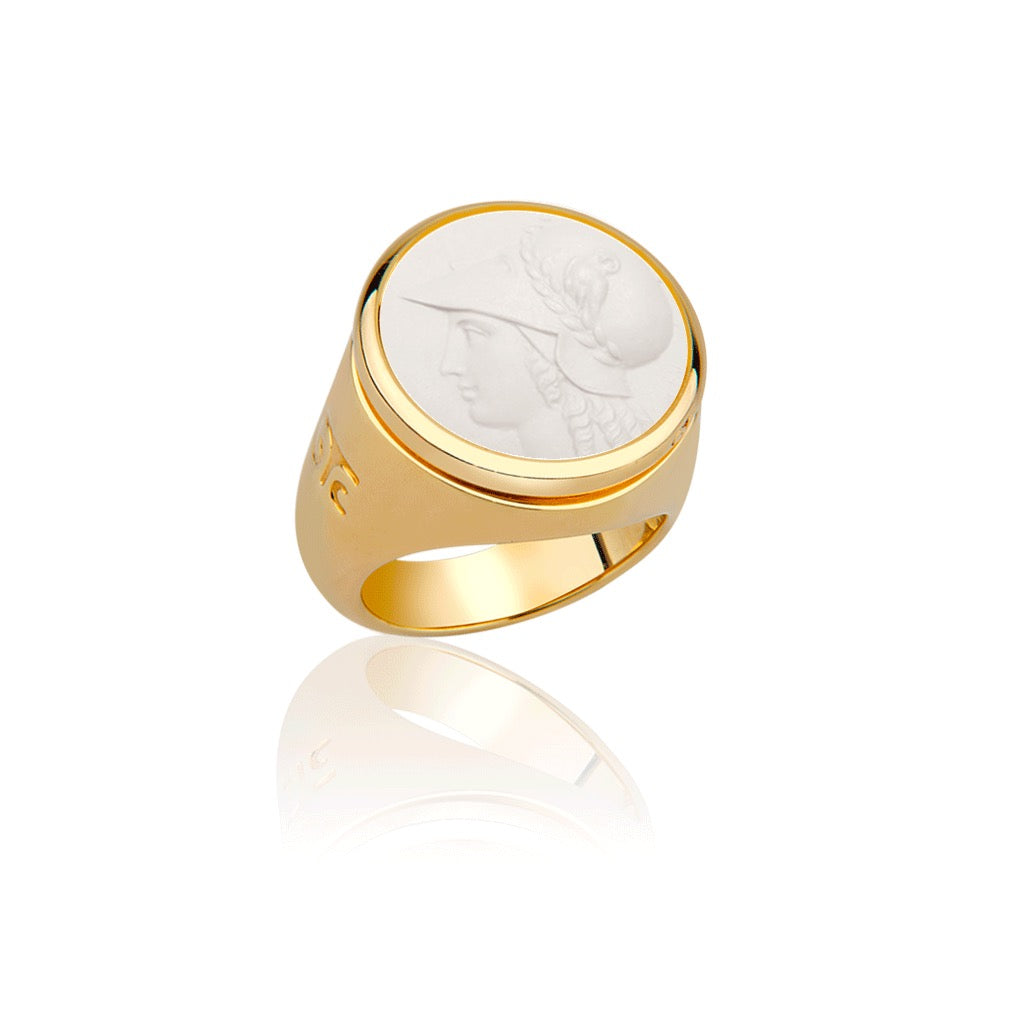
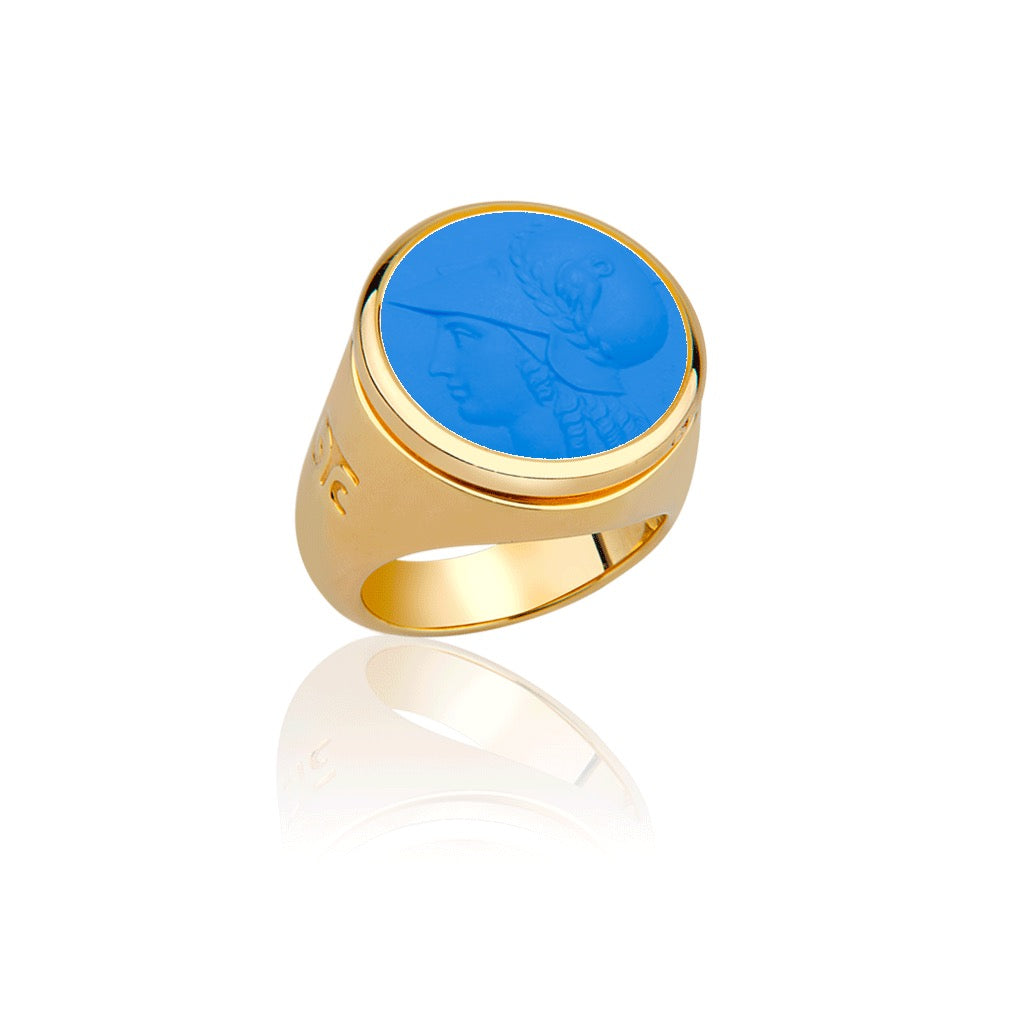
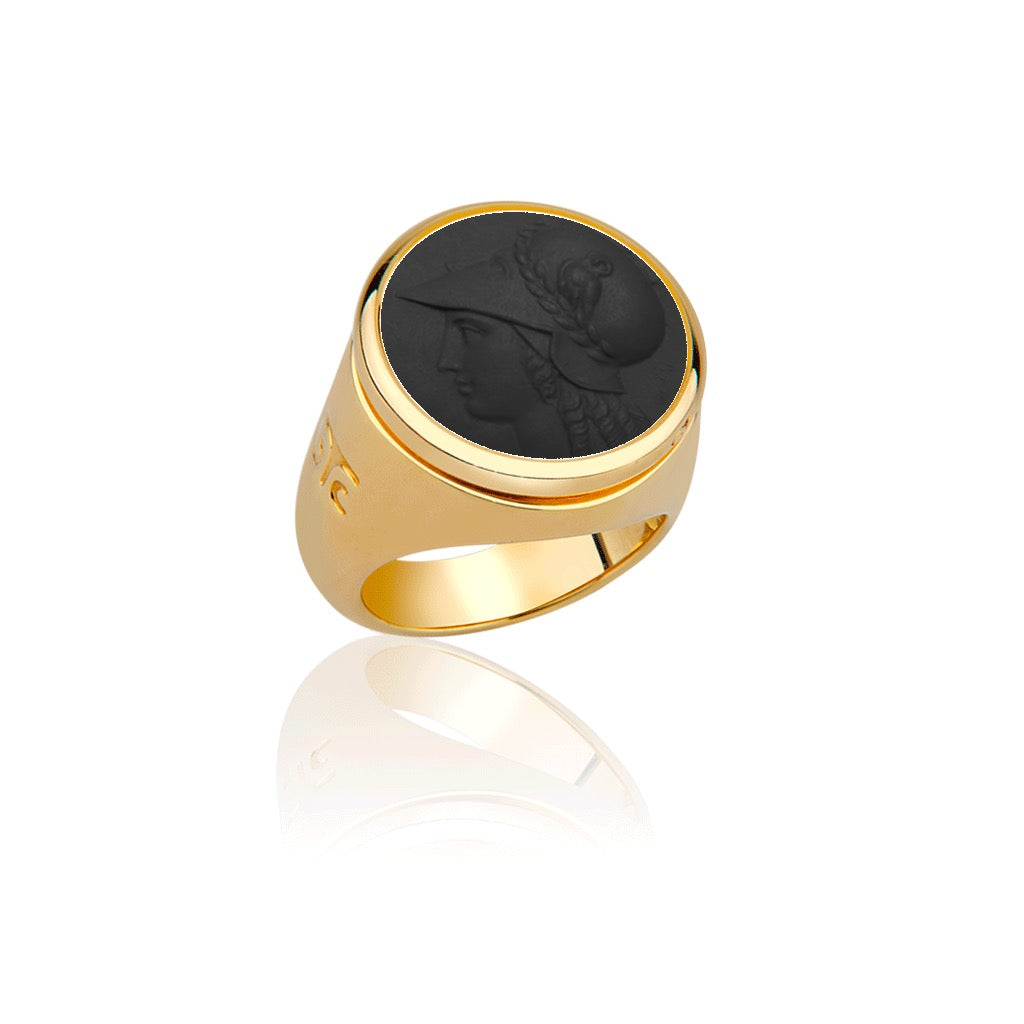
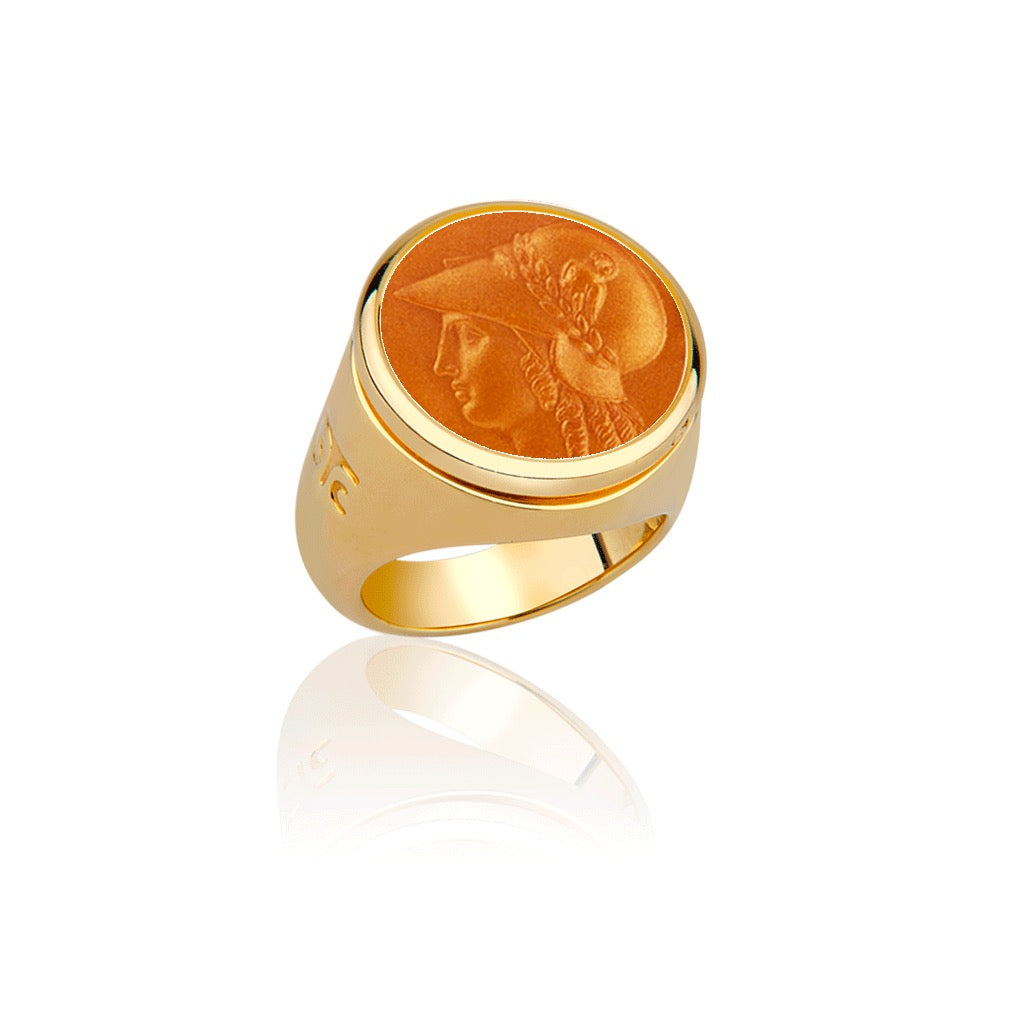
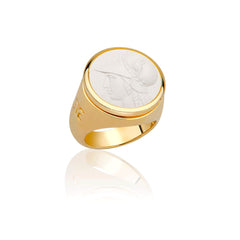
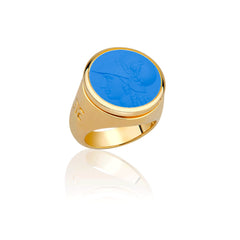
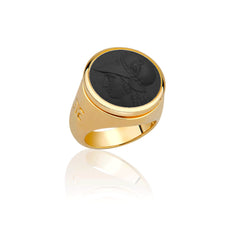
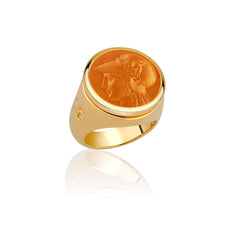
From the helmet, the owl emerges — Minerva’s symbol, the capacity to see with clarity in shadow. In this precise detail lies all the fascination of the Luxor model: a round, heavy ring in gilded bronze, perfectly smooth, that guides the eye across the cameo — and there the goddess’s profile reveals itself, the detail that the light, shifting, reveals. The features on this profile carry a more composed quality, the thought sharpening before it becomes action — and the jewel, the moment it is worn, seems to fully sustain this concept through its presence: visible, concrete, precise. Minerva, facing left, in the moment that precedes the decision — the strategy taking shape in silence, the vision still building. In the round bezel, with its gentle curves around the cameo, every colour comes alive.
Minerva is azure — an intense tone that carries quiet, wisdom in its most concentrated form. She is white — the gathered hair, the crown in full light: absolute. She is black — and in black one is reminded that she sees beyond, through knowledge, where others stop. She is gold — and in gold everything reflects everything: the crown, the curls, the metal, the thought. Reflection, in the fullest sense.
Every attribute of the goddess in this relief is a tribute to the lucid mind, to the ingenuity and craftsmanship she presides over. This ring exists thanks to the same knowledge Minerva protects — lost-wax casting, the hands of artisans who transform an idea into bronze: an ancient profile in a contemporary jewel.
Important Notes
The jewels' colors in the photo may look different from the original one. This depends from the resolution. Each object is handmade and has unique characteristics.Size chart

SIZE GUIDE
Find your size
Simple steps to measure the correct size of your finger:
- Measure your finger at the end of the day;
- Do not measure your finger when it is either too hot or too cold;
- Don’t forget that our hands are not identical, and that a ring that might fit on a finger on our left hand might not fit on the same finger on our right hand;
- Please be sure to check that your selected size slides along the full length of your finger.
To measure the circumference of your finger, you can use a taylor’s tape measure, or take a look at our video demonstration for another technique (which will require a ring that fits on your selected finger.) This size corresponds to the circumference, which you must use to find your corresponding appropriate size. (S - M - L - XL)
| Size | Italy | USA | France | Diameter (mm) | Circumference (mm) |
|---|---|---|---|---|---|
| S | 12 > 13 | 6 > 6,5 | 52 > 53 | 16,5 > 16,9 | 52 > 53 |
| M | 14 > 15 | 7 > 7 1/4 | 54 > 55 | 17,2 > 17,4 | 54 > 55 |
| L | 16 > 17 | 7,5 > 8 | 56 > 57 | 17,8 > 18,1 | 56 > 57 |
| XL | 18 > 19 | 8, 5 > 9 | 58 > 59 | 18,5 > 18,8 | 58 > 59 |
| 2XL | 20 | 9 | 60 | 19,1 | 60 |
| 3XL | 22 | 10 | 62 | 19,7 | 62 |
| 4XL | 24 | 10 3/4 | 64 | 20,4 | 64 |
| 5XL | 26 | 11 3/4 | 66 | 21 | 66 |
Minerva left side
Lead with wisdom.
The Roman goddess of wisdom, medicine, the arts, dyeing, science and trade, but also of war. As Minerva Medica she is the patroness of physicians. She is the daughter of Jupiter. In the temple on the Capitoline Hill she was worshipped together with Jupiter and Juno, with whom she formed a powerful triad of gods. Another temple of her was located on the Aventine Hill. The church of Santa Maria sopra Minerva is built on one of her temples. Every year from March 19 - 23 the Quinquatria was held, the primary Minerva festival. This festival was mainly celebrated by artisans but also by students. On June 13 the minor Quinquatrus was observed. Minerva is believed to be the inventor of numbers and musical instruments. She is thought to be of Etruscan origin, as the goddess Minerva. Later she was equated with the Greek Athena. Paris Louvre - Munich Glyptothek - London British Museum
Show all products- Choosing a selection results in a full page refresh.