
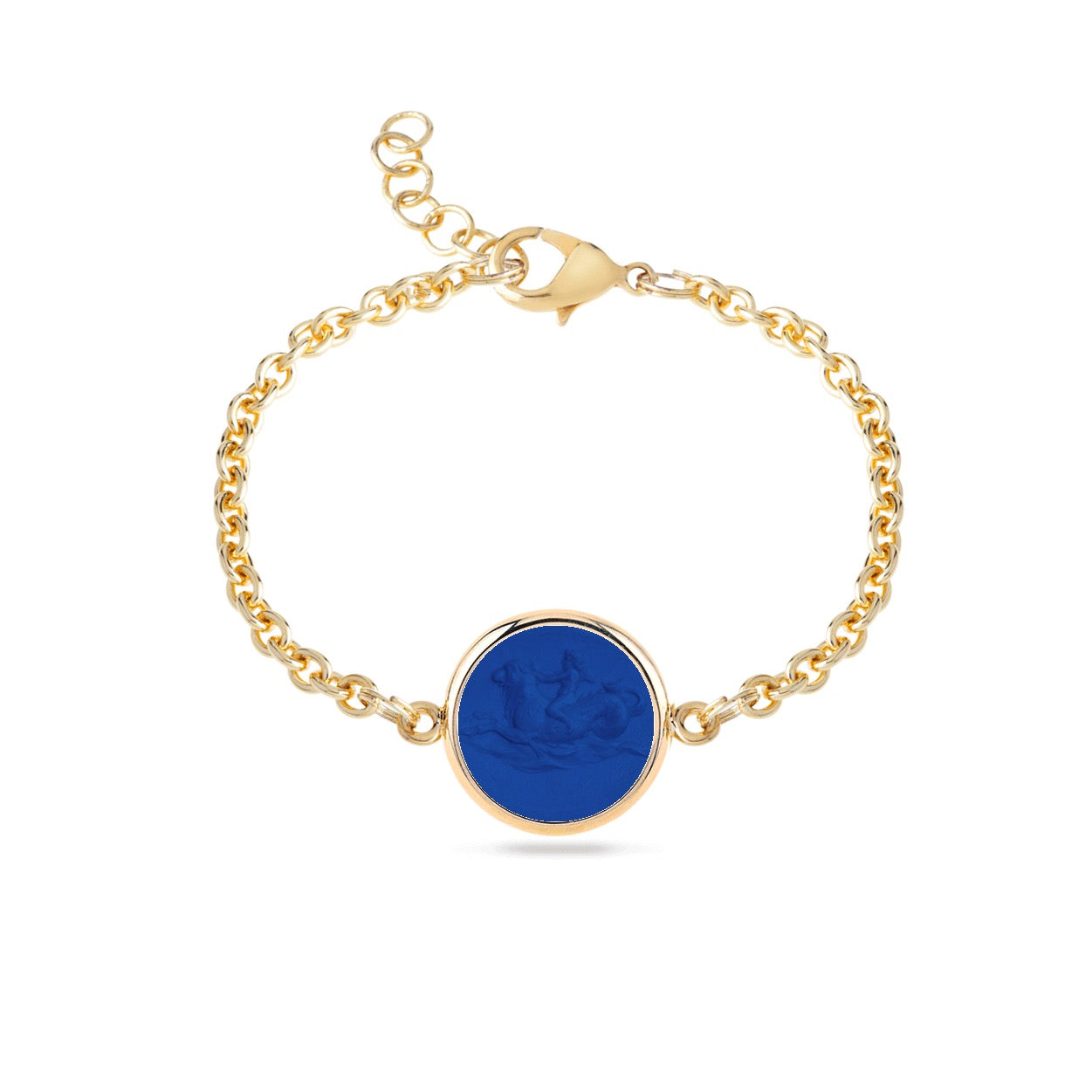
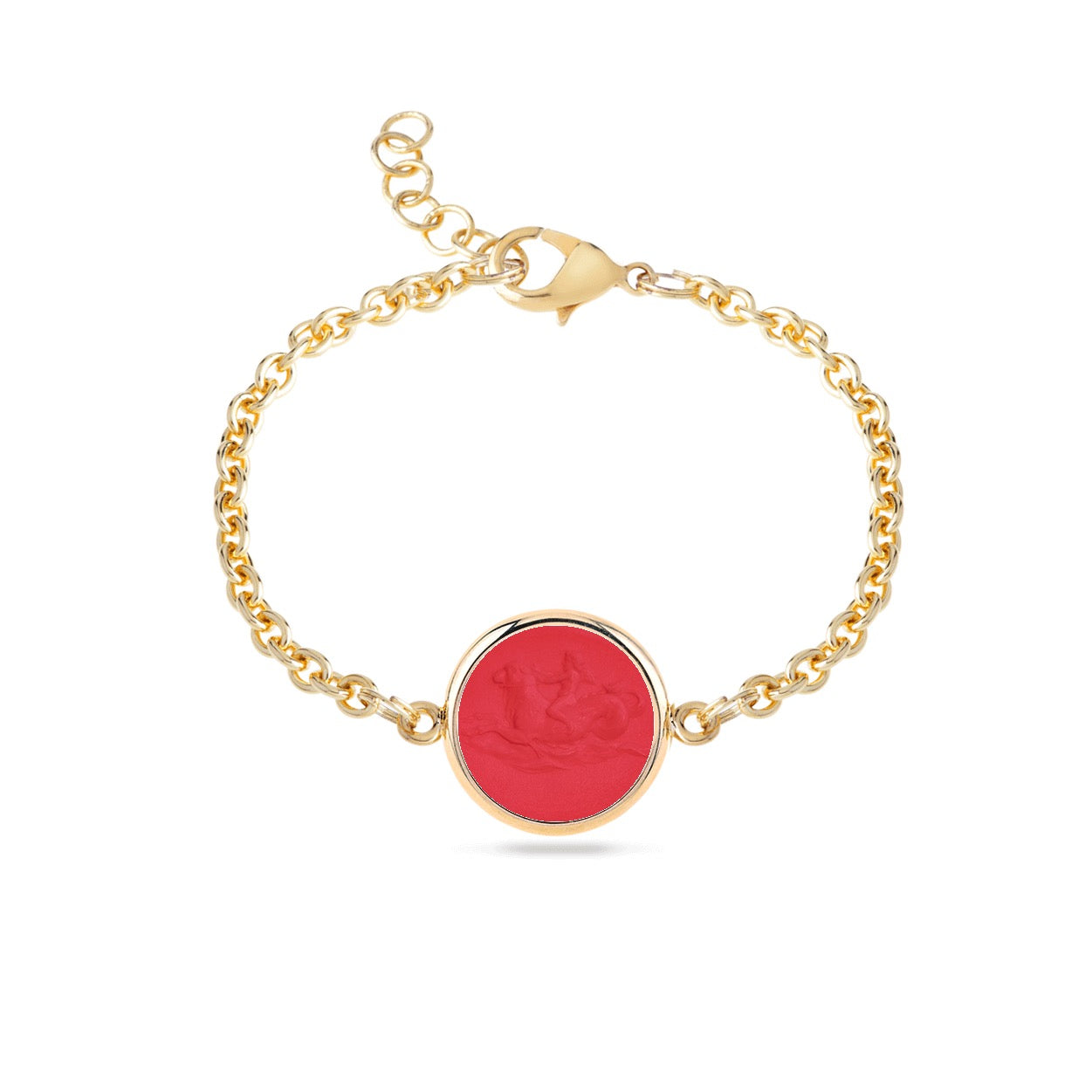
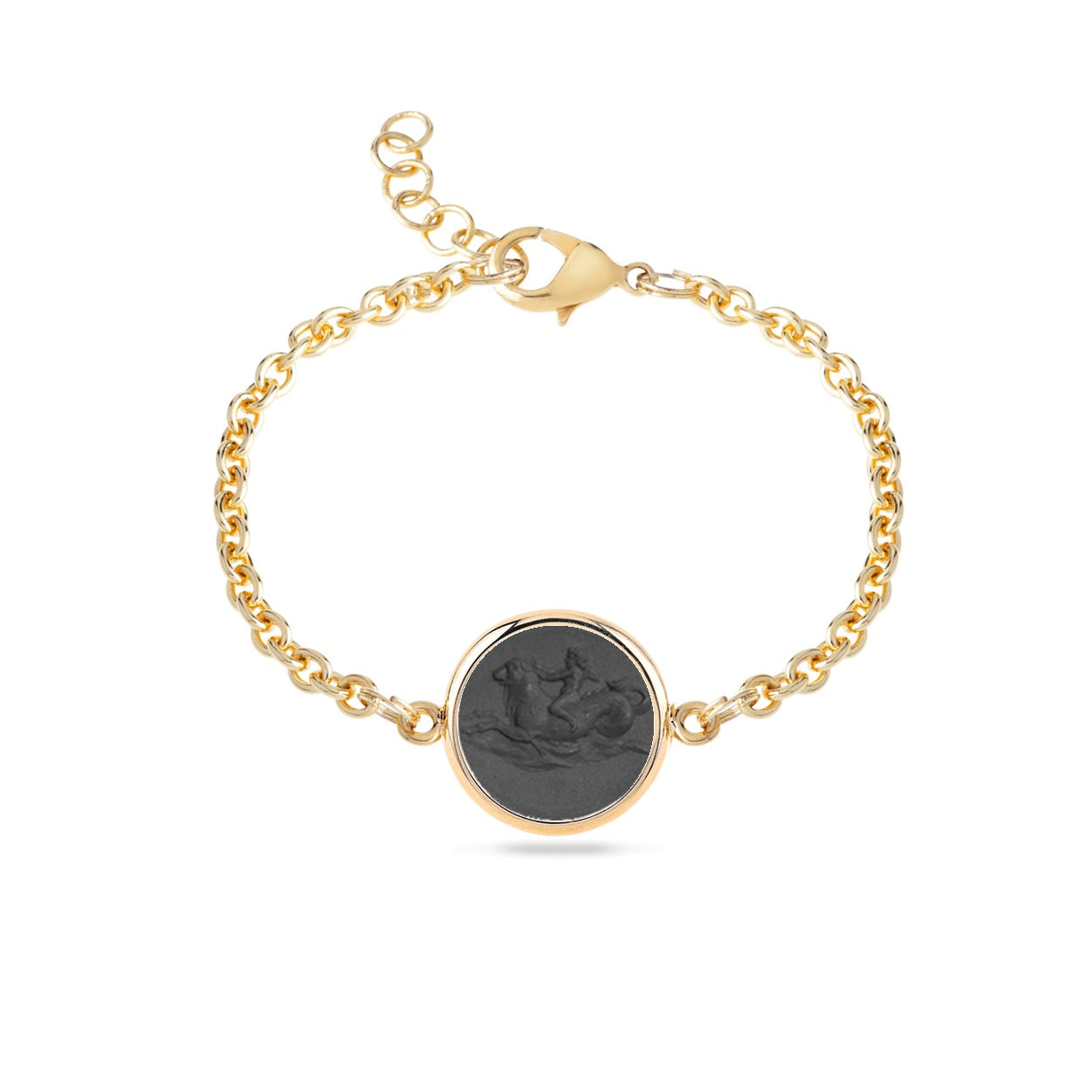
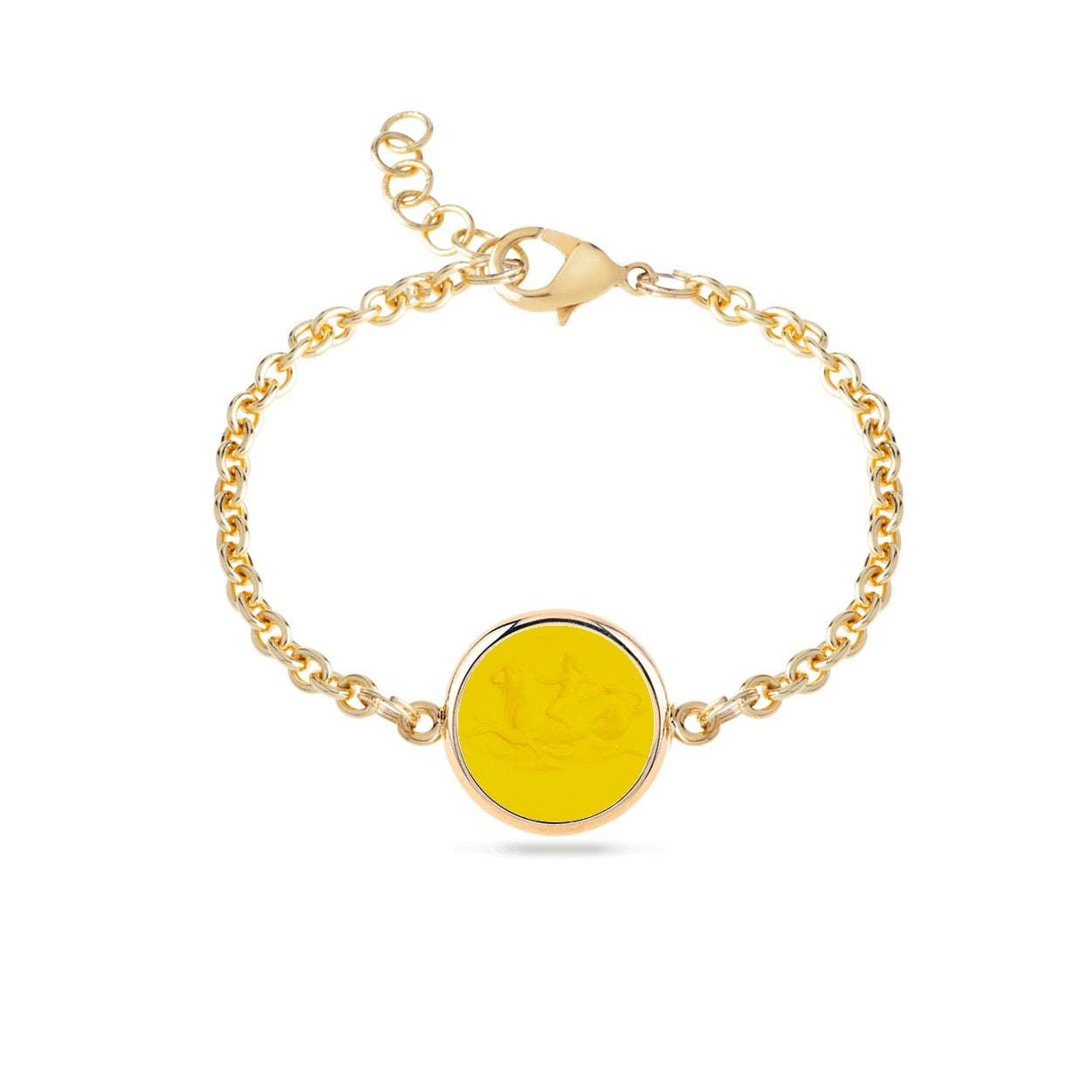
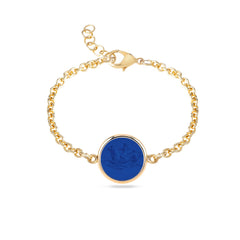
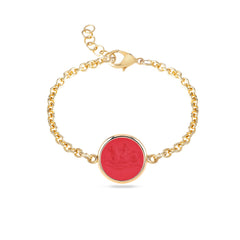
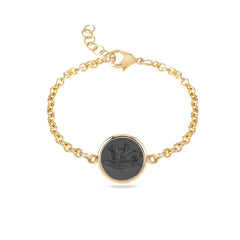
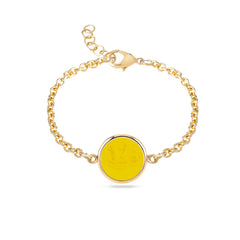
In this jewel Cupid rides a sea calf on the waves of an open sea: the figures are small, precise, extraordinarily alive. The composition tells everything: the posture of the rider, the body of the animal launched forward, the scene aimed at something far away. The sea calf is a fantastical creature of Graeco-Roman iconography: half calf, half fish, always racing toward open water. The god on this mount is one of the most beloved scenes of antiquity, playful and light, carrying with it the joy of going, of travelling, of discovery. The engraving is precise and full of life: forms built with care, the movement readable up close, every detail emerging with ease. The gilded bezel frames the scene and brings it forward, giving it the right light. The chain accompanies the bezel from both sides with a natural rhythm and keeps it always in position. A jewel that settles on the wrist with discretion, worn every day, almost without noticing. The colours tell the many facets of love and the discoveries made through this emotion: in blue the figures emerge against a dense and deep ground, they seem almost to have risen from the pigment itself, alive with a painterly quality; in yellow the dynamism amplifies, the colour puts everything in motion, the light drives the scene with solar energy; in black every mark is absolute, the movement concentrates, the narrative becomes essential; in red the cameo recalls the coral of the sea floor that Cupid encounters along his journey — warm, deep, stirred by the current. A journey in miniature, always on the wrist.
Important Notes
The jewels' colors in the photo may look different from the original one. This depends from the resolution. Each object is handmade and has unique characteristics.Size chart

SIZE GUIDE
Find your size
Simple steps to measure the correct size of your wrist:
To measure the circumference of your wrist, you can use the paper sizer, or you can use a taylor’s measuring tape. This length corresponds to the circumference of your wrist, which you must have to find your corresponding appropriate size. (S - M - L - XL)
| Size | Cm | Inch | Extension |
|---|---|---|---|
| S | 1617 | 6,306,69 | 3 cm - 1,20 inch3 cm - 1,20 inch |
| M | 1819 | 7,097,48 | 3 cm - 1,20 inch3 cm - 1,20 inch |
| L | 2021 | 7,878,27 | 3 cm - 1,20 inch3 cm - 1,20 inch |
| XL | 22 | 8,66 | 3 cm - 1,20 inch |
Cupid on Sea Calf
Let love take you in new directions.
In Roman mythology, Cupid (Latin cupido, meaning “desire”) is the god of desire, affection and erotic love. He is often portrayed as the son of the goddess Venus, with a father rarely mentioned. His Greek counterpart is Eros. Cupid is also known in Latin as Amor (“Love”). The Amores (plural) or amorini in the later terminology of art history are the equivalent of the Greek Erotes. Although Eros appears in Classical Greek art as a slender winged youth, during the Hellenistic period he was increasingly portrayed as a chubby boy. During this time, his iconography acquired the bow and arrow that remain a distinguishing attribute; a person, or even a deity, who is shot by Cupid’s arrow is filled with uncontrollable desire. The Roman Cupid retains these characteristics, which continue in the depiction of multiple cupids in both Roman art and the later classical tradition of Western art. Cupid’s ability to compel love and desire plays an instigating role in several myths or literary scenarios. In Vergil’s Aeneid, Cupid prompts Dido to fall in love with Aeneas, with tragic results. Ovid makes Cupid the patron of love poets. Cupid is a central character, however, in only the traditional tale of Cupid and Psyche, as told by Apuleius. Cupid was a continuously popular figure in the Middle Ages, when under Christian influence he often had a dual nature as Heavenly and Earthly love, and in the Renaissance, when a renewed interest in classical philosophy endowed him with complex allegorical meanings. In contemporary popular culture, Cupid is shown shooting his bow to inspire romantic love, often as an icon of Valentine’s Day.
Show all products- Choosing a selection results in a full page refresh.