

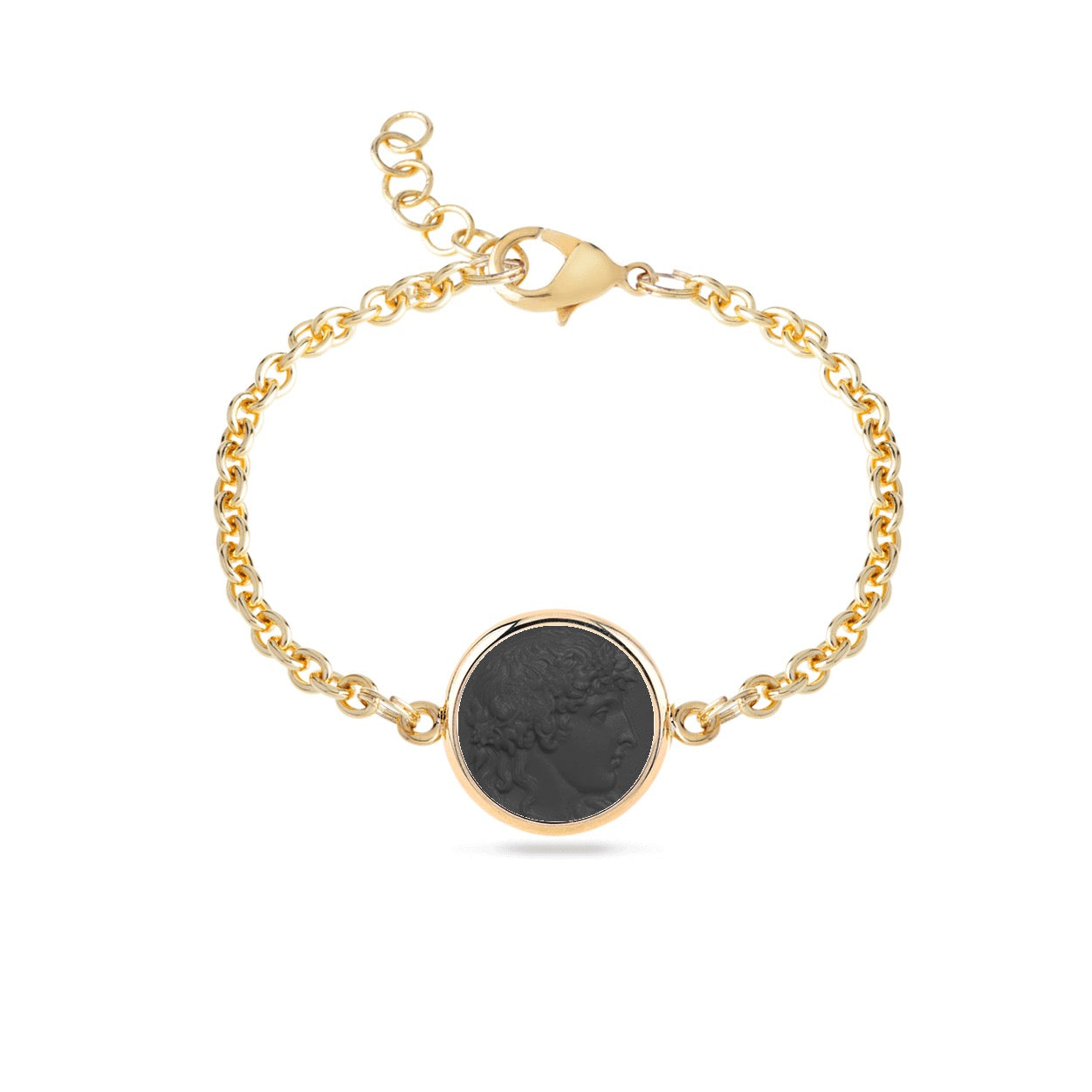


Hadrian’s favourite, Antinous was brought to Rome from Bithynia and lived always at his side. This profile tells everything about his figure — inner and outer beauty, both engraved in a few centimetres with extraordinary precision. The carefully carved hair, the perfect profile, the firm chin: every element of the engraving is rendered with a care that reads immediately, when you bring it close. There is something particular in this portrait. That introspective gaze, and this inner self-awareness. Honoured by time itself. It is in the simplicity of this bracelet that the full power of the portrait emerges: a few grams on the wrist, a subject that arrives intact, right now. A portrait that stays with you, every time. The gold chain brings it to the wrist with great ease — flexible, adapting to any wrist. Yellow revives him, gives him new light — fresh, immediate, easy to wear every day. In this colour the profile emerges with great clarity. Pearl caresses the lines differently: the hair, the chin, the details of the engraving shift with every movement, always alive. A surface you enjoy looking at. Porphyry gives him depth — it recalls Roman sculptures, carries something solid and precious, and wears beautifully. Green recalls the gardens of Villa Adriana: the most natural colour for him, classical, effortless to wear. Every colour gives him a different character and a new interpretation. It is extraordinarily light and goes with everything. That too is part of its story — it speaks of us as well. Our GTc signature is engraved on the back of the bezel.
Important Notes
The jewels' colors in the photo may look different from the original one. This depends from the resolution. Each object is handmade and has unique characteristics.Size chart

SIZE GUIDE
Find your size
Simple steps to measure the correct size of your wrist:
To measure the circumference of your wrist, you can use the paper sizer, or you can use a taylor’s measuring tape. This length corresponds to the circumference of your wrist, which you must have to find your corresponding appropriate size. (S - M - L - XL)
| Size | Cm | Inch | Extension |
|---|---|---|---|
| S | 1617 | 6,306,69 | 3 cm - 1,20 inch3 cm - 1,20 inch |
| M | 1819 | 7,097,48 | 3 cm - 1,20 inch3 cm - 1,20 inch |
| L | 2021 | 7,878,27 | 3 cm - 1,20 inch3 cm - 1,20 inch |
| XL | 22 | 8,66 | 3 cm - 1,20 inch |
Antinous
Love remembered is never lost.
Antinous (also Antinoo or Antinoös; 27 November, c. 111 – before 30 October 130) was a Bithynian Greek youth and a favourite, or lover, of the Roman emperor Hadrian. He was deified after his death, being worshiped in both the Greek East and Latin West, sometimes as a god (theos) and sometimes merely as a deified mortal (heros). Antinous became associated with homosexuality in Western culture, appearing in the work of Oscar Wilde and the Portuguese poet Fernando Pessoa.
Show all products- Choosing a selection results in a full page refresh.