
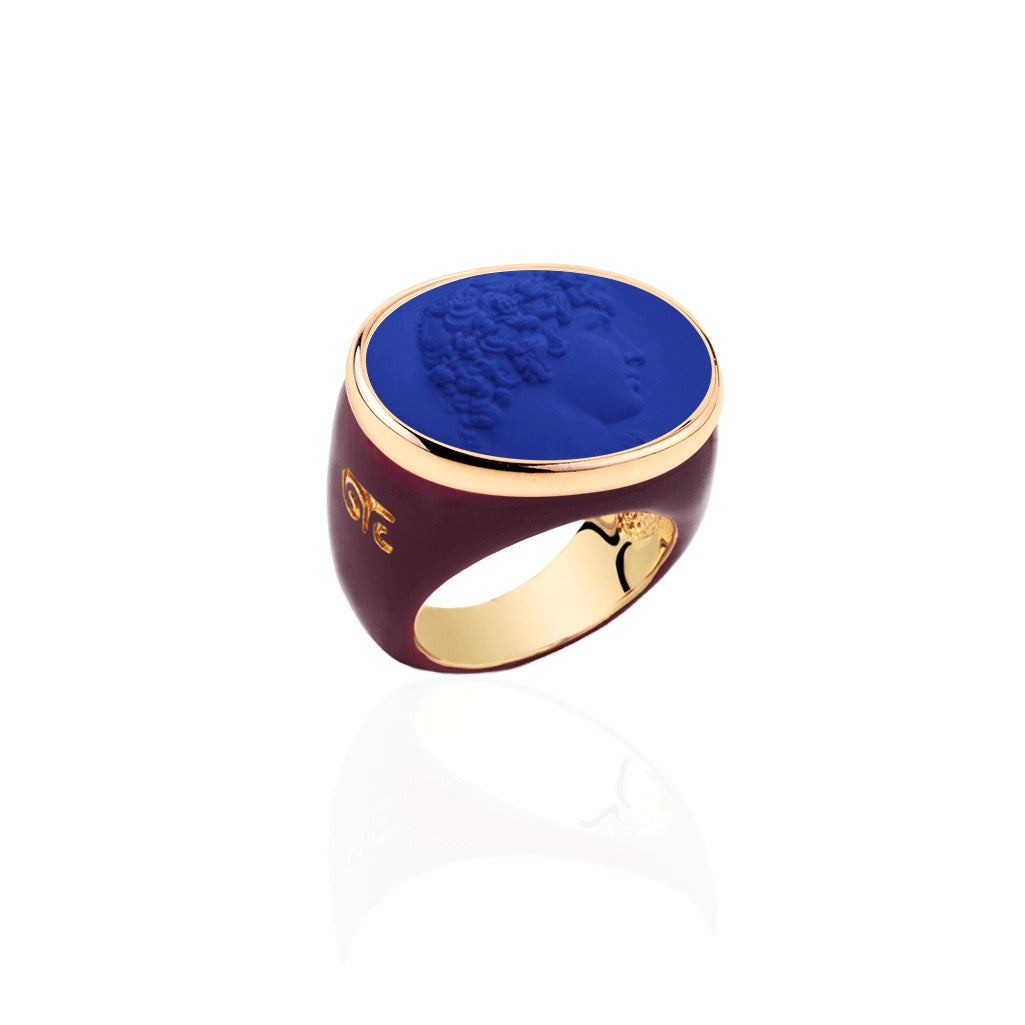
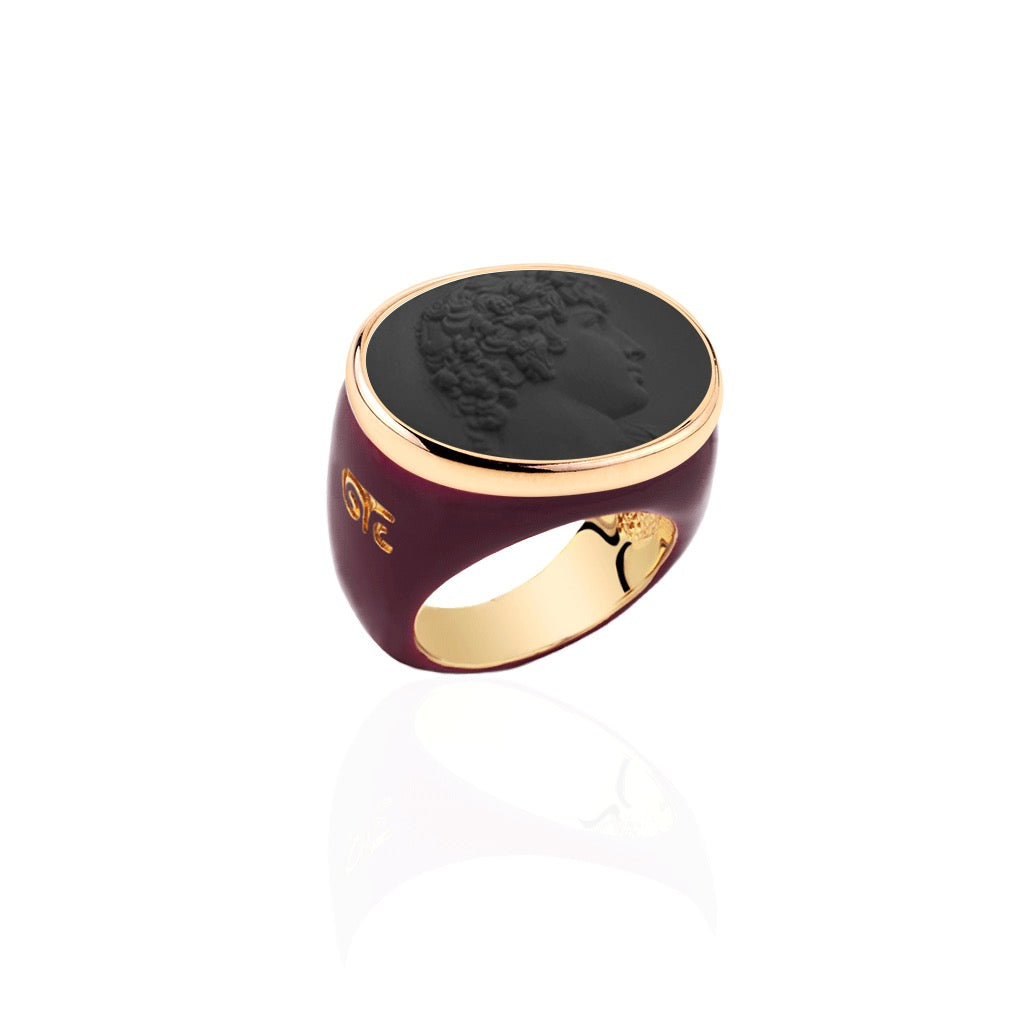
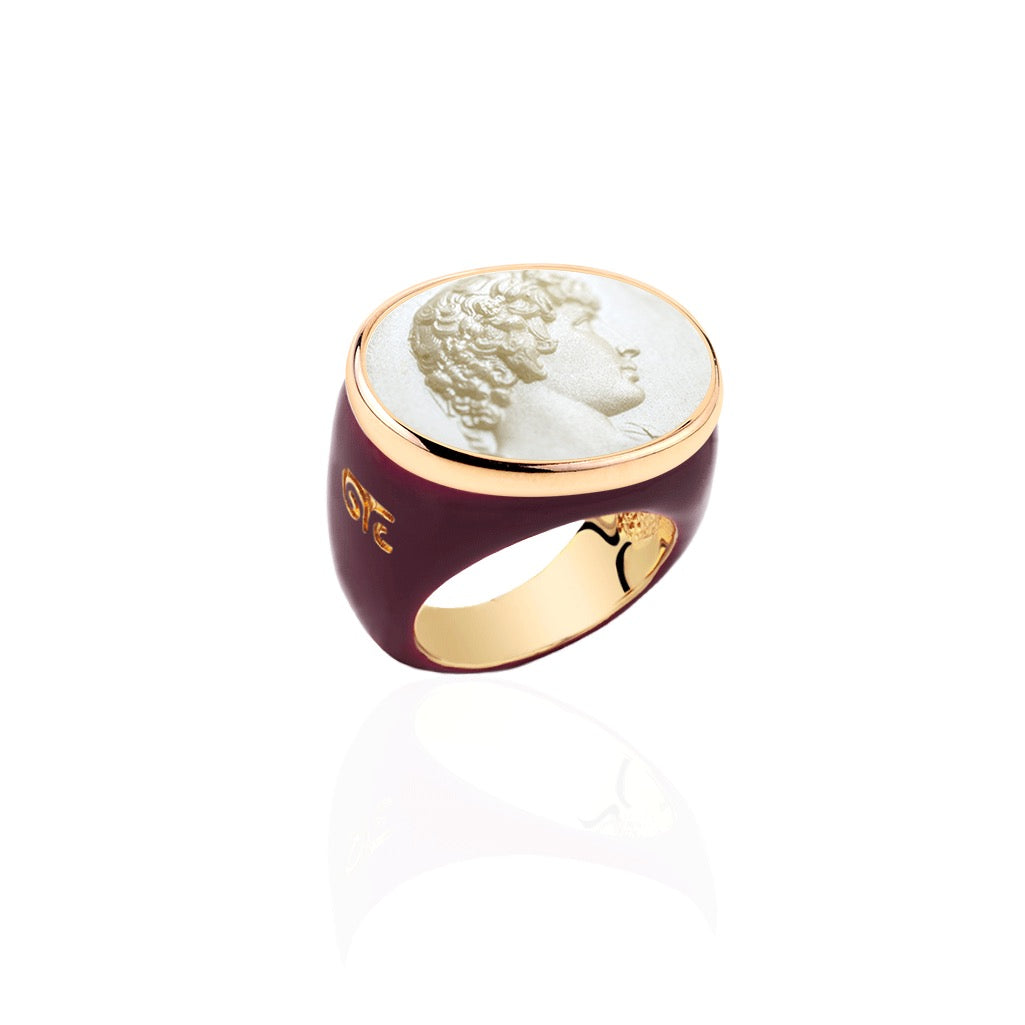

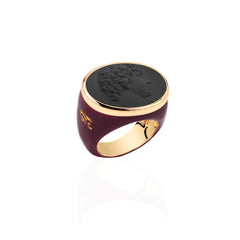
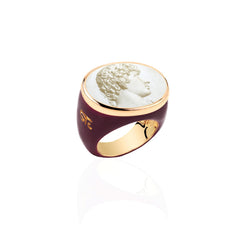
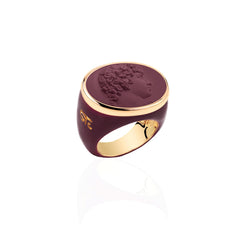
We recognise it without needing to know the name: this profile is a portrait of classical art in which each of us can find themselves. Young, deeply loved in Rome and deified — his face can be found in countless sculptures, in museums around the world. Antinous, on this Lumen ring, takes on a new intimacy: the bordeaux wraps the relief and draws it closer, makes it more personal. The delicacy of the features, the gentleness of spirit that gives him his beauty — all of it is held within the density of this colour. The smooth enamel, the soft volumes of this model, the full weight of the bronze make it a jewel that lives on the hand, something that belongs to us.
Antinous is both a memory and a universal feeling: the recognition of oneself in form and substance. There is an Antinous in each of us — the special part, the qualities that make us unique. Wearing this ring, one senses this expression of two beauties — inner and outer. On the colour of this ground it becomes ever more gathered, ever more one's own.
Blue on bordeaux is an accord of two colours most prized in antiquity, rare — here, with this finish, it becomes at once classical and contemporary: an ancient mantle made strikingly modern by these clean lines. Black gives him still more intensity: the relief draws inward, a presence held entirely within its own dense curves. Pearl makes him shine — soft light resting on the intaglio, every detail in full clarity. Porphyry is a band of colour circling the finger in a single tone — cameo and ground merge into one, the colours and forms of Rome itself, like an architecture of volumes and lines you trace with your fingers, smoothed by time.
Σημαντικές σημειώσεις
The jewels' colors in the photo may look different from the original one. This depends from the resolution. Each object is handmade and has unique characteristics.Πίνακας μεγεθών

SIZE GUIDE
Find your size
Simple steps to measure the correct size of your finger:
- Measure your finger at the end of the day;
- Do not measure your finger when it is either too hot or too cold;
- Don’t forget that our hands are not identical, and that a ring that might fit on a finger on our left hand might not fit on the same finger on our right hand;
- Please be sure to check that your selected size slides along the full length of your finger.
To measure the circumference of your finger, you can use a taylor’s tape measure, or take a look at our video demonstration for another technique (which will require a ring that fits on your selected finger.) This size corresponds to the circumference, which you must use to find your corresponding appropriate size. (S - M - L - XL)
| Size | Italy | USA | France | Diameter (mm) | Circumference (mm) |
|---|---|---|---|---|---|
| S | 12 > 13 | 6 > 6,5 | 52 > 53 | 16,5 > 16,9 | 52 > 53 |
| M | 14 > 15 | 7 > 7 1/4 | 54 > 55 | 17,2 > 17,4 | 54 > 55 |
| L | 16 > 17 | 7,5 > 8 | 56 > 57 | 17,8 > 18,1 | 56 > 57 |
| XL | 18 > 19 | 8, 5 > 9 | 58 > 59 | 18,5 > 18,8 | 58 > 59 |
| 2XL | 20 | 9 | 60 | 19,1 | 60 |
| 3XL | 22 | 10 | 62 | 19,7 | 62 |
| 4XL | 24 | 10 3/4 | 64 | 20,4 | 64 |
| 5XL | 26 | 11 3/4 | 66 | 21 | 66 |
Antinous
Love remembered is never lost.
Antinous (also Antinoo or Antinoös; 27 November, c. 111 – before 30 October 130) was a Bithynian Greek youth and a favourite, or lover, of the Roman emperor Hadrian. He was deified after his death, being worshiped in both the Greek East and Latin West, sometimes as a god (theos) and sometimes merely as a deified mortal (heros). Antinous became associated with homosexuality in Western culture, appearing in the work of Oscar Wilde and the Portuguese poet Fernando Pessoa.
Show all products- Η επιλογή μιας επιλογής έχει ως αποτέλεσμα μια πλήρη ανανέωση σελίδας.